
Content Writer & SEO Specialist
Content Writer & SEO Specialist
Aditya Sharma is a content writer at OptM Solutions specializing in automotive electronics, embedded systems, telematics, electric vehicle technologies, connected mobility, and autonomous driving technologies.
LinkedIn ProfileDeploying a reliable, high-performance Instrument Cluster has evolved from an optional premium feature into a critical regulatory necessity for modern commercial vehicle fleets and passenger vehicle OEMs. In the era of software-defined vehicles (SDVs), the driver's primary dashboard interface has moved far beyond mechanical cables and physical pointer needles.
This deep engineering guide explores the architecture, underlying technologies, integration workflows, and design philosophies of the modern automotive instrument cluster. Whether you are an embedded systems engineer, an automotive procurement lead, or an OEM product manager, this comprehensive guide will provide a definitive understanding of how modern display architectures are built, integrated, and validated.
What Is an Instrument Cluster?
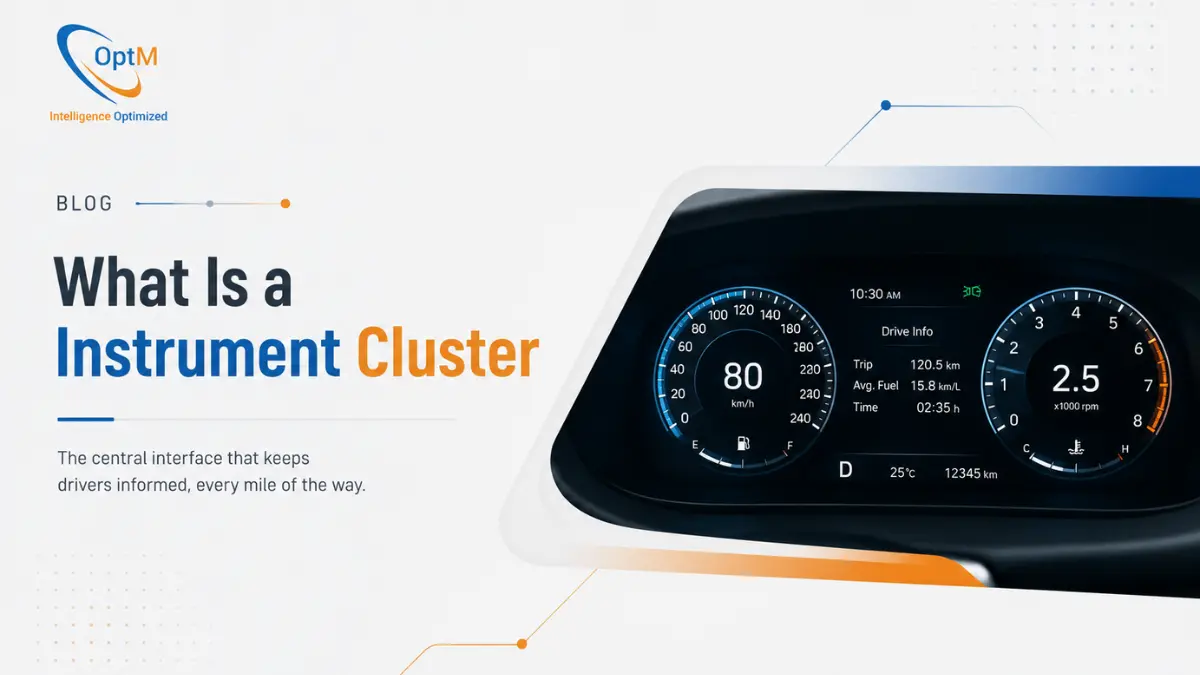
A digital instrument cluster is an advanced automotive electronic display architecture positioned directly within the driver's primary line of sight. Operating on high-performance embedded systems, it aggregates high-frequency telemetry data from multiple Electronic Control Units (ECUs) over in-vehicle networks to visualize safety-critical diagnostics, real-time vehicle speed, and automated alerts with zero frame drop.
The Evolution of the Automotive Dashboard
Historically, the instrument cluster was a purely mechanical or electromechanical assembly. A physical cable connected to the vehicle's transmission turned a gear that physical pointers reacted to. Fuel gauges relied on crude analog resistance signals from floating sensors inside the tank.
Today, modernization has completely overhauled this paradigm. Driven by high-performance Systems-on-Chip (SoCs), modern digital instrument clusters serve as intelligent edge-processing nodes. They must boot in milliseconds, handle complex multi-layered graphical rendering using frameworks like Qt, and comply with strict functional safety standards.
The B2B Market Reality
The transition toward electrification and connected mobility has permanently altered procurement cycles. According to global automotive market studies by Fortune Business Insights, the global automotive digital instrument cluster market size is projected to expand significantly, growing from roughly $10.00 billion in 2026 to $17.90 billion by 2034, exhibiting a stable Compound Annual Growth Rate (CAGR) of 7.6%. This growth is heavily driven by the massive commercial fleet demand for Electric Vehicles (EVs) and the integration of Advanced Driver Assistance Systems (ADAS).
For Tier 1 suppliers and OEMs, developing these displays requires rigorous engineering, specialized display hardware logic, and ARAI-oriented deployment readiness to withstand harsh physical and electronic vehicle environments.
How Instrument Cluster Works
Understanding exactly how instrument cluster works requires tracing the pathway from a physical sensor state to a rendered pixel on the screen. The entire workflow occurs within milliseconds to ensure the driver experiences real-time feedback without perceptible latency.
1. Data Ingestion & Network Telemetry
The instrument cluster does not generate primary vehicle information; it acts as a highly specialized aggregation hub. When a vehicle accelerates, wheel speed sensors stream high-frequency raw electrical pulses to the powertrain ECU. The ECU processes these signals and broadcasts the normalized speed value as an identifier-tagged frame across the vehicle network.
2. Protocol Translation and Processing
The network payload travels via the controller area network (CAN) or J1939 communication systems directly to the cluster's physical transceiver interface. The hardware abstraction layer (HAL) within the cluster's operating system captures these raw packets. The embedded software extracts the binary payload, decodes the bit field according to pre-defined network matrix databases (.DBC files), and passes the floating-point values to the core application software layers.
3. HMI Rendering Pipeline
Once the application layer registers the data, the graphics engine takes over. Utilizing vector-based rendering tools, the software dynamically recalculates the pointer position or updates the digital typography layout. This data is pushed through GPU acceleration pipelines using OpenGL or Vulkan API frameworks to output a crisp, anti-aliased frame onto the display panel.
Engineering Floor Perspective: During a recent architecture optimization workflow for a connected vehicle platform, our engineering teams encountered significant data friction points when bridging high-frequency J1939 telematics inputs with localized CAN nodes. The resolution required implementing custom hardware abstraction layers to normalize data transmission without overloading the core ECU processing budgets.
Components of Instrument Cluster
An automotive-grade digital cockpit is a highly complex multi-layered assembly designed to survive environmental extremes while maintaining uncompromised electronic stability. Selecting the right components of instrument cluster hardware—from the processing cores to the transceivers—is critical for ensuring zero frame drops during safety-critical events.
- Embedded Hardware Core (SoC and MCU): The hardware architecture typically relies on an asymmetric dual-core processing topology. A high-frequency multi-core ARM Cortex-A class processor paired with a dedicated GPU handles the resource-heavy graphical interface and fluid 60 fps layout rendering. Parallel to this, a separate safety microcontroller (MCU) monitors system health and ensures critical warning lamps remain functional even if the main OS crashes.
- Automotive-Grade Display Panels: Cluster displays use high-contrast Thin-Film Transistor (TFT) LCD or organic light-emitting diode (OLED) sheets optimized for automotive operation. These panels deliver up to 1000 nits of luminance, utilize specialized anti-glare (AG) surface treatments, and maintain sustained pixel behavior across a broad thermal operational matrix (-40°C to +85°C).
- Power Management and Connectivity: Operating within an unstable electrical ecosystem requires specialized Power Management ICs (PMICs). Vehicle networks routinely introduce high-voltage load dumps and electromagnetic interference (EMI). The PMIC regulates these fluctuations to supply clean DC rails to the SoC. Connectivity interfaces integrated directly onto the custom PCB include CAN, LIN, Automotive Ethernet, and BLE/LTE modems.
- Ruggedized Structural Enclosure: The internal components are secured within a tailor-made enclosure featuring a customized PCB layout optimized for minimal footprint. These mechanical housings are built using advanced die-cast aluminum or automotive-grade polycarbonates featuring IP65 or IP67 ingress protection metrics to isolate sensitive internal traces from moisture and chassis vibrations.
Instrument Cluster Architecture
Designing a robust software-defined vehicle cockpit requires separating structural layers to ensure failure propagation is completely blocked. A stable instrument cluster architecture physically isolates safety-critical RTOS threads from rich infotainment processing, utilizing a highly modular ecosystem.
The Layered Operating System Topology
Modern clusters use specialized hypervisors or dedicated Real-Time Operating Systems (RTOS) like QNX or INTEGRITY, often combined with an Embedded Linux baseline depending on safety certification requirements. The architecture is logically segmented into distinct functional components:
- Hardware Abstraction Layer (HAL): This low-level software interface normalizes data streams originating from physical silicon registers, masking underlying hardware changes from the upper application logic.
- Core Operating System: Safety-critical applications are deployed onto deterministic RTOS partitions, while advanced user interfaces can leverage specialized Linux or Android Automotive environments.
- Application & Graphics Engine Stack: Operating on frameworks like the cross-platform Qt platform, this layer handles responsive interface transformations and dynamic visual layouts.
Fail-Safe Redundancy Mechanisms
A core pillar of cluster architecture is behavioral isolation. If a memory leak occurs within the rich navigation rendering component, the system's watchdog timer triggers an isolated context reset. During this brief recovery window, the underlying safety MCU takes direct control of the display layer over high-priority hardware lines to keep critical indicators—such as brake failure, oil pressure warnings, and speed readouts—fully active and visible to the driver.
Functions of Instrument Cluster
The digital instrument cluster operates as the central visual terminal for vehicle functional safety. Beyond mere speed readouts, the core functions of instrument cluster systems now encompass dynamic ADAS visualization, intelligent warning mapping, and real-time electric vehicle battery metrics.
- Primary Fleet & Vehicle Diagnostics: The most fundamental task is displaying dynamic performance telemetry, including instantaneous velocity, powertrain rotational velocities, and trip counters. For EV platforms, this shifts to advanced battery intelligence, including State of Charge (SoC), energy regeneration indices, and dynamic thermal profiles.
- Safety Critical Status Alerts & Telltales: The cluster continuously updates the driver on braking integrity via the integrated ABS module, monitors tire inflation pressures, and manages emissions diagnostics. These alerts use strict standardized color typography (red for critical faults, yellow for warnings).
- Integrated ADAS System Mapping: As driver assistance systems become standard, the cluster visualizes real-time sensor fusion feeds. This includes projecting radar tracking data for active lane boundary lines, adaptive cruise control distances, and blind-spot collision risks directly into the driver's primary viewing zone.
- Infotainment and Telematics Convergence: Modern clusters integrate turn-by-turn navigation mapping, media metadata, and connected transport notifications seamlessly into the dashboard layout to minimize the need for the driver to look away from the road.
Benefits of Instrument Cluster
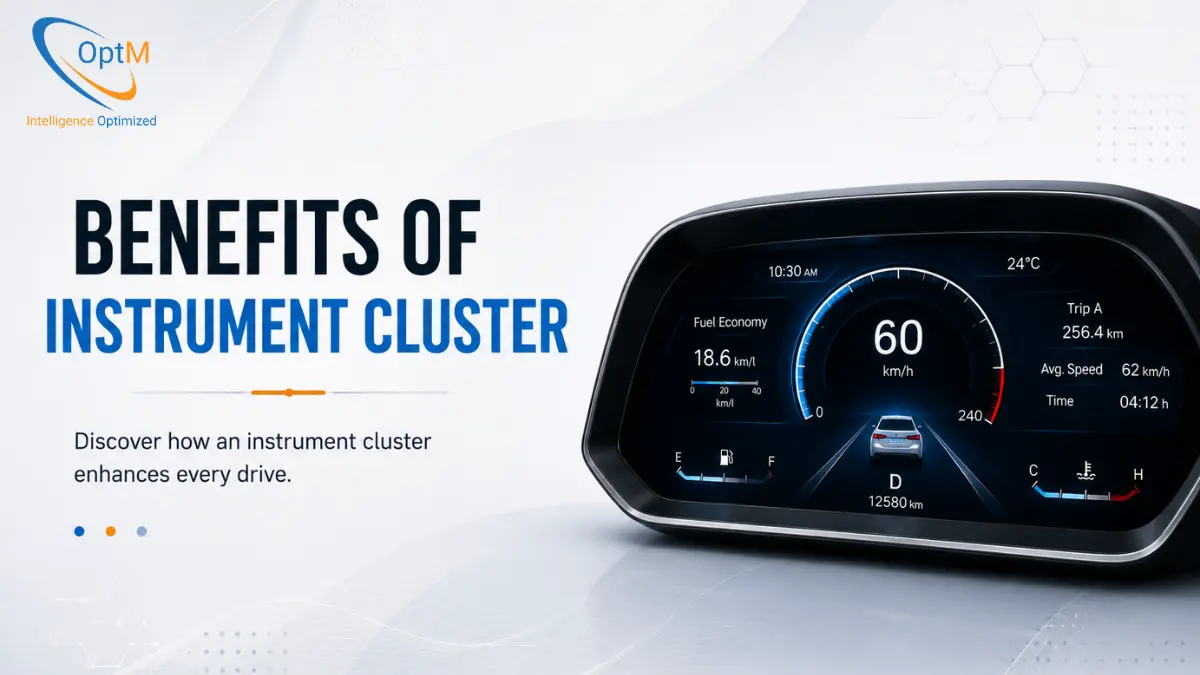
Upgrading from electromechanical gauges to a high-performance digital ecosystem offers profound operational advantages. For OEMs and fleet operators, the benefits of instrument cluster digitization translate directly to lower manufacturing costs through single-hardware scalability and vastly improved asset tracking.
| Stakeholder | Key Technical & Operational Value Proposition |
|---|---|
| Automotive OEMs | Hardware Standardization: A single hardware display module can be deployed across an entire vehicle lineup, differentiating models purely via software configuration. Over-the-Air Updates: Secure OTA frameworks allow OEMs to update graphics layouts or patch firmware anomalies without requiring dealership visits. |
| Fleet Operators | Predictive Maintenance: Direct integration with remote telematics data gateways provides precise diagnostic fault codes immediately over cloud interfaces. Uptime Maximization: Resolving mechanical issues before catastrophic highway breakdowns significantly increases active fleet uptime. |
| End-Use Drivers | Cognitive Optimization: Dynamic delivery of context-specific road data lowers visual strain. For example, expanding reversing camera guidelines automatically while downplaying the tachometer during a parking maneuver. |
Role of Embedded Software in Instrument Clusters
Because the display hardware is inert on its own, the role of embedded software in instrument clusters defines the actual boot latency, execution safety, and visual smoothness. The software design dictates how effectively the cluster manages high-speed data under extreme processing loads.
Board Support Packages (BSP) & Device Drivers
Every custom cluster board requires a tailored Board Support Package (BSP). The BSP configures the fundamental silicon hooks, registers pin-out maps, enables flash memory interfaces, and initializes peripheral controllers. Low-level device drivers are carefully written to handle high-brightness display initialization, touchscreen SPI/I2C buses, and high-frequency hardware clocks to avoid interface stuttering.
Real-Time Thread Prioritization Architectures
In safety-critical automotive environments, clusters must run on robust RTOS or embedded Linux baselines to ensure real-time diagnostics render with zero frame drop during critical warning states. To achieve this stability, embedded engineers configure strict multi-threaded prioritization layers:
- Priority Level 1 (Hard RTOS): Critical interrupts (e.g., CAN fault buffers, ABS triggers, airbag deployment frames).
- Priority Level 2 (Determined Task): Dynamic telemetry processing (e.g., real-time velocity, RPM).
- Priority Level 3 (Asynchronous Thread): Non-critical media and comfort displays (e.g., navigation maps).
If a critical engine thermal overload packet registers on the CAN transceiver, the hard real-time scheduler immediately preempts non-critical tasks to ensure the warning indicator displays within single-digit millisecond latency windows.
Instrument Cluster UI/UX Design
An exceptional instrument cluster requires a careful balance between artistic aesthetic and rigorous cognitive engineering. Balancing cognitive load with dense data delivery is the primary objective of modern instrument cluster UI/UX design.
Cognitive Loading and Visual Hierarchy Principles
Automotive HMI design centers on the "glance concept." A driver should look down at the display, extract the necessary operational detail, and return focus to the roadway within a 150-millisecond window. To achieve this efficiency:
- Chromatic Strategy: Bright, high-contrast primary colors indicate critical states, while muted or neutral palettes are used for steady-state indicators.
- Typography Selection: Clean, sans-serif typefaces with generous kerning prevent digital legibility degradation under high-vibration driving conditions.
Graphics Acceleration with the Qt Engine
To build premium, responsive user interfaces, development teams rely heavily on specialized frameworks like Qt and QML. Qt enables a streamlined workflow between UI/UX designers and embedded software developers. It compile-optimizes graphic layouts directly down to highly efficient C++ code structures, leveraging deep hardware acceleration on the SoC's GPU. This enables fluid, consistent 60fps rendering for needle animations and layout transitions without overheating the display unit.
Instrument Cluster Integration with ECUs, Sensors and Vehicle Networks
The cluster is not an isolated component; its utility depends entirely on seamless interoperability with the vehicle's broader control ecosystem. Achieving flawless instrument cluster integration with ECUs, sensors and vehicle networks requires sophisticated hardware abstraction layers to translate diverse communication protocols accurately.
Navigating the In-Vehicle Network Matrix
The integration architecture must balance multiple network protocols simultaneously. High-speed CAN buses handle traditional mechanical telemetry, while specialized J1939 connections handle heavy-duty commercial vehicle parameters. For high-bandwidth data needs—such as streaming high-resolution navigation maps or real-time surround-view camera feeds—engineers implement high-speed Automotive Ethernet linkages.
Multi-System Communication Interoperability
- EV Powertrain Synchronizations: The cluster reads and displays motor management data, battery discharge metrics, and thermal protection profiles directly from the powertrain module.
- Safety Integration and Handovers: When external safety arrays detect sudden obstacles, the cluster coordinates with the ADAS ECU to immediately render warning indicators or trigger automated emergency visual cues.
- Internal Sensor Fusion: The dashboard system links with internal AI monitoring systems to instantly display warnings if driver distraction or fatigue is detected.
Instrument Cluster Testing and Validation
Given its role in driver safety communication, an instrument cluster must undergo an extensive verification lifecycle before receiving production sign-off. Before any display unit hits the production line, rigorous instrument cluster testing and validation under Hardware-in-the-Loop (HIL) conditions ensures ARAI-oriented deployment readiness.
1. Model-Based Development (MBD) Verification
To reduce time-to-market, engineering workflows leverage model-based development frameworks. Before physical hardware prototypes are assembled, the system's control logic and data routing pathways are modeled and simulated within computer environments. This enables early algorithm validation and structural debugging long before target chip production begins.
2. Hardware-in-the-Loop (HIL) Stress Profiling
Once physical hardware leaves assembly, it is integrated into a Hardware-in-the-Loop (HIL) testing laboratory. Specialized simulation equipment mimics the vehicle's electronic infrastructure, streaming hundreds of CAN messages simultaneously. HIL test cases purposefully simulate abnormal data spikes, bus corruption states, and sudden voltage drops to verify the cluster's software handling remains secure and resilient.
3. Environmental and Regulatory Validation
Physical assemblies must survive severe environmental simulation cycles:
- Thermal Cyclic Testing: Continuous operation profiles spanning extended cycles from -40°C to +105°C.
- Mechanical Vibration Profiles: Multi-axis random vibration sweeps mimicking years of harsh driving over unpaved surfaces.
- Electromagnetic Compatibility (EMC): Verifying the cluster survives extreme electrostatic discharges (ESD) and emits zero disruptive radiation fields.
Challenges in Instrument Cluster Development
Building next-generation digital display architectures involves navigating complex engineering trade-offs. Resolving thermal dissipation within sealed dashboards and meeting strict millisecond boot targets are primary challenges in instrument cluster development that embedded engineers must expertly navigate.
- Meeting Strict Millisecond Boot Targets: From the moment a driver cycles the vehicle's ignition switch, the instrument cluster must achieve full operational readouts within a fraction of a second. Engineering teams must optimize boot-loaders, utilize minimal kernel footprints, and hardcode fast-boot pipelines to ensure critical warning indicators light up instantly.
- Managing Thermal Profiles: High-performance graphics processors generate significant thermal energy. However, dashboard spaces are tightly sealed, unventilated cavities. Engineers must design complex passive thermal dissipation structures and implement software-driven thermal throttling mechanisms to protect internal components.
- Mitigating Cybersecurity Risks: As clusters integrate with connected telematics units and cloud ecosystems to fetch OTA packages, they become potential entry points for cyber threats. Securing the system requires hardware-enforced secure boot keys and cryptographic authentication of incoming data frames.
- Balancing BOM Boundaries: Balancing the high-performance chipsets needed for smooth 60fps animations with the cost constraints of mass production requires meticulous optimization of every line of code to maximize hardware efficiency.
Partnering for Next-Generation Cockpit Solutions
An advanced digital instrument cluster is the foundational core of the modern intelligent vehicle cockpit, demanding flawless hardware-software integration, rigorous functional safety compliance, and robust thermal management. Building these deterministic systems from the ground up requires significant engineering bandwidth and highly specialized embedded expertise.
If your automotive or engineering organization is looking to deploy scalable, ARAI-ready display architectures without extending time-to-market, explore OptM’s production-ready Digital Instrument Cluster solutions. We provide end-to-end product engineering—from custom Qt-based HMI rendering and RTOS prioritization to ruggedized PCB design and ECU integration.
Frequently Asked Questions
What is the primary difference between a digital instrument cluster and a center-console infotainment head unit?
The digital instrument cluster is a safety-critical system (often rated ASIL B or C) that displays regulatory data like real-time velocity, functional warnings, and ADAS alerts directly in the driver’s line of sight. The infotainment head unit is a non-safety-critical domain (typically ASIL-exempt) handling secondary features like multimedia, comfort options, and general telephone connectivity.
What does 'ARAI-oriented deployment readiness' mean for Indian automotive markets?
ARAI (Automotive Research Association of India) readiness means the display module complies with strict domestic regulations, including specific vibration tests, electromagnetic compatibility (EMC) guidelines, and regional thermal standards before receiving road-going certification.
Why can't automakers use standard consumer tablets as instrument clusters?
Consumer tablets lack automotive-grade ruggedization. They cannot survive the physical vehicle environment, which demands continuous operations between -40°C and +85°C, high-voltage vehicle electrical fluctuations, extreme multi-axis vibration profiles, and sunlight readability up to 1000 nits.
What are 'telltales' on an automotive dashboard?
Telltales are globally standardized safety icons (like the engine check symbol, airbag status indicator, or ABS warning lamp) that must instantly light up to communicate localized vehicle faults or status changes.
How does the shift to Software-Defined Vehicles (SDVs) change cluster procurement?
In SDVs, hardware is decoupled from software. OEMs no longer purchase a unique physical cluster for every vehicle trim; instead, they procure a single standardized digital screen assembly and differentiate vehicle lines via OTA software adjustments.
Can a digital instrument cluster display navigation maps natively?
Yes. Modern digital instrument clusters leverage high-speed Automotive Ethernet pipelines to stream uncompressed, real-time map data directly from the infotainment or navigation module right into the forward display pane.
Why is a Compound Annual Growth Rate (CAGR) of 7.6% significant for digital clusters?
It demonstrates a massive industrial transition where commercial logistics fleets and passenger vehicles are permanently phasing out legacy analog indicators to support electric vehicles (EVs) and automated driving assistance computing.