
Content Writer & SEO Specialist
Content Writer & SEO Specialist
Aditya Sharma is a content writer at OptM Solutions specializing in automotive electronics, embedded systems, telematics, electric vehicle technologies, connected mobility, and autonomous driving technologies.
LinkedIn ProfileThe automotive dashboard has undergone a radical transformation. For decades, drivers relied on a static array of mechanical needles, plastic dials, and electromechanical fuel gauges to understand their vehicle's status. Today, those physical components have been entirely replaced by high-definition, software-driven edge-computing nodes.
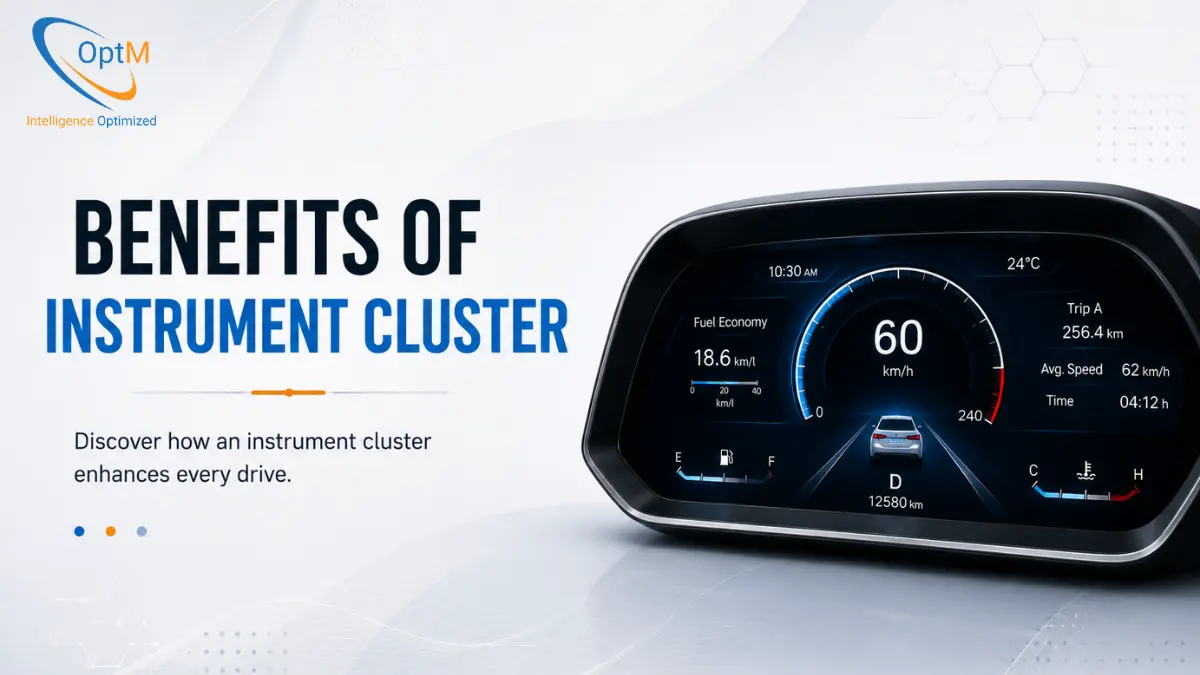
If you are an automotive OEM, a Tier 1 supplier, or a fleet manager, the transition to digital display architectures is no longer just about aesthetics—it is a strategic necessity for remaining competitive in the era of connected mobility. Before exploring the specific advantages these systems offer, it is helpful to establish a baseline understanding of what is an instrument cluster and how its role has expanded from simple speed tracking to serving as the central intelligence hub of the vehicle cockpit.
This comprehensive guide breaks down the multi-layered benefits of digital instrument clusters, exploring how they reduce manufacturing complexities, enhance driver safety, enable commercial fleet tracking, and future-proof vehicle platforms through software scalability.
The Market Reality: Why Digital is the New Standard
The shift toward fully digital dashboards is accelerating rapidly, driven by the global push for electric vehicles (EVs) and Advanced Driver Assistance Systems (ADAS).
According to global market analysis by Fortune Business Insights, the global automotive digital instrument cluster market is projected to grow from $10.00 billion in 2026 to $17.90 billion by 2034, reflecting a strong Compound Annual Growth Rate (CAGR) of 7.6%.
This multi-billion-dollar shift is not accidental. Automakers are adopting digital displays because they solve fundamental engineering and business bottlenecks that legacy analog systems simply cannot address.
1. Manufacturing and Cost Benefits for OEMs
For vehicle manufacturers, building thousands of cars a day requires ruthless efficiency. The legacy approach to instrument clusters involved manufacturing dozens of different mechanical dashboard variants to accommodate different vehicle trims (e.g., base models vs. premium models, diesel vs. petrol, metric vs. imperial speeds).
Standardizing the Bill of Materials (BOM)
One of the most significant benefits of a digital architecture is hardware standardization. By utilizing a robust instrument cluster architecture, an OEM can install the exact same physical display panel and processor across their entire vehicle lineup. The differentiation between a base-model sedan and a luxury SUV is achieved entirely through software. This drastically simplifies the supply chain, reduces tooling costs, and minimizes warehouse inventory.
Over-The-Air (OTA) Updates and Post-Sale Revenue
Unlike an analog gauge, which remains identical from the day it leaves the factory until the day the car is scrapped, a software-defined display can evolve.
Because of the specialized role of embedded software in instrument clusters, automakers can securely push Over-The-Air (OTA) firmware updates. If a minor software anomaly is discovered, it can be patched remotely without forcing thousands of customers into physical dealership recalls. Furthermore, OEMs can generate post-sale revenue by allowing drivers to purchase and download new digital dashboard themes directly from the cloud.
2. Advantages for Commercial Fleets and Logistics
For enterprise logistics and commercial transport companies, a vehicle is a revenue-generating asset. Minimizing downtime is critical. Digital clusters provide fleet managers with unprecedented visibility into the health of their assets.
Predictive Maintenance and Cloud Connectivity
A physical warning light (like a generic "Check Engine" indicator) gives a driver zero context about the severity of a vehicle fault. Is it a loose gas cap, or is the transmission about to fail?
A digital cluster changes this dynamic. By achieving deep instrument cluster integration with ECUs, sensors and vehicle networks, the dashboard reads exact diagnostic fault codes directly from the powertrain. When integrated with a telematics gateway, the cluster can instantly push this diagnostic data to the fleet manager's cloud dashboard. This enables predictive maintenance—allowing fleet operators to route a truck to a repair bay before a catastrophic highway breakdown occurs.
3. Improving Driver Safety and Cognitive Focus
A major objective of modern vehicle design is reducing driver distraction. In complex driving scenarios, forcing the human eye to scan across multiple scattered physical gauges increases cognitive load and slows reaction times.
Context-Aware Display Logic
Understanding how instrument cluster works reveals its ability to adapt dynamically. Because the graphics are rendered via software, the cluster only shows the driver what they need to see at that specific moment.
- Highway Driving: The cluster minimizes media details and expands ADAS visuals, highlighting adaptive cruise control distances.
- Parking Maneuvers: The speedometer shrinks to the corner of the screen, while high-definition reversing camera guidelines take center stage.
- Critical Faults: If the vehicle's ABS fails, a deterministic Real-Time Operating System (RTOS) preempts all non-critical UI elements to instantly flash a high-contrast red warning, ensuring the driver cannot miss the alert.
Seamless Human-Machine Interfaces
Achieving this level of fluid, distraction-free communication requires exceptional instrument cluster UI/UX design. By utilizing advanced vector-graphics frameworks like Qt, engineers can ensure that warning animations and needle movements run smoothly at 60 frames per second without stuttering, which drastically reduces visual fatigue during long drives.
4. Unlocking Electric Vehicle (EV) Intelligence
The internal combustion engine (ICE) requires relatively simple dashboard metrics: fuel level, RPM, and engine temperature. Electric vehicles are vastly more complex, governed by sensitive electrochemical realities. Attempting to manage an EV using analog dials is virtually impossible.
Dynamic Range and Battery Health
Digital clusters interface directly with the EV's Battery Management System (BMS) to visualize critical energy data. Instead of a vague fuel needle, digital displays provide highly accurate State of Charge (SoC) percentages.
More importantly, edge-processing algorithms calculate dynamic range estimations based on real-time variables like cabin heating loads and exterior weather conditions. The cluster can also render energy-flow animations, showing the driver exactly when kinetic energy is being recaptured through regenerative braking.
5. Overcoming Engineering Hurdles for Better Reliability
Historically, the automotive industry was hesitant to replace physical gauges with screens out of fear that a computer crash would blind the driver to their speed. Today, the engineering behind these systems has advanced to a point where digital clusters are significantly more reliable than their mechanical predecessors.
No Mechanical Wear and Tear
Mechanical clusters rely on physical stepper motors and plastic gears that degrade, stick, or snap after years of high-vibration driving. Digital clusters eliminate moving parts entirely. By selecting ruggedized components of instrument cluster hardware—such as automotive-grade display panels and IP67-rated enclosures—engineers create display nodes that easily outlast the physical chassis of the vehicle.
Built-In Safety Redundancies
To ensure absolute reliability, embedded engineers must navigate several challenges in instrument cluster development. One major challenge is ensuring the screen never freezes. Modern clusters solve this through asymmetric hardware processing. If the main graphics processor crashes, an independent safety microcontroller immediately detects the fault and illuminates physical LED warning lights built into the dashboard bezel.
Validating these failsafe mechanisms requires exhaustive laboratory stress cycles. Before any display reaches the assembly line, it undergoes rigorous instrument cluster testing and validation, including severe thermal shock and prolonged vibration testing to guarantee ARAI-oriented deployment readiness.
Transitioning from Concept to Automotive-Grade Reality
The benefits of upgrading to a digital instrument cluster span the entire automotive value chain. For the OEM, it drastically reduces manufacturing complexity and enables OTA scalability. For commercial fleet operators, it unlocks predictive vehicle maintenance through deep diagnostic visibility. For the driver, it delivers an adaptive, context-aware interface that significantly reduces cognitive distraction.
However, designing an automotive digital display from scratch—managing thermal constraints, securing embedded OS partitions, and achieving flawless 60fps UI rendering—demands specialized engineering expertise.
If your organization is ready to move beyond legacy mechanical constraints and integrate next-generation display architectures into your vehicle platforms, explore OptM's production-ready Digital Instrument Cluster solutions. Our dedicated engineering teams provide end-to-end integration support, ensuring your software-defined cockpit is robust, compliant, and ready for the future of connected mobility.
Frequently Asked Questions
How does a digital dashboard lower an OEM's Total Cost of Ownership (TCO) across vehicle variants?
Digitization allows single-hardware optimization. OEMs standardize their display procurement and differentiate between base vehicle configurations and luxury models entirely through software profiles, avoiding specialized mechanical toolings.
How do Over-the-Air (OTA) firmware updates reduce warranty expenses?
If a firmware bug is discovered, the manufacturer can deploy a remote patch to the vehicle fleet over a secure network. This avoids the massive parts and labor costs associated with physical dealership recall programs.
How do digital clusters help fleet logistics managers minimize vehicle down-times?
By integrating directly with telematics systems, the cluster broadcasts exact diagnostic trouble codes to a remote cloud interface the moment an anomaly is detected. This enables predictive maintenance before an on-road failure occurs.
Why do digital dashboards outlast legacy electromechanical gauge assemblies?
Mechanical gauge configurations rely on physical stepper motors, return springs, and plastic gears that suffer from material fatigue and wear over time. Digital screens have zero moving components, eliminating mechanical failure points.
How does a dynamic screen layout reduce human visual strain during night driving?
The cluster leverages ambient light sensors to automatically modulate contrast profiles and dim backlight panels, showing only context-specific travel details to keep cabin glare from fatiguing the driver's eyes.
What commercial monetization opportunities do software-defined clusters create post-sale?
OEMs can introduce digital store models allowing consumers to purchase and install custom theme configurations, performance analytics modules, or layout skins over the air long after the initial sale.
How does a digital display help an EV driver maximize their battery range?
The screen delivers clear energy flow animations that track real-time power metrics, training the operator to adjust their acceleration and optimize energy recapture through regenerative braking.