
Content Writer & SEO Specialist
Content Writer & SEO Specialist
Aditya Sharma is a content writer at OptM Solutions specializing in automotive electronics, embedded systems, telematics, electric vehicle technologies, connected mobility, and autonomous driving technologies.
LinkedIn ProfileThe greatest engineering challenge in modern automotive technology is not building a faster processor or a more efficient cellular antenna; it is the act of translation. A vehicle is a closed, deterministic, mathematically precise physical environment. The cloud is an open, asynchronous, non-deterministic digital environment. Connecting these two completely different worlds requires an intermediary capable of stitching together raw electrical voltage, space-based satellite timing, high-frequency radio waves, and complex enterprise software architecture.
This intermediary is the Telematics Control Unit (TCU). However, a TCU in isolation is simply an inert circuit board. Its true value is realized entirely through system integration.
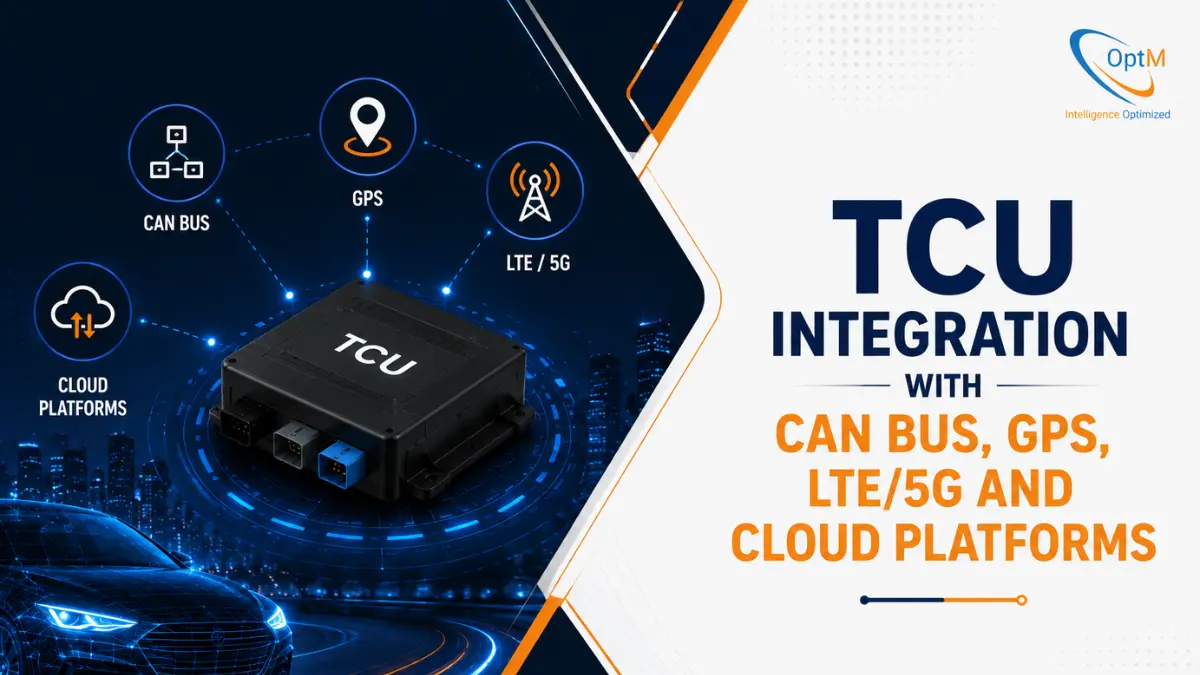
Telematics integration is the highly coordinated engineering process of bridging a vehicle’s internal communication buses with wide-area wireless networks and cloud backends. It establishes a seamless, low-latency data pipeline that intercepts physical copper wire signals, appends precise spatial and temporal stamps, modulates the data over multi-band cellular networks, and unpacks the resulting telemetry into enterprise databases. To understand the fundamental hardware that makes this possible, you can review the baseline definition of what a telematics control unit is.
Achieving this seamless integration is an immensely complex undertaking. An engineering team must successfully merge four completely distinct technological ecosystems—each governed by different global standards, latency tolerances, and physical constraints—without causing a single system crash. Whether you are a junior developer tasked with parsing a J1939 log or a senior architect designing a next-generation Software-Defined Vehicle (SDV) platform, understanding the mechanics of this four-pillar integration is non-negotiable.
This guide provides an extreme deep dive into the exact protocols, hardware layers, and software architectures used to integrate the CAN bus, GNSS tracking, 5G cellular modulation, and cloud infrastructure into a unified automotive ecosystem.
1. In-Vehicle Integration: Tapping into the CAN Bus & J1939 Architecture
The first step of integration is physical and localized. Before a TCU can send data to the cloud, it must harvest that data from the vehicle's internal nervous system. This requires integrating directly with the Controller Area Network (CAN) and its commercial heavy-duty counterpart, SAE J1939.
The Physics of CAN Integration
To an embedded systems engineer, the CAN bus is not software; it is physics. The TCU integrates into the vehicle via a physical connection to a twisted pair of copper wires: CAN-High and CAN-Low.
When an Electronic Control Unit (ECU)—such as the engine controller—needs to transmit its RPM, it does not send a digital file. It simultaneously raises the voltage on the CAN-High wire (typically to 3.5V) and drops the voltage on the CAN-Low wire (to 1.5V). This 2V differential creates a "dominant" state, representing a logical '0'. When the voltages return to their resting state of 2.5V, it creates a "recessive" state, representing a logical '1'.
The TCU utilizes an integrated CAN transceiver (such as an NXP TJA1043) to read these microscopic voltage shifts millions of times per second. The transceiver translates these differential voltages into a clean, digital RX/TX (Receive/Transmit) logic stream that the TCU’s core microcontroller can process.
Navigating the Arbitration Protocol (CSMA/CD+AMP)
Integration requires playing by the strict rules of the vehicle's network. The CAN bus uses a protocol called Carrier Sense Multiple Access with Collision Resolution (CSMA/CD+AMP). Because all ECUs share the same two wires, if two ECUs try to "talk" at the exact same millisecond, the system resolves the collision using message IDs.
Lower message IDs have higher priority. For example, an Anti-lock Braking System (ABS) alert might have an ID of 0x01, while the radio volume control might have an ID of 0x3F. If both transmit simultaneously, the braking signal overrides the radio signal at the electrical level. A properly integrated TCU must be programmed to respect this arbitration, ensuring that its requests for diagnostic data never step on the toes of safety-critical powertrain messages.
Decoding SAE J1939 for Commercial Fleets
While passenger cars use standard 11-bit CAN identifiers (CAN 2.0A), commercial trucks, agricultural equipment, and heavy machinery utilize the SAE J1939 standard, which operates on an extended 29-bit identifier framework (CAN 2.0B).
Integrating with J1939 requires the TCU's software stack to unpack incredibly dense Parameter Group Numbers (PGNs) and Suspect Parameter Numbers (SPNs).
- PGN (Parameter Group Number): Acts as the "header" telling the TCU what category of data is arriving.
- SPN (Suspect Parameter Number): Represents the specific data point within that group.
Engineering Example: If the TCU intercepts PGN 65262 (Engine Temperature 1), the firmware parsing engine knows to look inside that specific message frame for SPN 110 (Engine Coolant Temperature). The software then applies the J1939 standard scaling factor (1 byte, 1°C per bit, offset of -40°C) to convert a raw hex value into a human-readable "85°C".
Resolving "Engineering Floor" Friction: Direct Memory Access (DMA)
A common friction point during TCU integration occurs during "bus load spikes." If a commercial truck executes a hard braking event, hundreds of ECUs flood the bus simultaneously. If the TCU’s main CPU tries to read every single incoming frame manually using standard interrupt requests, the CPU will choke, resulting in dropped frames or a system crash.
To solve this, senior engineers integrate utilizing Direct Memory Access (DMA). The CAN controller hardware writes the incoming messages directly into the TCU’s RAM, completely bypassing the main CPU. This hardware-level abstraction allows the system to ingest massive bursts of data smoothly. You can explore the internal mechanics of how a telematics unit processes data locally via memory allocation before it prepares it for the cloud.
2. Spatial Ingestion: Fusing GPS/GNSS Data for Accurate Mapping
A perfectly extracted CAN payload is utterly useless to a fleet manager if they do not know exactly where and when that data was generated. The second pillar of integration is localization.
Multi-Constellation Tracking and NMEA 0183
Older telematics devices integrated a basic GPS receiver that communicated exclusively with the US Department of Defense satellite array. Modern TCUs integrate multi-constellation Global Navigation Satellite System (GNSS) modules. These chips (such as those from u-blox or Qualcomm) listen to GPS, Galileo (EU), GLONASS (Russia), and BeiDou (China) simultaneously.
The integration between the GNSS chip and the TCU's main processor is typically handled via an internal UART or SPI connection, passing data using the standardized NMEA 0183 protocol. The TCU parses specific NMEA "sentences" to extract location data. For example, the $GPRMC (Recommended Minimum Specific GPS/TRANSIT Data) sentence provides the core time, latitude, longitude, and speed, while the $GPGGA sentence provides altitude and satellite fix quality.
By integrating multi-band receivers (tracking both L1 and L5 frequency bands), the TCU can correct for ionospheric signal delays, bringing locational accuracy down from 5 meters to sub-meter resolution, which is critical for lane-level tracking. To review how these specific silicon chips sit on the circuit board, review the structural components of a telematics control unit.
Sensor Fusion and the "Tunnel Challenge"
Satellite integration alone is not enough. If a delivery vehicle drives into a two-mile underground tunnel, or navigates the "urban canyons" of downtown Manhattan, the GNSS signal is physically blocked by concrete and steel. If the TCU relies purely on satellites, the vehicle will disappear from the fleet dashboard.
To bridge this gap, engineers deploy "Sensor Fusion" and "Dead Reckoning." The TCU integrates a 6-axis Inertial Measurement Unit (IMU) directly on the circuit board, featuring a 3-axis accelerometer and a 3-axis gyroscope.
When the GNSS signal drops (known as a signal denial environment), the TCU’s edge-processing algorithm takes over. It feeds the last known satellite coordinate into a complex mathematical model (often an Extended Kalman Filter). The filter continuously calculates the vehicle's current position by integrating the vehicle's yaw rate (from the gyroscope), its acceleration (from the accelerometer), and the exact wheel-speed tick data pulled directly from the CAN bus.
By fusing spatial hardware with in-vehicle networks, the TCU maintains a highly accurate, uninterrupted location trail through the longest tunnels and darkest parking garages.
3. Wide-Area Airtime: Modulation over LTE and 5G Networks
Once the TCU has aggregated the internal engine data and appended a precise spatial-temporal stamp, the data must leave the vehicle. The third pillar of integration bridges the gap between the car and the public cellular network.
The Multi-Band Baseband Pipeline
Integrating a cellular modem is not as simple as attaching an antenna. The modem sub-system consists of a Baseband Processor (which runs the 3GPP cellular protocol stacks) and a Radio Frequency Front-End (RFFE) module.
When the TCU's application processor has a payload ready, it sends it to the baseband processor. The baseband processor takes the digital '1s' and '0s' and applies complex modulation schemes (such as 256-QAM or Quadrature Amplitude Modulation). The RFFE then amplifies this modulated signal, passing it through specialized band-pass filters to isolate the exact frequency required by the local telecom carrier, and blasts it out of the vehicle’s roof-mounted MIMO (Multiple Input, Multiple Output) antenna.
The Transition to 5G URLLC and V2X
For the last decade, LTE Cat 4, Cat M1, and NB-IoT networks provided adequate bandwidth for simple fleet tracking. However, the integration demands of modern SDVs are forcing a rapid shift toward 5G Standalone (SA) networks.
The critical integration feature of 5G is URLLC (Ultra-Reliable Low-Latency Communication). Legacy 4G networks typically exhibited a "ping" or latency of 50 to 100 milliseconds. While fine for fuel reporting, 100 milliseconds is a matter of life and death if a vehicle is relying on cloud data to engage automatic emergency braking.
According to research published by the 5G Automotive Association (5GAA), advanced Cellular Vehicle-to-Everything (C-V2X) architecture utilizing 5G networks reduces end-to-end communication latency to between 1 and 4 milliseconds, enabling real-time cooperative collision avoidance and automated intersection management. Integrating this 5G pipeline directly supports the advanced cellular-based vehicle communication ecosystems required for future autonomous mobility.
Store-and-Forward Architecture: Surviving Blackout Zones
Cellular coverage is never 100% reliable. Commercial trucks frequently drive through remote logging routes, deserts, and mountain passes where cellular handshake fails.
A robust integration architecture accounts for this using a "Store-and-Forward" methodology. If the modem reports a loss of cellular bearer, the TCU's operating system instantly routes all incoming CAN and GPS data into an internal SQLite database housed on a non-volatile eMMC flash storage chip. The data is chronologically queued. The exact microsecond the baseband processor re-establishes a network connection, the software initiates a background worker process to execute a bulk burst-upload, clearing the backlog and ensuring zero data loss for enterprise accounting systems.
4. Cloud Platform Ingestion: Parsing Telemetry into Enterprise Backends
The final pillar of integration occurs entirely outside the vehicle. The raw RF signal arrives at a cell tower, travels through the telecom provider's fiber optic backbone, and enters a cloud architecture (such as AWS IoT Core, Microsoft Azure IoT Hub, or a private enterprise server).
Lightweight Messaging Protocols: MQTT over HTTP
In traditional web development, computers talk to clouds using HTTP (Hypertext Transfer Protocol). For vehicle telematics, HTTP is an incredibly inefficient integration choice. HTTP requires a "heavy" handshake for every single message, attaching massive headers to tiny data payloads. It also requires the vehicle to constantly ask the server, "Do you have any new commands for me?"
Instead, senior engineers integrate TCUs using MQTT (Message Queuing Telemetry Transport). MQTT is a publish/subscribe protocol designed explicitly for high-latency, low-bandwidth IoT environments.
- Stateful Connections: The TCU opens a single, secure TLS 1.3 socket to the cloud broker and keeps it open.
- Minimal Overhead: The data header is only 2 bytes long (compared to hundreds of bytes for HTTP).
- Quality of Service (QoS): MQTT allows the engineer to specify delivery guarantees. For standard fuel metrics, QoS 0 (Fire and Forget) is used. For critical diagnostic trouble codes or billing mileage, QoS 1 (Delivered at least once, requiring a cloud acknowledgment) is integrated.
This bidirectional, always-on connection is exactly what allows fleet managers to execute remote updates and onboard diagnostics instantly, without waiting for the vehicle to "check in."
Binary Serialization: The End of JSON
Once the protocol is established, the actual data format must be integrated. Many junior developers attempt to send telemetry payloads using JSON (JavaScript Object Notation) because it is human-readable.
In automotive engineering, human-readable text is a waste of cellular bandwidth. A JSON string like {"Engine_RPM": 2450} consumes 19 bytes of data. When transmitting 1,000 parameters per second, JSON will bankrupt a fleet operator's SIM card data plan.
Modern integration pipelines utilize Binary Serialization, predominantly Google Protocol Buffers (Protobuf). The TCU and the Cloud both hold a shared .proto schema file. The TCU strips away all the text, converting the data into a microscopic string of highly compressed hexadecimal bits (e.g., 0x08 0x9A 0x13). The cloud ingests this tiny binary blob and uses the schema to instantly "rehydrate" it back into Engine_RPM: 2450. Integrating Protobuf reduces cellular payload sizes by up to 80% while significantly accelerating edge processing speeds.
Cloud Parsing and Hot/Cold Routing
Once the binary data is unpacked inside AWS IoT Core or Azure IoT Hub, the cloud architecture must route it. Using cloud-native Rule Engines, the telemetry is split:
- Hot Path: Critical events (eCall crash alerts, active fault codes) are routed to in-memory databases (like DynamoDB or Redis) to trigger instant SMS alerts or populate live dispatch dashboards.
- Cold Path: Standard operational data (GPS trails, fuel economy metrics) are routed to cheap, long-term object storage (like Amazon S3) for end-of-month machine learning analysis or historical compliance auditing.
5. The Multi-Tasking Architecture: Balancing Concurrent Functions
How does a TCU manage CAN bus ingestion, GPS sensor fusion, 5G RF modulation, and MQTT cloud serialization simultaneously without crashing? It relies on the integration of advanced software architecture.
Asymmetric Multiprocessing (AMP)
To manage these vastly different workloads, a high-end TCU utilizes an Asymmetric Multiprocessing (AMP) layout. The hardware features two distinct processors running two different operating systems, deeply integrated via Inter-Processor Communication (IPC) frameworks like RPMsg.
- The Cortex-A Domain (Embedded Linux): This high-power processor handles the "IT" workload. It runs the TCP/IP stack for the cellular modem, executes the Protobuf serialization, and manages the complex TLS 1.3 cryptographic handshakes with the cloud.
- The Cortex-M Domain (RTOS): This low-power, hyper-reliable microcontroller handles the "Automotive" workload. It runs a Real-Time Operating System (RTOS). Its sole job is to monitor the vehicle ignition state, manage CAN bus interrupts, and ensure that safety-critical data is captured with deterministic microsecond precision.
This separation of concerns ensures that if the Linux system experiences a kernel panic due to a corrupted cloud download, the RTOS side continues to manage vehicle safety functions uninterrupted. To understand the broader hardware foundations that support this AMP layout, review the principles of telematics control unit architecture.
| Integration Endpoint | Primary Processor | Execution Tolerance | Data Protocol / Standard |
|---|---|---|---|
| In-Vehicle CAN/J1939 | RTOS (Cortex-M) | < 1 millisecond (Strict) | ISO 11898, SAE J1939 |
| GNSS & Sensor Fusion | RTOS / Linux (Shared) | 10 - 50 milliseconds | NMEA 0183, I2C/SPI |
| 5G Cellular Modulation | Linux (Cortex-A) | Variable (Carrier Dependent) | 3GPP Rel 15/16 |
| Cloud MQTT Serialization | Linux (Cortex-A) | 100 - 500 milliseconds | MQTT, Protobuf, TLS 1.3 |
6. Security and Failure Management across Integration Endpoints
Connecting the closed, private network of a vehicle's braking and steering systems directly to the public internet creates a terrifying attack surface. A flawless integration is not just about making the data flow; it is about ensuring that malicious data cannot flow backward into the car.
The Silicon-Level Vault: Hardware Security Modules
Software firewalls are insufficient for automotive integration. True security is integrated directly into the silicon via a Hardware Security Module (HSM).
The HSM is a physically isolated chip on the TCU board that generates and stores the vehicle's unique x.509 cryptographic certificates and private keys. When the Linux processor needs to open an MQTT connection to the cloud, it does not have the keys. It must pass the connection request to the HSM. The HSM authenticates the request, performs the cryptographic math inside its impenetrable vault, and returns the encrypted payload. Because the keys never leave the HSM, a hacker cannot steal them, even if they completely compromise the main Linux operating system.
Secure Onboard Communication (SecOC)
To prevent internal spoofing (e.g., a hacker accessing the infotainment system's Bluetooth and trying to send a fake "apply brakes" message over the CAN bus), engineers integrate AUTOSAR SecOC (Secure Onboard Communication). SecOC appends a truncated Message Authentication Code (MAC) to critical CAN frames. The TCU verifies this MAC against a shared secret key before allowing the message to pass between networks, acting as a strict internal firewall.
Guarding these integration points requires solving immense connected vehicle engineering hurdles and staying continuously ahead of modern automotive cybersecurity defenses.
7. Business Impact: What True System Integration Unlocks
Why invest millions of dollars into engineering this flawless, four-pillar integration? Because when the CAN bus, GPS, 5G modem, and Cloud platform operate as a single, unified nervous system, the financial return on investment (ROI) is transformative.
When integration is flawless, predictive maintenance becomes a reality. Instead of relying on a mechanic's intuition, a fleet manager's dashboard automatically alerts them that a specific truck's transmission temperature is trending 4% higher than the fleet average, prompting a $200 fluid flush before it turns into a $6,000 transmission replacement.
According to exhaustive industry studies by the American Transportation Research Institute (ATRI), predictive maintenance enabled by deeply integrated telematics systems reduces overall vehicle maintenance costs by up to 20%, while simultaneously reducing unscheduled vehicle downtime by up to 25%.
These combined capabilities fundamentally restructure the economics of operating a commercial fleet, driving unprecedented operational cost savings and vehicle efficiency.
The OptM Integration Framework: Production-Ready Automotive Gateways
Achieving this level of end-to-end integration is beyond the scope of consumer electronics developers or aftermarket tracking startups. It requires specialized, industrial-grade product engineering capable of navigating strict automotive safety standards and complex enterprise cloud architectures.
At OptM Solutions, our embedded electronics and software engineering teams specialize in building the bridges that make connected mobility possible. We design and configure highly scalable Telematics Control Units featuring natively integrated CAN-FD transceivers, high-performance 5G modems, and secure multi-constellation GNSS engines.
Our system architectures deploy optimized Embedded Linux environments combined with secure hardware root-of-trust implementations, ensuring that your telemetry data flows from the engine block to the cloud dashboard with absolute security, zero frame drops, and single-digit millisecond latency.
Conclusion
The Telematics Control Unit is the ultimate technological translator. Its value lies entirely in its integration capabilities. A TCU must harvest raw, volatile electrical signals from the CAN bus, fuse them with satellite-derived spatial coordinates, compress them using binary serialization, and modulate them across 5G radio frequencies into secure cloud platforms.
Failure at any single point in this integration chain results in lost data, drained vehicle batteries, or catastrophic cybersecurity breaches. However, when architected correctly, this four-pillar integration pipeline transforms a fleet of isolated mechanical assets into a synchronized, intelligent, and highly profitable digital network.
Stitching together high-speed vehicle networks, cellular bands, and complex cloud backends requires an integration architecture engineered for continuous industrial endurance. For automotive engineering leads, Tier 1 suppliers, and fleet operators looking to accelerate their platform development without risking hardware bottlenecks, explore how our production-ready systems bridge the hardware-software gap by reviewing OptM’s Advanced Telematics Solutions.
Frequently Asked Questions
How does a TCU read differential voltage on a CAN bus?
The TCU uses a physical CAN transceiver that monitors the voltage gap between the CAN-High and CAN-Low wires. It translates a 2V difference into a logical '0' and a resting state into a logical '1', passing this digital stream to the processor.
What is the technical advantage of MQTT over HTTP for telemetry?
HTTP requires a heavy "handshake" and large headers for every message. MQTT maintains a lightweight, open, stateful connection with a tiny 2-byte header, saving massive amounts of bandwidth and allowing instant bidirectional cloud commands.
How does the TCU handle J1939 protocols for commercial trucks?
The TCU firmware unpacks extended 29-bit identifiers, reading specific Parameter Group Numbers (PGNs). It extracts the raw hex data and applies standardized scaling factors to convert it into human-readable metrics, like engine oil temperature.
Why is 5G URLLC necessary for advanced integration?
Ultra-Reliable Low-Latency Communication (URLLC) reduces network ping from 50ms down to 1-4ms. This nearly instantaneous integration is mandatory for safety applications like automated intersection management and collision avoidance.
What happens to data integration when driving through a cellular dead zone?
The TCU utilizes a "Store-and-Forward" architecture. It writes all incoming CAN and GPS data into an internal SQLite database. The exact millisecond the 5G connection is restored, it executes a bulk burst-upload to the cloud.
How does cloud 'Hot Path' vs 'Cold Path' data routing work?
Critical integration events (like crash alerts) use the Hot Path, routing instantly to in-memory databases for live dashboards. Standard operational data (like fuel economy) uses the Cold Path, routing to cheap long-term storage for machine learning analysis.
What is Sensor Fusion in the context of GPS integration?
Sensor Fusion combines data from different hardware sources. The TCU mathematically blends satellite coordinates with the internal accelerometer, gyroscope, and wheel-speed pulses to calculate exact positioning when the GPS signal is physically blocked.