
Content Writer & SEO Specialist
Content Writer & SEO Specialist
Aditya Sharma is a content writer at OptM Solutions specializing in automotive electronics, embedded systems, telematics, electric vehicle technologies, connected mobility, and autonomous driving technologies.
LinkedIn ProfileThe era of the static vehicle is over. Historically, the moment a vehicle rolled off the assembly line, its software was permanently frozen in time. If an automaker discovered a critical flaw in the braking algorithm, or if a fleet manager needed to pull an engine fault code, the solution was entirely physical. It required routing the two-ton machine into a dealership service bay, physically plugging a specialized scanner into the OBD-II port, and paying a technician for hours of manual labor.
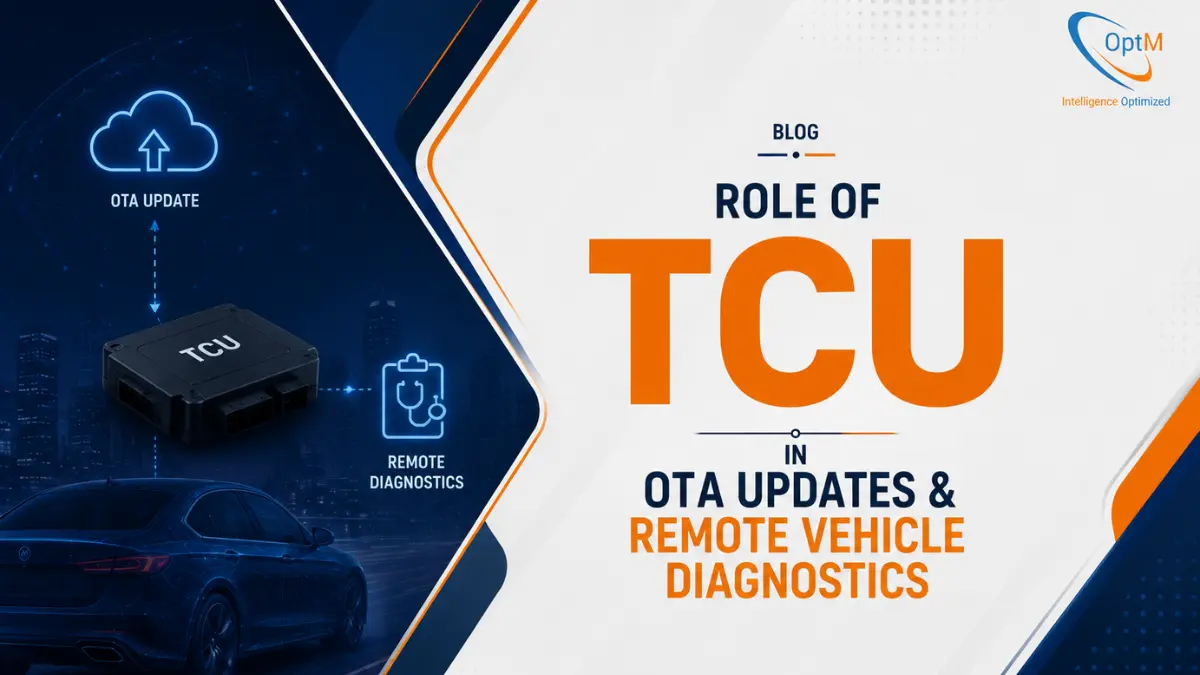
Today, that physical tether has been severed by the Telematics Control Unit (TCU). The TCU has transformed the modern vehicle from a depreciating piece of hardware into a continuously evolving, self-healing digital asset. By serving as the central orchestrator of both Over-The-Air (OTA) software updates and Remote Vehicle Diagnostics (RVD), this embedded gateway manages the vehicle's entire software lifecycle without it ever leaving the driveway or the logistics route.
The Role of the TCU in OTA and Diagnostics:
The role of a Telematics Control Unit in OTA updates and remote vehicle diagnostics is to act as the secure, bidirectional communication gateway between OEM cloud servers and the vehicle's internal Electronic Control Units (ECUs). It actively queries internal networks to extract and transmit diagnostic trouble codes to the cloud, while securely downloading, authenticating, and installing firmware updates to resolve software faults remotely.
The economic impact of this capability cannot be overstated. According to a comprehensive analysis by McKinsey & Company, deploying advanced predictive maintenance and remote diagnostic capabilities can reduce unscheduled commercial vehicle downtime by up to 50% and extend the life of aging machinery by 20%. For automotive manufacturers, the ability to push a wireless patch instead of issuing a massive physical recall saves billions of dollars annually.
However, executing an OTA update on a moving vehicle is exponentially more difficult than updating a smartphone. A dropped cellular connection during a smartphone update might force a reboot; a dropped connection while flashing an automotive powertrain module can "brick" the vehicle, rendering it useless and potentially causing a catastrophic safety failure.
Understanding exactly how this process works—how the hardware ensures absolute safety, manages cryptographic security, and executes diagnostic polling—is critical. Whether you are mapping the foundational architecture of a telematics control unit or architecting the next generation of software-defined fleets, this guide will unpack the deep engineering mechanics behind remote diagnostics and OTA orchestration.
Unpacking Over-The-Air (OTA) Updates: FOTA vs SOTA
When we discuss wireless vehicle updates, we are actually discussing two distinctly different engineering workflows: Software Over-The-Air (SOTA) and Firmware Over-The-Air (FOTA). The TCU manages both, but the stakes and the mechanics vary wildly.
Software Over-The-Air (SOTA)
SOTA refers to updating the higher-level applications that sit in the vehicle's "IT" domain. This includes updating the graphical user interface (GUI) on the infotainment screen, pushing new high-definition navigation maps, or updating the Bluetooth pairing protocols.
SOTA updates are relatively low-risk. They typically run on robust operating systems like Automotive Grade Linux (AGL) or Android Automotive. If a SOTA update fails mid-download, the radio might stop working temporarily, but the vehicle's core driving mechanics remain unaffected.
Firmware Over-The-Air (FOTA)
FOTA is the process of updating the low-level, safety-critical machine code running on deeply embedded Electronic Control Units (ECUs)—such as the Anti-lock Braking System (ABS), the Battery Management System (BMS), or the Engine Control Module (ECM).
These ECUs run on bare-metal firmware or strict Real-Time Operating Systems (RTOS). FOTA updates are incredibly high-risk. A corrupted firmware flash on the steering ECU could lead to a loss of vehicle control. Because of this, the TCU acts as a heavily fortified "Diagnostic Master Node" during a FOTA campaign.
The Mechanical Step-by-Step Execution of an OTA Campaign
An OTA update is not a single action; it is a highly orchestrated multi-stage pipeline.
- Cloud Campaign Injection & Delta Encoding: Automakers do not send the entire 5-gigabyte operating system file over the cellular network. They use "Delta Encoding" (such as bsdiff or bspatch algorithms). The cloud server compares the new software version to the old version and creates a "Delta" file containing only the specific lines of binary code that have changed. This reduces the cellular payload size by up to 90%, preserving bandwidth.
- Edge Ingestion: The TCU connects to the OEM cloud over a secure TLS 1.3 socket. It downloads the encrypted Delta file into its local non-volatile flash storage (eMMC).
- Verification Handshake: Before the TCU does anything with the file, it passes it to its internal Hardware Security Module (HSM). The HSM decrypts the package and checks its cryptographic hash (like SHA-256) against the OEM's public key. If a single bit of the file has been altered by a hacker or corrupted by a poor 5G signal, the hash will not match. The TCU will instantly quarantine the file and abort the update.
This intricate download pathway relies entirely on the quality of the underlying silicon, which is why selecting the right components for a telematics control unit is the first line of defense against OTA failures.
Ensuring Safety and Reliability During OTA Update Campaigns
Downloading the code is only the first half of the battle. Flashing that code into the vehicle's nervous system without causing a catastrophic failure requires rigorous, mechanical fail-safes.
The "Safe State" Verification Matrix
The TCU will never flash an ECU while the vehicle is in motion. Before an installation sequence begins, the TCU acts as a strict auditor. It queries the internal vehicle networks to verify a "Safe State" matrix.
- Is the KL15 (Ignition) line off? The engine must not be running.
- Is the parking brake engaged? The vehicle cannot roll.
- Is the 12V auxiliary battery charged above 70%? A voltage drop during a flash sequence will corrupt the ECU memory.
- Is the EV high-voltage contactor open? Ensuring the drivetrain is physically decoupled.
If any of these parameters fail, the TCU postpones the installation and alerts the driver.
Double-Banking (A/B Partition) Storage Architecture
What happens if the vehicle is in a safe state, the TCU begins flashing the engine ECU, and a sudden power failure interrupts the process at 50% completion? In a legacy system, that ECU is now "bricked." It contains half of the old code and half of the new code, meaning it cannot boot.
Modern TCUs solve this using "Double-Banking" or A/B Partition architecture. The target ECU is manufactured with double the required flash memory, split into Partition A and Partition B.
If Partition A is currently running the active vehicle software, the TCU sends the new OTA update exclusively to Partition B. The vehicle continues to run perfectly on Partition A while Partition B is being rewritten in the background. Once the TCU confirms that Partition B has been fully and correctly flashed, it commands the ECU's bootloader to switch its active pointer. The next time the driver starts the car, it boots from Partition B.
If the flash process to Partition B fails halfway through, the bootloader simply ignores it and continues booting from the safe, original code in Partition A. This fail-safe architecture guarantees a zero-brick OTA campaign.
Remote Vehicle Diagnostics: The Onboard Virtual Mechanic
While OTA updates allow automakers to write to the vehicle, Remote Vehicle Diagnostics (RVD) allows fleet managers and engineers to read from it. The TCU shifts the diagnostic paradigm from reactive (waiting for a part to break) to active, continuous monitoring.
Unified Diagnostic Services (UDS over IP / ISO 14229)
The primary language the TCU uses to extract health data from the vehicle is Unified Diagnostic Services (UDS), defined by the ISO 14229 standard. UDS is a client-server protocol. The TCU acts as the "Client" (the interrogator), and the individual ECUs act as the "Servers" (the responders).
The TCU is programmed to send specific hexadecimal service requests across the CAN bus. For example:
- Service $19 (Read DTC Information): The TCU routinely broadcasts this request. Any ECU experiencing an internal fault responds with its specific Diagnostic Trouble Code (DTC).
- Service $22 (Read Data By Identifier): The TCU uses this to pull live, real-time metrics, such as asking the Battery Management System for the exact temperature of battery cell #42.
When standardizing this data flow for modern cloud infrastructure, engineers frequently utilize Diagnostics over Internet Protocol (DoIP / ISO 13400). DoIP allows the TCU to package these complex UDS hexadecimal queries into standard Ethernet frames, allowing enterprise cloud servers to directly query a specific ECU inside a truck driving thousands of miles away as if the server were physically plugged into the dashboard.
The Journey of a Diagnostic Trouble Code (DTC)
Consider a commercial logistics truck hauling heavy freight up a steep mountain pass. The transmission fluid temperature begins to spike dangerously high.
- The Transmission Control Unit (a specific ECU) detects the overheating fluid and generates a pending DTC.
- The Telematics Control Unit, actively polling the network using UDS Service $19, intercepts this pending DTC.
- The TCU does not wait for the driver to notice a warning light. It immediately translates the hex code into a human-readable format, wraps it in a lightweight MQTT payload, and transmits it over the 5G network.
- The fleet dispatcher's dashboard turns red, displaying the exact fault. The dispatcher radios the driver to pull over and let the transmission cool, preventing a complete mechanical failure.
To understand how the TCU sifts through thousands of normal messages to find these critical anomalies at the network edge, you can explore the micro-mechanics of how a telematics control unit works.
Shifting from Reactive Repairs to Predictive Maintenance
The combination of continuous remote diagnostics and massive cloud computing power unlocks the holy grail of fleet management: Predictive Maintenance.
Reactive maintenance fixes things after they break. Preventative maintenance replaces parts on a strict schedule (e.g., changing oil every 10,000 miles), which often wastes money replacing perfectly good parts. Predictive maintenance uses live telemetry data to replace parts exactly when they are about to fail.
Real-World Deep Data Analytics
Because the TCU continuously feeds high-resolution sensor data to the cloud, machine learning algorithms can establish baseline performance metrics for every single vehicle in a fleet.
If a fleet operates 500 identical electric delivery vans, the cloud knows exactly how the battery voltage should respond when the van accelerates under a 2,000-pound payload. If Van #14 begins to show a micro-voltage sag that deviates from the fleet average over a three-week period, the system flags an anomaly. The battery hasn't failed, and no check-engine light is on, but the degradation signature is clear.
The fleet manager schedules Van #14 for battery service during a planned weekend downtime. The repair is made seamlessly, without interrupting a single delivery route. This level of foresight is exactly how advanced data harvesting generates direct business advantages for telematics fleets, massively driving down the Total Cost of Ownership (TCO).
Navigating the Cross-Platform Integration Landscape
A TCU cannot orchestrate OTA updates or extract UDS diagnostics if it cannot physically speak to the various components inside and outside the vehicle. It must act as a central, high-speed translator.
Inside a modern Software-Defined Vehicle, different systems run at completely different speeds. The TCU must bridge these domains smoothly. It must pull low-speed diagnostic data from legacy LIN bus connections, ingest medium-speed powertrain alerts from the CAN-FD backbone, and simultaneously route multi-gigabit OTA map updates down through the high-speed Automotive Ethernet (100Base-T1) lines directly to the infotainment unit.
If the TCU's internal processor throttles or drops packets during this complex routing, an OTA update will crash. The technical nuances of configuring this hardware to speak multiple languages without latency are immense. Engineering teams must rigorously map their automotive CAN bus, cellular modems, and cloud platforms to ensure the pipeline remains open, secure, and lightning-fast.
Security Management: Protecting the OTA Attack Surface
Opening a two-way wireless data pipe straight into the vehicle’s central nervous system is a massive security risk. If an automaker can push a braking algorithm update remotely, a sophisticated cyber-terrorist could theoretically do the same. Protecting the OTA and remote diagnostic attack surface is the single most critical mandate of the TCU.
The Internet Gatekeeper and Network Segmentation
The TCU serves as the structural firewall between public internet nodes and private vehicle logic streams. It achieves this through strict network segmentation. The architecture is designed so that the cellular modem has no direct, physical wiring path to the safety-critical CAN bus. Any data coming from the cloud must pass through the TCU’s main processor, which acts as a strict border patrol agent, inspecting every packet before deciding if it is allowed to cross into the vehicle network.
SecOC and the Silicon-Level Vault
To prevent hackers from injecting fake OTA files or spoofed diagnostic commands, the industry relies on Secure Onboard Communication (SecOC) and Hardware Security Modules (HSMs).
When the cloud sends a remote diagnostic command (e.g., "Unlock the doors"), it attaches a cryptographic signature. The TCU receives this, but its main processor cannot verify the signature alone. It passes the signature to the HSM—an isolated silicon vault on the circuit board that contains the OEM's private keys. The HSM mathematically proves that the command truly came from the automaker's authorized server and not a hacker. Because the keys are locked in silicon, they cannot be extracted by malicious software.
Overcoming these vulnerabilities is an ongoing arms race, requiring engineering teams to deeply understand and mitigate modern automotive cybersecurity defenses and connected vehicle engineering hurdles.
The Macro Connection: Shaping the Connected Mobility Landscape
The impact of seamless OTA updates and remote diagnostics extends far beyond the individual car. It is the foundational requirement for the broader connected mobility ecosystem.
Smart cities, intelligent traffic grids, and automated logistics networks rely on vehicles acting as predictable, reliable digital nodes. If a subset of vehicles in a smart city is running outdated V2X (Vehicle-to-Everything) communication software, or if a commercial fleet is ignoring failing brake sensors, the entire ecosystem becomes dangerous and inefficient.
By ensuring that millions of vehicles are continuously monitored for mechanical health and continuously updated with the latest security and safety protocols, the TCU ensures the integrity of the macro network. It is the silent enforcer that makes a cellular-based connected vehicle network mathematically and operationally viable.
The OptM Framework: Production-Ready Diagnostics and Update Engines
Designing a gateway capable of pulling UDS diagnostics, executing A/B partition OTA flashes, managing HSM cryptography, and routing 5G cloud data simultaneously requires highly specialized, industrial B2B engineering.
OptM Solutions provides the embedded development capabilities required to build these fail-safe environments. We design customized, highly secure communication gateways running Adaptive AUTOSAR stacks and optimized Embedded Linux baselines.
Our engineering teams ensure that your hardware features the necessary edge-processing power, memory layouts, and secure CAN/Ethernet bridging to deliver stable, zero-fault update campaigns. By integrating our production-ready platforms, automotive OEMs and Tier 1 suppliers can deploy deep edge analytics capabilities and comprehensive OTA management without risking hardware bottlenecks or security breaches.
Conclusion
The Telematics Control Unit has permanently altered the relationship between automakers, fleet operators, and their vehicles. By serving as the orchestrator of Over-The-Air updates and Remote Vehicle Diagnostics, the TCU ensures that a vehicle is no longer defined by the day it was manufactured, but by its capacity to improve continuously throughout its operational life.
Mastering UDS polling, Delta encoding, Double-Banking memory architectures, and HSM cryptography allows engineering teams to shift away from expensive, reactive physical maintenance and toward a highly profitable, predictive digital model.
Orchestrating safe, zero-fault firmware campaigns and deep edge diagnostics requires a hardware and software baseline engineered for continuous industrial endurance. For automotive engineering leads, Tier 1 suppliers, and fleet operations teams looking to elevate their vehicle intelligence platforms, explore how our production-ready systems streamline over-the-air deployment by reviewing OptM’s Advanced Telematics Solutions.
Frequently Asked Questions
What is the fundamental difference between FOTA and SOTA?
SOTA (Software OTA) updates user-facing applications like infotainment screens and maps. FOTA (Firmware OTA) updates the low-level, safety-critical machine code running on powertrain, braking, and steering ECUs.
How does A/B partition double-banking prevent bricked ECUs?
The ECU flash memory is split in half. The TCU downloads the new update entirely into the inactive 'B' partition while the car runs on 'A'. If the update drops at 99%, the car safely ignores 'B' and continues booting from the original 'A' code.
What specific 'Safe State' checks happen before an OTA flash?
The TCU queries the network to ensure the ignition is off, the parking brake is engaged, the EV contactor is open, and the 12V battery is above 70% charge to ensure a voltage drop doesn't corrupt the flash process.
How does the TCU use Unified Diagnostic Services (UDS)?
The TCU acts as a client, broadcasting standardized UDS hex queries across the CAN bus. If it sends Service $19, any ECU experiencing a fault will reply with its specific Diagnostic Trouble Code (DTC), which the TCU forwards to the cloud.
Why do automakers use Delta Encoding for OTA files?
Instead of sending a 5GB operating system file, the cloud compares the old and new code, generating a "Delta" file containing only the specific lines of code that changed. This shrinks the cellular payload by up to 90%.
How does DoIP (Diagnostics over IP) change vehicle maintenance?
DoIP packages complex diagnostic hex queries into standard Ethernet frames. This allows enterprise cloud servers to directly query a specific engine ECU inside a truck driving remotely as if the server were physically plugged into the dashboard.
Can a hacker intercept an OTA update mid-download?
Even if intercepted, the file is useless. The TCU's Hardware Security Module (HSM) checks the file's cryptographic hash (SHA-256) against the OEM's public key. If a single bit was altered, the TCU instantly quarantines the file and aborts the update.