
Content Writer & SEO Specialist
Content Writer & SEO Specialist
Aditya Sharma is a content writer at OptM Solutions specializing in automotive electronics, embedded systems, telematics, electric vehicle technologies, connected mobility, and autonomous driving technologies.
LinkedIn ProfileFor years, the automotive and logistics industries viewed vehicle tracking devices simply as a cost of doing business. You installed a basic GPS tracker to see where a delivery truck was, and that was the end of it.
Today, that mindset is completely outdated. Modern vehicles are essentially rolling computers, and the hardware that connects them to the internet is the single most important investment a company can make. We have shifted from asking, "How much does it cost to track this vehicle?" to "How much money can this vehicle save us, and how can it generate new revenue?"
If you are new to this technology, reading our foundational guide on What is Telematics Control Unit will show you that this device is the central communication hub of the car. Once you understand the hardware, the financial advantages become incredibly clear.
What are the Tangible Benefits of a Telematics Control Unit?
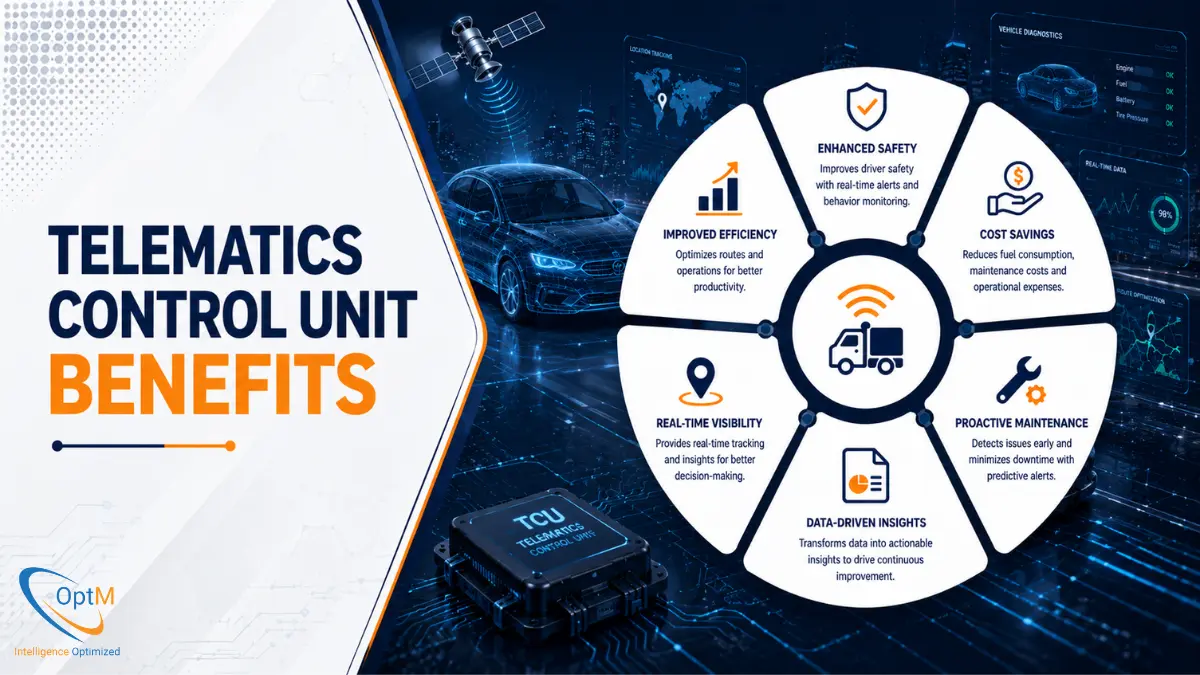
The primary benefits of a Telematics Control Unit (TCU) include drastic reductions in fleet fuel consumption, the elimination of costly physical dealership recalls through remote software updates, extended vehicle lifespans via predictive maintenance, and the creation of post-sale software subscription revenues for automakers.
The financial impact is proven. According to comprehensive market research by Berg Insight, implementing advanced fleet telematics reduces overall fuel consumption by 10% to 15% and can decrease vehicle idle times by up to 30%.
To make this technology easy to understand, we have divided the benefits based on exactly who experiences them. Whether you are an automaker building the car, a fleet manager routing trucks, or a safety officer lowering insurance costs, here are the clear, real-world benefits of a TCU.
Key Benefits for Automakers (OEMs) and Tier 1 Suppliers
When a vehicle leaves the manufacturing plant, the automaker's relationship with that car used to be mostly over—until something broke. Today, automakers (OEMs) use TCUs to fundamentally change their business models, turning a one-time hardware sale into a continuous, profitable digital relationship.
Benefit 1: Reducing Warranty and Recall Costs via Remote OTA Updates
Historically, if an automaker discovered a software bug that caused the infotainment screen to freeze, they had to issue a physical recall. Millions of customers had to drive their cars to a dealership, and the automaker had to pay the dealership mechanics for their time. A single software recall could easily cost an OEM hundreds of millions of dollars.
- How the TCU solves this: The TCU manages the secure downloading and installation of software patches over the cellular network.
- The ROI: What used to be a $500-per-vehicle physical recall is now a $0.50 cellular data transfer. The automaker patches the bug while the car is parked in the owner's driveway overnight. You can explore exactly how this secure flashing process works in our guide on the Role of TCU in OTA Updates and Remote Vehicle Diagnostics.
Benefit 2: Generating New Revenue through Post-Sale Software Subscriptions
Automakers are no longer limited to the money they make on the day the car is sold. TCUs allow them to sell digital upgrades over the lifespan of the vehicle.
- How the TCU solves this: Think of it like downloading a new app on your phone. If a driver decides they want heated seats, advanced driver-assistance systems (ADAS), or a premium navigation package, they can purchase it via a smartphone app.
- The ROI: The automaker sends a signal to the TCU, and the TCU unlocks the software-limited feature inside the car. This creates a massive, recurring revenue stream for automakers that never existed before.
Benefit 3: Improving Future Vehicle Designs using Real-World Data
Automotive engineers no longer have to guess how their cars are performing in the real world.
- How the TCU solves this: The TCU aggregates anonymized data from millions of vehicles. Engineers can see exactly how a specific brake pad wears down in the extreme cold of Canada versus the extreme heat of Arizona.
- The ROI: This real-world, crowdsourced telemetry data is fed directly back into the Research & Development (R&D) process, allowing automakers to design next-generation vehicles that are safer, cheaper to build, and more reliable.
Key Benefits for Commercial Fleet Operators
For commercial logistics companies, delivery services, and public transport systems, profit margins are notoriously thin. The Total Cost of Ownership (TCO) for a commercial truck includes fuel, maintenance, and driver wages. The TCU is the ultimate tool for driving these operational costs down.
Benefit 4: Lowering Fuel Costs by Reducing Engine Idling
Fuel is typically the largest variable expense for any fleet. A TCU does much more than just tell you how much fuel is in the tank; it tells you how that fuel is being wasted.
- How the TCU solves this: A common problem in logistics is "engine idling"—when a driver leaves the truck running while parked to keep the cabin warm. A TCU monitors exactly how many hours a week a truck spends idling.
- The ROI: Fleet managers can use this data to coach drivers or set automatic engine shut-offs, saving thousands of gallons of diesel fuel across a large fleet every single month.
Benefit 5: Preventing Expensive Breakdowns with Predictive Maintenance
For decades, the standard approach to vehicle maintenance was "run until it breaks." When a commercial truck breaks down on the side of the highway, the costs are staggering. The fleet operator pays for an emergency tow, rush-ordered parts, and loses roughly $800 to $1,000 per day in missed deliveries.
- How the TCU solves this: The TCU acts as an onboard doctor that never sleeps. By constantly monitoring the vehicle's internal nervous system, it spots tiny symptoms of failure long before the vehicle breaks down. If the transmission fluid runs 5 degrees hotter than normal for a week, the TCU flags it.
- The ROI: The fleet manager gets an alert to bring the truck in for service on a Friday. The repair is scheduled during planned downtime, parts are ordered at standard prices, and a catastrophic highway breakdown is completely avoided. You can see how the unit calculates these specific thresholds in the article detailing Telematics Control Unit Functions.
Benefit 6: Optimizing Delivery Routes to Avoid Traffic and Delays
Traffic jams cost money. While a standard smartphone GPS helps a driver navigate, an enterprise TCU feeds live location data directly into a company's central dispatch system.
- How the TCU solves this: If a severe weather event shuts down a highway, the fleet manager's dashboard instantly identifies all company trucks heading toward the gridlock.
- The ROI: Dispatchers can dynamically reroute those trucks in real-time, ensuring on-time deliveries and happy customers. To understand how the hardware maps this location data seamlessly, first understand breakdown of TCU Integration with CAN Bus, GPS, LTE/5G and Cloud Platforms.
Benefit 7: Automating Compliance (ELD) and Fuel Tax Reporting (IFTA)
The transportation industry is heavily regulated. Keeping track of driver hours and fuel taxes manually using paper logs causes massive administrative headaches and human errors.
- How the TCU solves this: The TCU automatically records exactly when the vehicle's engine turns on, when it moves, and when it stops. It also uses hyper-accurate GPS to log exactly how many miles were driven in specific tax jurisdictions.
- The ROI: This ensures absolute compliance with federal Hours of Service (HoS) regulations, protecting the company from massive fines. What used to take accounting teams days of sorting through driver receipts is now compiled into an automated, error-free fuel tax report at the end of the month.
Key Benefits for Safety and Risk Management
Protecting human life is the most important benefit of connected vehicle technology. Beyond the moral imperative, improving safety directly reduces corporate liability and expensive insurance claims.
Benefit 8: Lowering Insurance Premiums through Driver Safety Scoring
Dashboard cameras are great for seeing what happened after an accident, but TCUs help prevent the accident from happening in the first place.
- How the TCU solves this: The TCU cross-references its internal motion sensors with the vehicle's pedals and steering wheel. It knows exactly when a driver slams on the brakes, takes a corner too fast, or accelerates dangerously. This data is compiled into a "Safety Score" for each driver.
- The ROI: Fleet managers can provide targeted safety training to risky drivers. Furthermore, many insurance providers offer "Usage-Based Insurance" (UBI). By sharing your fleet's safe driving data, companies frequently see their commercial insurance premiums slashed by up to 20%.
Benefit 9: Saving Lives with Automated Emergency Crash Response (eCall)
If the worst does happen and a vehicle is involved in a severe crash, every second counts.
- How the TCU solves this: If the airbags deploy, the TCU instantly interrupts all other functions and automatically dials emergency services. It transmits the exact GPS location, the direction the vehicle was traveling, and the severity of the impact.
- The ROI: According to research published by the National Highway Traffic Safety Administration (NHTSA), the integration of advanced telematics and automated crash notification systems can reduce emergency response times significantly, increasing the survival rate of severe crash victims.
Key Benefits for Electric Vehicles (EVs)
As the automotive industry transitions to electric mobility, the TCU transitions from being a helpful tool to an absolute necessity. Electric vehicles (EVs) operate differently than gas vehicles, and managing them requires deep, real-time data insights.
Benefit 10: Eliminating Range Anxiety with Accurate Battery Tracking
In a gas car, the fuel gauge is fairly simple. In an EV, how far you can drive is heavily affected by outside temperature, the weight of the cargo, and the steepness of the hills on the route.
- How the TCU solves this: The TCU constantly monitors these variables and feeds the battery data to the cloud.
- The ROI: It provides fleet dispatchers with highly accurate, real-time range estimations. A dispatcher will never mistakenly assign a delivery route to an EV truck that doesn't have enough battery to complete the round trip, completely eliminating "range anxiety."
Benefit 11: Extending Battery Life through Thermal Management Monitoring
An EV battery pack is the single most expensive component in the vehicle. Extreme heat or extreme cold can permanently damage the battery cells.
- How the TCU solves this: The TCU continuously monitors the temperature of individual battery cells.
- The ROI: If it detects a cell overheating during a high-speed fast-charging session, it communicates with the charging station to slow down the power flow. This protects the battery's lifespan, saving the company from a $15,000 battery replacement, and ensures the vehicle remains safe.
The OptM Engineering Advantage: Securing Your ROI
It is important to remember a vital reality: none of these benefits are achievable if the hardware breaks down.
A cheap, aftermarket tracking dongle might save a few dollars upfront, but it will overheat, drop cellular connections, and fail to process the data accurately. Realizing the massive ROI of connected mobility requires production-ready, professional B2B engineering.
At OptM Solutions, we design highly robust vehicle gateways built for industrial endurance. By integrating secure hardware and frictionless communication systems, we ensure that fleet data is captured accurately, encrypted safely, and transmitted securely. Whether you are managing advanced commercial logistics or developing electric vehicle powertrains, our hardware ensures that your telematics investment translates directly into operational excellence. To understand the deep engineering that powers these capabilities, understanding core Working of Telematics Control Unit is very crucial.
Conclusion
The Telematics Control Unit has fundamentally changed the economics of the automotive world. It is an active revenue generator and the ultimate tool for cost reduction.
By making headings easy to scan and breaking down the benefits by stakeholder, it is clear that the ROI of a high-performance TCU heavily outweighs its initial cost. It transforms raw vehicle data into structured, actionable business intelligence for automakers, fleet managers, and safety officers alike.
Realizing the full financial and operational benefits of connected mobility requires hardware built for the realities of the road. For automakers, Tier 1 suppliers, and fleet operators looking to optimize their vehicle architectures, explore how our secure, low-latency communication gateways drive tangible ROI on the OptM Telematics Control Unit product page.
Frequently Asked Questions
How exactly does a TCU reduce commercial fleet fuel consumption?
By monitoring the exact duration of engine idling, detecting inefficient aerodynamic drag, and flagging harsh acceleration, fleet managers can use TCU data to correct driver behavior, typically cutting fuel waste by 10% to 15%.
Are OTA updates financially cheaper than traditional physical recalls?
Drastically. A physical dealership recall involves technician labor, logistics, and loaner cars, costing OEMs hundreds of dollars per vehicle. An OTA firmware patch costs mere cents in cellular data transfer fees.
How does Usage-Based Insurance (UBI) leverage TCU hardware?
Insurance companies assess risk based on actual driving physics. By sharing the TCU’s hard data on safe braking, cornering, and speed compliance, fleet operators can prove their safety record and secure up to 20% lower premiums.
What is the typical ROI timeline for installing advanced TCUs in a fleet?
For commercial fleets, ROI is often realized within 6 to 12 months. The immediate savings generated by eliminated towing fees (via predictive maintenance) and automated fuel tax reporting quickly offset the initial hardware investment.
Can automakers use TCUs to sell software features post-purchase?
Yes. Automakers can build a car with hardware for heated seats or ADAS, but lock them in software. The TCU allows users to purchase subscriptions later, unlocking these features remotely and creating recurring revenue for OEMs.
How does the TCU eliminate range anxiety in Electric Vehicles?
Instead of guessing range based strictly on battery percentage, the TCU calculates it dynamically by fusing live State-of-Charge (SoC) data with cloud metrics like upcoming route topography, payload weight, and real-time weather conditions.
Does the TCU assist with federal transport compliance?
Yes, TCUs act as the backbone for Electronic Logging Devices (ELDs). They automate Hours of Service (HoS) tracking to ensure drivers rest legally, protecting companies from massive federal compliance audits and fines.