
Content Writer & SEO Specialist
Content Writer & SEO Specialist
Aditya Sharma is a content writer at OptM Solutions specializing in automotive electronics, embedded systems, telematics, electric vehicle technologies, connected mobility, and autonomous driving technologies.
LinkedIn ProfileWhen we discuss the evolution of modern connected mobility, it is easy to get caught up in the sheer processing power of individual microchips or the speed of 5G cellular modems. However, while hardware components are the essential building blocks, the architecture is the master blueprint. If you take the world's fastest processor and pair it with the fastest cellular modem but wire them together using a flawed design, the entire system will bottleneck. The architecture determines whether a vehicle operates as a seamless, high-speed digital ecosystem or a clunky, unreliable liability.
Before diving deep into the structural layout, it is helpful to understand the foundational concept of What is a Telematics Control Unit. Once you recognize that this device is the central bridge between a car and the cloud, you can appreciate why its internal design is so critical.
What is Telematics Control Unit Architecture?
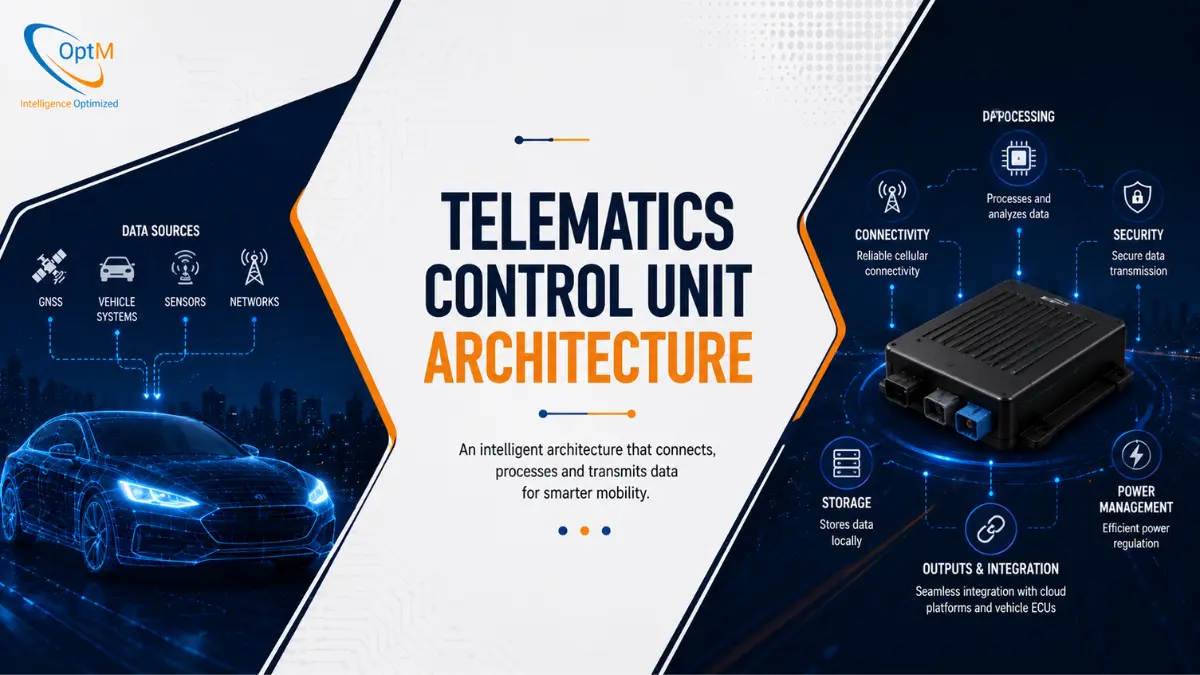
Telematics Control Unit Architecture is the structural framework that dictates how a vehicle's communication hardware, operating systems, and edge-computing software interact. A robust architecture strictly decouples safety-critical vehicle networks from cloud-facing cellular modems, ensuring high-speed data routing without compromising core automotive safety.
The financial and operational stakes behind this architectural shift are monumental. As the industry transitions toward Software-Defined Vehicles (SDVs), the underlying electrical and electronic (E/E) architectures must support massive data volumes. According to global research by McKinsey & Company, this transition toward centralized E/E architectures and connected mobility will drive the automotive software market to expand rapidly, reaching projected revenues of $80 billion by 2030.
In this comprehensive guide, we will break down the layered E/E architecture of a modern Telematics Control Unit (TCU). We will explore how engineers decouple hardware from software, balance extreme data throughput with rigorous safety standards, and build the foundation that will power the next decade of intelligent transportation.
The Macro View: Decoupling Hardware and Software
To understand why modern TCU architecture is designed the way it is, we must look at the problem it was built to solve: the monolithic legacy system.
The Problem with Legacy Systems
In early automotive telematics, the hardware and software were permanently intertwined. If an Original Equipment Manufacturer (OEM) bought a tracking unit from a supplier, the software was written explicitly for that exact physical circuit board. If the cellular network evolved from 3G to 4G, or if the automaker wanted to upgrade to a faster processor, they could not simply update the code. They had to throw the entire physical box away, buy a newly designed box, and rewrite all the software from scratch.
This monolithic approach was acceptable when TCUs only sent a GPS ping once every ten minutes. However, in an era where vehicles process gigabytes of data per hour and require continuous security patches, this approach creates massive financial bottlenecks.
The Modern 4-Tier Stack
To solve this, modern TCU architecture relies on a "Layered Architecture" approach. By breaking the system into distinct, isolated tiers, engineers can update or swap one layer without destroying the others. The standard architecture is built on four distinct pillars:
- Physical Hardware: The actual silicon chips, circuit boards, and antennas.
- Hardware Abstraction Layer (HAL): The software wrapper that translates universal commands into the specific electrical signals required by the silicon.
- Middleware & Operating System (OS): The core brains managing memory, processes, and network security.
- Upper Application Layer: The specific programs running fleet analytics, edge diagnostics, and cloud communications.
The Business Value for OEMs
This decoupled architecture prevents "vendor lock-in." If a global supply chain shortage makes a specific NXP or Qualcomm processor unavailable, the automaker can switch to a different supplier's chip. Because the layers are decoupled, the engineering team only has to tweak the Hardware Abstraction Layer; the millions of lines of complex application code running on top remain completely untouched. This architectural flexibility saves automakers years of engineering time and millions of dollars in redesign costs.
Tier 1: The Physical Hardware Architecture (The Silicon Foundation)
The lowest level of the architecture is the physical printed circuit board (PCB). Designing this layer requires balancing extreme data throughput with the incredibly harsh physical environment of a moving vehicle.
System-on-Chip (SoC) vs. Discrete Components
Historically, TCUs were built using discrete components—meaning the main processor, the memory, and the network controllers were all separate physical chips spread out across a large board.
Modern architectures utilize highly integrated System-on-Chip (SoC) designs. An SoC combines a Central Processing Unit (CPU), a Graphics Processing Unit (GPU) for display handling, and a Neural Processing Unit (NPU) for running Artificial Intelligence algorithms, all onto a single piece of silicon. This tight integration drastically reduces the physical footprint of the TCU while massively increasing the speed at which data travels between the processing cores.
The Asymmetric Processing Layout
A critical architectural choice is how processing power is distributed. You cannot rely on a single processor to do everything. Modern TCUs feature an asymmetric physical layout:
- The Application Processor: A high-power, multi-core engine designed to do the heavy lifting, such as compressing video files or packaging large data payloads for the cloud.
- The System Microcontroller (MCU): A low-power, hyper-reliable chip that never turns off. It constantly monitors the vehicle's ignition state and manages basic safety interrupts.
By physically separating these two brains, the architecture ensures that if the heavy-lifting processor freezes while downloading a large file, the low-power MCU remains active and can safely reset the system without losing vehicle control data. To explore the exact chips and silicon layouts used in these designs, you can review our deep dive into the Components of Telematics Control Unit.
Thermal and Spatial Architecture
From a physical design perspective, heat is the enemy of architecture. A 5G cellular modem pushing maximum bandwidth generates significant thermal energy. However, because TCUs are often mounted inside dusty commercial truck chassis or sealed behind passenger car dashboards, engineers cannot use mechanical cooling fans (which fail when clogged with dust).
The physical architecture must facilitate passive thermal conduction. Engineers design the PCB to draw heat away from the 5G modem and transfer it into the TCU's die-cast aluminum enclosure. The metal box itself becomes a giant heatsink, dissipating the thermal load safely into the surrounding air.
Tier 2: The Hardware Abstraction Layer (HAL)
Directly above the physical silicon sits the most crucial, yet invisible, architectural component: the Hardware Abstraction Layer (HAL).
What is the HAL?
Think of the HAL as a universal translator. Every physical microchip speaks a slightly different electrical language. If the upper-level software wants to turn on the cellular modem, it shouldn't have to know the exact voltage or pin configuration of that specific modem.
The HAL wraps around the hardware drivers. It provides a standardized menu of commands (Application Programming Interfaces, or APIs) to the upper software. When the software says "Turn on Modem," the HAL receives that generic command and translates it into the highly specific binary code required by whichever physical modem happens to be soldered to the board.
Standardization (AUTOSAR)
In the automotive world, the HAL is heavily governed by global standards, the most prominent being AUTOSAR (Automotive Open System Architecture).
Adaptive AUTOSAR is an architectural framework developed by a consortium of the world's leading automakers and Tier 1 suppliers. It provides a standardized software architecture for high-performance computing platforms in vehicles. Adhering to AUTOSAR standards is mandatory for modern E/E architectures because it ensures interoperability. If an OEM purchases a TCU from OptM, the OEM's proprietary fleet management applications will run flawlessly on our hardware because the AUTOSAR-compliant HAL acts as a standardized bridge between the two.
Tier 3: The Dual-OS Software Architecture (Linux + RTOS)
Because the TCU operates as both an internet-connected computer and a safety-critical automotive component, a single operating system is insufficient. The architecture must deploy a dual-OS strategy.
The Concept of Asymmetric Multiprocessing (AMP)
Asymmetric Multiprocessing (AMP) is an architectural approach where two completely different operating systems run side-by-side on the same physical hardware, completely isolated from one another. This ensures that the tasks of one OS do not interfere with the tasks of the other.
The Embedded Linux Domain
The first domain runs a rich operating system, typically a highly customized version of Embedded Linux or Automotive Grade Linux (AGL). This domain is dedicated to heavy data lifting and broad connectivity.
The Embedded Linux architecture manages the complex TCP/IP network stacks required for 5G internet routing. It runs the predictive maintenance algorithms, manages secure cloud connections using TLS 1.3 encryption, and handles the compression of massive Protocol Buffer payloads. Linux is powerful and flexible, making it ideal for the "IT" side of the vehicle.
The Real-Time Operating System (RTOS) Domain
The second domain runs a Real-Time Operating System (RTOS), such as QNX or FreeRTOS. This domain is dedicated to absolute, deterministic safety.
In an RTOS, tasks are guaranteed to execute within a precise number of microseconds. If the vehicle is involved in a crash, the RTOS must instantly capture the airbag deployment signal and trigger the eCall emergency response system. It cannot wait for a background cloud download to finish.
The architecture strictly isolates these two domains. If the Embedded Linux side crashes because of a corrupted cloud file, the RTOS side continues running flawlessly, ensuring that critical vehicle safety functions are never compromised. To understand exactly how these two operating systems pass data back and forth internally, read our step-by-step breakdown of Telematics Control Unit Working.
The Vehicle Network Interface Architecture
The TCU is only as valuable as the data it can extract from the car. The Network Interface Architecture is the gateway between the TCU's internal processors and the vehicle's vast internal nervous system.
Isolated Bus Architecture
A modern vehicle contains multiple separate network buses. There is a bus for the infotainment system (controlling the radio and air conditioning), a bus for the powertrain (controlling the engine and transmission), and a bus for the ADAS (controlling the cameras and automatic braking).
A secure TCU architecture never connects all these systems to a single wire. It utilizes an isolated bus architecture. The TCU features multiple physical transceiver ports, connecting independently to each network. This physical separation ensures that if a hacker manages to compromise the infotainment network through a rogue Bluetooth connection, they cannot cross over and access the safety-critical steering or braking networks.
Handling the Bandwidth Spectrum
The architecture must seamlessly route and ingest data arriving at vastly different speeds and volumes:
- Low-Speed Data (LIN Bus): Used for simple, non-critical status tracking, like confirming that the passenger door is locked or the mirrors are folded.
- Medium-Speed Data (CAN-FD & J1939): The heavy lifter for engine telemetry. CAN-FD (Flexible Data-rate) can push up to 8 Megabits per second, allowing the TCU to ingest hundreds of diagnostic trouble codes, RPM metrics, and fuel pressure readings simultaneously.
- Ultra-High-Speed Data (Automotive Ethernet): Standard CAN lines choke when trying to transmit raw video feeds from ADAS cameras or high-resolution LiDAR point clouds. Modern architectures incorporate Automotive Ethernet (100Base-T1 / 1000Base-T1) switches, utilizing a single twisted pair of copper wires to move gigabits of raw sensor data per second.
Wireless Communication & RF Architecture
Once data is extracted from the vehicle, it must be transmitted. Architecting the TCU's connection to the outside world is an exercise in extreme radio frequency (RF) management.
Multi-Radio Coexistence
A modern TCU is packed with transmitters. It must house a 5G cellular modem, a Wi-Fi 6 router for depot offloading, a Bluetooth Low Energy (BLE) chip for smartphone digital keys, and a multi-constellation GNSS receiver for satellite tracking.
The architectural challenge is "Coexistence." If all these radios transmit at the exact same time inside a tiny metal box, the radio waves will interfere with each other, causing dropped packets and severe signal degradation. The RF architecture utilizes complex band-pass filters and intelligent time-division multiplexing. This means the system synchronizes the radios at the microsecond level—for example, pausing the Wi-Fi transmission for a fraction of a millisecond while the 5G modem sends an urgent packet, ensuring absolute signal clarity.
Smart Antenna Architecture
Historically, cars used a single "whip" antenna. Today, TCU architectures utilize MIMO (Multiple Input, Multiple Output) antenna arrays, often housed in the "shark fin" on the vehicle's roof.
MIMO architecture uses multiple physical antennas to send and receive multiple data streams simultaneously on the same radio channel. As a vehicle drives down a highway at 120 km/h, the signal bounces off buildings and mountains. The TCU's baseband processor instantly analyzes these bouncing signals and recombines them, maximizing throughput and preventing dropped connections during high-speed cell tower handovers.
Power Architecture & State Management
A TCU must remain vigilant even when the car is turned off, but it cannot drain the 12V battery and leave the driver stranded. The invisible power grid that keeps the TCU alive is a masterclass in electrical efficiency.
The Power Management IC (PMIC) Hierarchy
The vehicle's alternator delivers a messy, fluctuating 12V to 14V power supply. The TCU's Power Management Integrated Circuit (PMIC) sits at the top of the power hierarchy. It acts as an electrical dam, taking this raw, dirty voltage and precisely stepping it down into the clean, perfectly regulated voltages required by the microchips (e.g., 3.3V, 1.8V, and 1.2V).
Sleep, Wake, and Deep-Standby States
The architecture dictates strict "state management." When the driver turns off the ignition (dropping the KL15 wire voltage), the PMIC initiates a controlled shutdown.
- It saves all critical data to the non-volatile flash memory.
- It completely cuts power to the massive 5G modem and the Embedded Linux application processor.
- It drops the system into a "Deep-Standby" state, pulling only a few micro-amps of power.
However, the TCU is never truly dead. A tiny, ultra-low-power micro-controller remains awake, listening. If a fleet manager sends a remote command to unlock the doors, or if the accelerometer detects a severe impact while parked, this micro-controller instantly triggers the PMIC to wake up the main processor and boot the system back to full power in seconds. To see how this precise power management translates into real-world business value, such as pre-conditioning an EV battery before a trip, explore our article on Telematics Control Unit Benefits.
Security Architecture: "Secure by Design"
Because the architecture serves as the physical bridge between the public internet and the vehicle's internal brakes and steering, cybersecurity work cannot be an afterthought. It must be woven into the silicon from day one.
The Hardware Root-of-Trust
Software firewalls are not enough; a hacker can eventually rewrite software. True security architecture relies on a "Hardware Root-of-Trust."
This is achieved using a Hardware Security Module (HSM). The HSM is a physically isolated silicon die on the circuit board that acts as an impenetrable vault. It stores the vehicle's unique cryptographic keys and digital certificates. When the TCU needs to encrypt a data payload or verify an incoming command, it passes the data to the HSM. The keys never leave the vault, meaning that even if a hacker breaches the Embedded Linux OS, they cannot steal the keys required to take control of the vehicle.
Secure Boot Architecture
The architecture protects against unauthorized code modifications through a sequence called "Secure Boot."
When the TCU powers on, it does not just immediately load the operating system. First, the unalterable hardware checks the digital signature of the bootloader. If the signature is valid, the bootloader starts and checks the signature of the OS kernel. The OS kernel then checks the signatures of the upper-layer applications. If at any point in this chain a signature fails—meaning a hacker has tampered with the code while the car was turned off—the system halts the boot process, quarantines the corrupted software, and falls back to a safe, verified backup image.
The OptM Architectural Advantage: Built for Production
Designing an E/E architecture that successfully balances gigabit data throughput, deterministic real-time safety, strict power budgets, and military-grade cryptography is not a task for generic, off-the-shelf consumer electronics. It requires production-ready, industrial B2B engineering.
OptM Media Solutions specializes in architecting highly scalable, Adaptive AUTOSAR-compliant E/E platforms that serve as the backbone for next-generation mobility. By leveraging highly optimized Embedded Linux baselines alongside secure Asymmetric Multiprocessing (AMP) layouts, we give automotive OEMs and Tier 1 suppliers the freedom to innovate without worrying about hardware bottlenecks.
Our architectures ensure that whether you are managing advanced Role of TCU in Connected Vehicle Ecosystems or deploying fleet-wide OTA updates, the data flows seamlessly, securely, and with zero frame drops. OptM builds the invisible foundation that allows automakers to realize the true revenue potential of software-defined vehicles.
Conclusion & Next Steps
The architecture of the Telematics Control Unit is the true foundation of the modern software-defined vehicle. While microchips provide the raw computing power, the layered architecture dictates the vehicle's lifespan, its resilience against cyberattacks, and its capacity to handle the exponential data loads of tomorrow.
A tightly coupled, monolithic system will severely limit an automaker's ability to compete in the connected mobility market. In contrast, a decoupled, dual-OS architecture built on rigorous AUTOSAR standards and hardware-level security provides a future-proof platform for continuous innovation. Understanding these intricate architectural realities is critical to overcoming the complex Challenges in Telematics Control Unit Development.
For automotive engineering teams, Tier 1 suppliers, and product managers, transitioning to a centralized, software-defined vehicle requires an architectural foundation that will not bottleneck your growth. Explore the deep architectural specifications, custom Linux baselines, and integration capabilities of our production-ready gateway on the OptM Telematics Control Unit product page.
Frequently Asked Questions
What does "decoupling hardware and software" mean in TCU architecture?
It means separating the physical silicon from the upper-layer applications using an abstraction layer. This allows automakers to swap out a cellular modem or processor without having to rewrite millions of lines of fleet management software.
Why is Adaptive AUTOSAR compliance critical for OEMs?
Adaptive AUTOSAR provides a globally standardized software framework. It ensures that software applications written by different Tier 1 suppliers will interface flawlessly with the TCU hardware, preventing vendor lock-in.
How does the architecture prevent infotainment hackers from accessing the brakes?
Through physical isolated bus architecture. The TCU features separate physical transceivers for the infotainment CAN and the safety CAN. This hardware separation acts as an unbridgeable firewall for malicious network traffic.
How does the physical metal enclosure act as a heat sink?
Because cooling fans fail in dusty environments, the PCB uses thermal vias to wick heat away from the 5G processor, transferring it into a die-cast aluminum enclosure which safely radiates the thermal load into the ambient air.
What is the exact role of the Hardware Abstraction Layer (HAL)?
The HAL is a software wrapper that translates universal application commands (like "Turn on Modem") into the highly specific, proprietary electrical signals required by whatever physical silicon chip is currently soldered to the board.
How does Secure Boot architecture protect the vehicle upon startup?
Secure Boot is a chain of trust. The unalterable hardware verifies the bootloader's digital signature, the bootloader verifies the OS, and the OS verifies the applications. If any code was tampered with while parked, the boot process halts.
How does the architecture route multi-gigabit video sensor data?
Standard CAN lines cannot handle video. Modern architectures incorporate Automotive Ethernet (100Base-T1) switches, utilizing a single twisted pair of copper wires to move gigabits of raw sensor and ADAS data into the processor without bottlenecks.