
Content Writer & SEO Specialist
Content Writer & SEO Specialist
Aditya Sharma is a content writer at OptM Solutions specializing in automotive electronics, embedded systems, telematics, electric vehicle technologies, connected mobility, and autonomous driving technologies.
LinkedIn ProfileFor decades, an automobile was essentially an isolated piece of machinery. Once it drove off the dealership lot, its only relationship with the outside world was physical: tires on the pavement and gas in the tank. Today, that isolation is over. Modern cars, trucks, and commercial fleets are highly collaborative digital entities. They participate actively in smart cities, automated logistics chains, and shared mobility networks.
However, a vehicle cannot simply connect to a smart city traffic grid on its own. It requires a highly secure, centralized gateway to manage the massive flow of incoming and outgoing data. This is where the Telematics Control Unit becomes the most critical piece of hardware in the entire automotive framework.
To fully grasp the scope of this transformation, it is essential to start by understanding what is a telematics control unit. Once you recognize that this hidden black box is responsible for bridging internal engine computers with the public internet, you realize that it acts as the primary orchestrator of the entire connected ecosystem.
The Connected Ecosystem Visualized
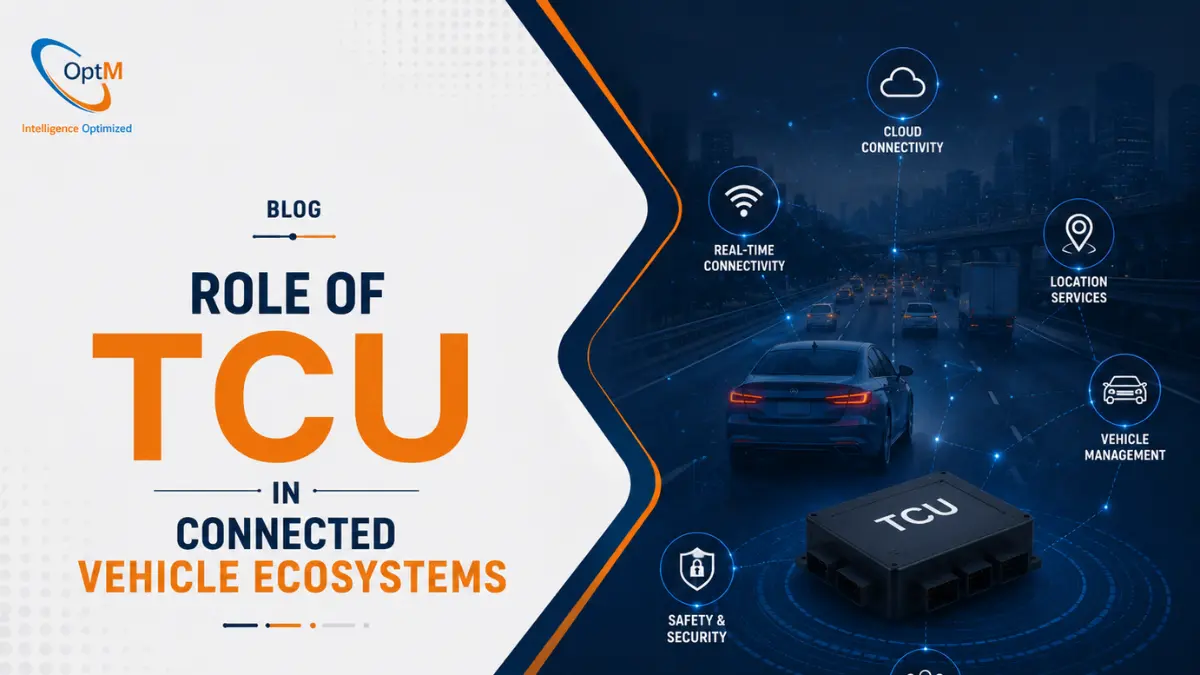
A connected vehicle ecosystem is a continuous digital loop. The TCU pulls live diagnostic data from the engine and battery, processes it at the edge, and transmits it via 5G to enterprise cloud servers. Simultaneously, the TCU receives incoming data from surrounding vehicles, smart traffic lights, and fleet dispatchers, feeding that intelligence back into the car’s braking, steering, and navigation systems.
The financial scale of this digital transformation is staggering. According to comprehensive market analysis by Grand View Research, the global Automotive Vehicle-to-Everything (V2X) market size is projected to grow to over $155 Billion by 2030, surging at an incredible Compound Annual Growth Rate (CAGR) of 42.2%. This growth is driven almost entirely by the rapid deployment of cellular connected gateways inside both passenger and commercial vehicles.
In this deep dive, we will explore exactly how the vehicle communication gateway operates as the ultimate anchor for modern smart cities, electric vehicle fleets, and automated transportation networks.
1. The Macro Ecosystem: Understanding V2X (Vehicle-to-Everything)
The true value of a connected vehicle is not just its ability to talk to a fleet manager's dashboard; it is the ability to talk to its immediate environment in real-time. This concept is broadly known as V2X (Vehicle-to-Everything), and it is fundamentally changing road safety and traffic efficiency. According to Global Market Insights, over 70% of new connected vehicles launched in 2024 already feature cellular V2X capabilities. Behind the scenes, this entire communication layer relies entirely on the underlying telematics control unit functions running flawlessly to process these external radio signals.
Vehicle-to-Vehicle (V2V) Communication
Think of V2V as a continuous, invisible conversation happening between cars on the highway. A TCU equipped with a 5G Ultra-Reliable Low-Latency Communication (URLLC) modem broadcasts its exact speed, heading, and braking status up to ten times per second to all vehicles within a 300-meter radius.
If a truck two lanes over and a quarter-mile ahead suddenly slams on its brakes due to an obstruction, you cannot physically see it. But that truck’s TCU instantly broadcasts a "Hard Braking Alert." Your TCU receives this signal instantly. Before your human eyes even register the brake lights ahead, your TCU flashes a warning on your dashboard or interfaces with your Advanced Driver Assistance Systems (ADAS) to begin pre-charging your brakes. V2V effectively eliminates blind-spot collisions and multi-car pileups by giving vehicles a digital sixth sense.
Vehicle-to-Infrastructure (V2I) Systems
V2I connects the vehicle directly to the physical road environment. Cities are upgrading traffic lights, electronic toll booths, and construction barriers with small roadside radio units.
When a connected car approaches a smart intersection, the traffic light broadcasts its phase timing (e.g., "I will turn red in exactly 4.2 seconds"). The TCU ingests this data, calculates the vehicle's current speed and distance, and determines if the car can safely make it through. If it calculates a red-light violation is imminent, it warns the driver to slow down. Similarly, V2I allows ambulances to broadcast a signal to upcoming traffic lights, forcing them to turn green and clearing the intersection before the ambulance arrives.
Vehicle-to-Network (V2N) and Vehicle-to-Pedestrian (V2P)
V2N utilizes standard cellular routing to connect the car to macro-analytics. It pulls down high-definition weather maps, reporting that a severe ice storm is moving across the route 50 miles ahead, allowing the navigation system to reroute the driver.
V2P is an emerging safety protocol. It allows the TCU to pick up localized cellular or Bluetooth signals from the smartphones of pedestrians or cyclists. If a delivery truck is backing out of a blind alley and a cyclist is approaching rapidly, the TCU detects the proximity of the cyclist’s phone and halts the truck automatically, protecting vulnerable road users.
2. Optimizing Commercial Fleets and Intelligent Logistics
In the commercial sector, a vehicle operating in isolation is a massive liability. Transport assets must be tightly integrated into a central logistics brain to maintain profitability. By deploying high-speed cellular gateways, fleet operators shift from simply tracking dots on a map to actively orchestrating their entire supply chain.
Real-Time Fleet Orchestration
Legacy tracking systems provided historical data—they told a dispatcher where a truck was ten minutes ago. In a modern logistics ecosystem, the TCU provides live, second-by-second orchestration.
If a long-haul truck is carrying temperature-sensitive pharmaceuticals, the TCU constantly monitors the refrigerated trailer's internal climate via the vehicle network. If the compressor fails and the temperature rises by two degrees, the TCU instantly alerts the dispatcher and the driver. The central dispatch system can dynamically reroute the truck to the nearest cold-storage repair facility, saving millions of dollars in spoiled cargo.
Furthermore, TCUs allow for intelligent load-balancing. If a warehouse receives a rush order, the dispatch software scans the live telemetry of all trucks in the area, analyzing their exact location, remaining fuel levels, and current cargo weight. It automatically assigns the pickup to the most efficient vehicle without human intervention.
Automating Regulatory Compliance
The logistics industry is heavily burdened by regulations. In North America and Europe, drivers must strictly track their Hours of Service (HoS) to prevent fatigue-related accidents, and companies must manually calculate complex fuel taxes based on the specific states or countries their trucks drive through.
The TCU automates this entire regulatory ecosystem. It acts as an Electronic Logging Device (ELD), flawlessly recording the exact second the engine turns on, the vehicle begins moving, and when it stops. It eliminates manual driver paperwork and prevents dispatchers from accidentally assigning a load to a driver who is legally required to rest. Because it tracks spatial movement with sub-meter accuracy, it also automates multi-jurisdictional fuel tax reporting, saving accounting departments countless hours of manual audits.
Integrating these features delivers massive, quantifiable business advantages for telematics fleets, turning the hardware from a compliance expense into a pure cost-saving engine.
3. Driving the Electric Vehicle (EV) and Charging Infrastructure Loop
The shift from internal combustion engines to battery electric vehicles (EVs) fundamentally rewires the automotive ecosystem. A gas-powered car can survive without an internet connection; an EV cannot. Cellular gateways are completely mandatory for managing the charging infrastructure loop.
Smart Range and Route Forecasting
"Range anxiety" remains the biggest hurdle for commercial EV adoption. In a diesel truck, a half-full tank generally means you can drive a predictable number of miles. In an electric delivery van, a 50% battery charge behaves very differently depending on the environment.
If the van is fully loaded with heavy cargo and driving up steep mountain roads in freezing weather, the battery will drain twice as fast. The TCU constantly fuses real-time State-of-Charge (SoC) data from the battery management system with external cloud data (topography maps, live weather feeds, and traffic density). It uses this combined intelligence to provide the driver and the dispatcher with a hyper-accurate, dynamically shifting range estimation, ensuring an EV truck never dies on the side of the highway.
Grid and Charger Integration (OCPP)
Electric vehicles must negotiate with the physical power grid. When an EV pulls up to a DC Fast Charging station, the car and the charger must hold a complex digital conversation before a single watt of electricity flows.
The TCU manages this handshake using standard protocols like the Open Charge Point Protocol (OCPP). It securely authenticates the vehicle's identity, verifies the fleet operator's billing account, and manages the thermal safety limits of the battery cells. If the TCU detects that the battery is getting too hot during a high-speed charge, it commands the charger to temporarily reduce the power flow, protecting the lifespan of the $20,000 battery pack.
4. Over-The-Air (OTA) Updates: Keeping the Ecosystem Fresh
In the past, a vehicle depreciated the moment it left the showroom. Its software was frozen in time. Today, a connected vehicle is a continuously improving digital asset. The ecosystem demands that cars receive the same seamless updates as your smartphone.
Ecosystem-Wide Software Management
Managing software updates for a two-ton machine traveling at 80 miles per hour is incredibly complex and high-risk. The TCU serves as the secure, localized download manager for the entire vehicle.
If an automaker discovers a flaw in the automatic braking algorithm, they do not issue a physical dealership recall. They push a Firmware Over-The-Air (FOTA) update. The TCU connects securely to the OEM's cloud servers, downloads the encrypted patch, verifies its digital signature to ensure it is not a malicious file, and waits for the car to be parked safely in the owner's driveway.
Once the car is turned off, the TCU acts as the diagnostic master node. It systematically flashes the new code into the braking computers across the internal wiring harness, updating the vehicle while the owner sleeps. Understanding how the unit specifically coordinates remote updates and onboard diagnostics is critical for automakers looking to slash warranty costs and keep their fleets technologically relevant for a decade.
5. The Edge vs. Cloud Data Balance
Participating in a massive digital ecosystem generates an unmanageable amount of data. A modern connected car generates upwards of 25 gigabytes of data every single hour. Pushing all of that raw data directly to the cloud would crash cellular networks and bankrupt fleet operators with exorbitant data bills.
Frugal Filtering and Edge Processing
To keep the ecosystem functional, the TCU acts as a smart sorting engine. It utilizes an architectural concept known as edge computing. Instead of sending raw data, it processes the information locally.
For instance, the engine temperature sensor might generate 1,000 readings every minute. The TCU does not send 1,000 readings to the cloud. It applies "frugal filtering." It holds the data in its local memory and checks if the temperature has spiked outside normal parameters. If the temperature is fine, the TCU simply deletes the raw data and sends a tiny, 1-kilobyte "System Normal" ping to the cloud once an hour.
However, if the temperature suddenly spikes, the TCU immediately bypasses the filter, packages the critical diagnostic trouble codes, and fires a high-priority alert to the dispatcher. This balance between local computing and cloud storage is the only way to make connected mobility financially viable. You can see the mechanical step-by-step breakdown of how a telematics unit processes data to understand the exact hardware configurations that make this possible.
6. The Architectural Challenge: Integrating Multiple Interfaces
Connecting a car to a smart city is not a matter of simply plugging an antenna into the dashboard. The TCU must act as a universal translator, bridging the gap between highly specialized, proprietary automotive networks and standardized public internet protocols.
Bridging the In-Vehicle and Out-Vehicle Networks
Inside the car, computers communicate using industrial protocols like the Controller Area Network (CAN bus) or Automotive Ethernet. These networks are extremely fast, but they speak a language that cloud servers do not understand. Outside the car, data moves via 5G TCP/IP networks.
The TCU must manage the incoming spectrum of low-speed commands (like door locks), mid-speed engine logs, and high-speed safety data streams (like LiDAR and camera feeds) simultaneously. It physically intercepts the voltage changes on the internal copper wires, translates them into digital bits, compresses them into lightweight binary formats (like Protocol Buffers), and modulates them out over the cellular antennas.
Achieving this translation without dropping data packets or introducing dangerous latency requires incredibly precise engineering. The configuration details of automotive CAN bus and 5G connectivity integration dictate whether a vehicle can successfully participate in a V2X ecosystem or if it will be left isolated due to hardware bottlenecks.
7. Defending the Attack Surface: Ecosystem Cybersecurity
As vehicles become active nodes in a global digital ecosystem, they inevitably attract malicious actors. A highly connected vehicle is an accessible target for remote exploits. If a hacker breaches a smartphone, they steal data. If a hacker breaches a TCU, they can theoretically take physical control of a two-ton moving vehicle.
The Gateway Firewall
Because the TCU sits exactly at the intersection between the public cellular network and the private, internal steering and braking computers, its primary mandate is defense. It must act as an impenetrable firewall.
Engineers utilize strict "network segmentation." The TCU physically isolates the public-facing internet connection from the safety-critical engine networks. It runs Intrusion Detection Systems (IDS) that constantly scan the internal wires for abnormal message frequencies or spoofed commands. Furthermore, the hardware itself features a physically isolated silicon die known as a Hardware Security Module (HSM). The HSM locks away the cryptographic keys required to encrypt data and authenticate cloud commands, ensuring that even if a hacker breaches the operating system, they cannot steal the keys to take control of the car.
Protecting the ecosystem requires solving massive connected car development challenges and staying constantly vigilant against modern automotive cybersecurity vulnerabilities.
The OptM Engineering Solution: Building the Ecosystem Backbone
Building a device capable of executing edge analytics, managing 5G connections, defending against cyberattacks, and flashing engine computers simultaneously requires highly specialized, industrial B2B engineering. Off-the-shelf consumer tracking dongles are completely incapable of supporting a true connected vehicle ecosystem.
OptM Solutions designs and delivers the production-ready hardware required to anchor modern mobility platforms. By leveraging optimized embedded Linux baselines alongside highly secure Real-Time Operating Systems (RTOS), we provide the massive processing power required for V2X communications while ensuring absolute, deterministic safety.
Our hardware features advanced vehicle bus bridging systems (supporting CAN-FD, J1939, and Automotive Ethernet) combined with robust hardware security modules. This creates a high-speed, zero-latency communication gateway that automakers and Tier 1 suppliers can trust to serve as the backbone of their software-defined vehicle architectures.
Conclusion
The vehicle is no longer a standalone product; it is a collaborative participant in a massive digital ecosystem. The Telematics Control Unit is the ultimate anchor for this transformation. It manages the complex V2X communications that will eliminate traffic fatalities, orchestrates the logistics data that keeps commercial fleets profitable, and provides the charging intelligence necessary to make the global transition to electric vehicles viable.
Without a high-performance communication gateway, an automaker's software innovations remain trapped inside the car, entirely disconnected from the broader world.
Engineering a safe, scalable, and highly collaborative vehicle ecosystem requires a communication foundation built for continuous industrial endurance. For automotive engineering leads, Tier 1 suppliers, and fleet operators looking to optimize their connected mobility platforms, explore how our production-ready systems drive true connectivity by reviewing OptM’s Automotive Telematics Solutions.
Frequently Asked Questions
How does V2X communication differ from standard telematics tracking?
Standard telematics sends vehicle data to a cloud server for a fleet manager. V2X (Vehicle-to-Everything) allows the car to broadcast data directly to surrounding vehicles and traffic lights in milliseconds to prevent immediate, localized collisions.
What role does the TCU play in the Open Charge Point Protocol (OCPP)?
The TCU manages the complex digital handshake between an EV and a Fast Charger. It authenticates the vehicle's billing identity and continuously communicates battery cell temperatures to the charger to prevent overheating.
How do TCUs enable intelligent load-balancing for logistics?
Dispatch software scans the live telemetry of all TCUs in a region. By analyzing exact location, remaining fuel, and cargo weight in real-time, the system automatically assigns rush-order pickups to the most efficient vehicle.
Why is edge filtering critical for smart city infrastructure?
A connected car generates up to 25GB of data an hour. If every car sent raw data, city networks would crash. The TCU acts as a smart sorting engine at the edge, sending only critical anomalies (like slipping on black ice) to the macro network.
How does V2P (Vehicle-to-Pedestrian) technology prevent accidents?
The TCU can detect localized cellular or Bluetooth signals from the smartphones of pedestrians. If a truck is backing up blindly and a cyclist approaches, the TCU detects the proximity and automatically applies the brakes.
How does the TCU help coordinate emergency response traffic?
Using V2I (Vehicle-to-Infrastructure) capabilities, a connected ambulance's TCU can broadcast a signal to upcoming smart traffic lights, forcing them to turn green and clear the intersection before the ambulance arrives.
Why must the TCU act as an ecosystem firewall?
Because the TCU is the only bridge between the public smart-city internet and the private steering/braking networks of the car. Without strict network segmentation, a compromised smart traffic light could theoretically be used to hack the vehicle.