
Content Writer & SEO Specialist
Content Writer & SEO Specialist
Aditya Sharma is a content writer at OptM Solutions specializing in automotive electronics, embedded systems, telematics, electric vehicle technologies, connected mobility, and autonomous driving technologies.
LinkedIn ProfileWhen evaluating how modern automotive platforms interface with global cloud networks, it is easy to focus exclusively on upper-layer software features like mobile applications, cloud analytics dashboards, and fleet management user interfaces. However, the commercial stability, functional reliability, and deployment safety of these digital features depend entirely on a single piece of hidden hardware: the Telematics Control Unit (TCU). For a comprehensive strategic overview of how these gateways interact with vehicle infrastructure, you can review the foundational guide on What is Telematics Control Unit.
To build an automotive platform capable of surviving a fifteen-year vehicle lifecycle, engineering and procurement teams must look past marketing claims and examine the internal circuit board. A production-grade TCU is not a simple monolithic tracking device. It is a highly complex, ruggedized assembly of specialized micro-components designed to work together under extreme environmental conditions.
What are the Main Components of a Telematics Control Unit?
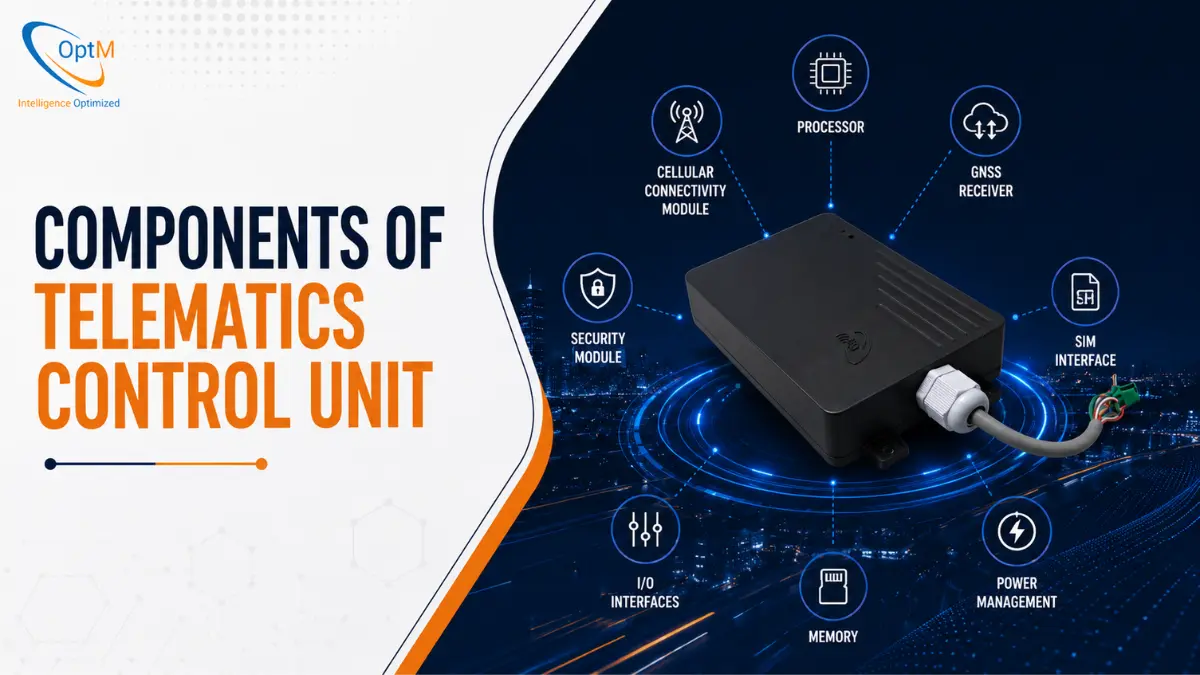
The primary components of a Telematics Control Unit (TCU) include the host application processor, a multi-band cellular modem (LTE/5G), a high-precision Global Navigation Satellite System (GNSS) module, in-vehicle network transceivers (CAN/J1939/Ethernet), an automotive-grade Power Management Integrated Circuit (PMIC), and a dedicated Hardware Security Module (HSM).
Every micro-component selected for a TCU directly influences edge computing capabilities, data transmission speeds, and overall system security. In this guide, we will break down the essential hardware components that form an automotive-grade communication gateway. We will explain exactly what each component does, how they interact, and why specific engineering choices are critical to achieving true business value.
1. The Core Processing Unit: The Brain of Edge Telematics
At the absolute center of the TCU's printed circuit board (PCB) sits the core processing assembly. This block is responsible for executing the local software stack, running edge analytics algorithms, managing memory queues, and controlling all external communication peripherals.
| Feature | Host Application Processor | Secondary Microcontroller |
|---|---|---|
| Operating Environment | Runs Embedded Linux / High-End OS | Runs Safety-Critical RTOS or bare-metal firmware |
| Primary Responsibility | Executes complex edge computing and analytics tasks | Manages deterministic, time-sensitive hardware tasks |
| Data Operations | Manages Protobuf serialization and cloud communication | Processes immediate vehicle bus interrupts and CAN polling |
| System Health & Power | Enters deep sleep to prevent battery drain | Monitors ignition (KL15) and directs Watchdog recovery sequences |
The Host Application Processor vs. The System Microcontroller
Modern high-performance gateways frequently deploy a dual-processor architecture to balance intense data computing with low-power safety constraints:
- The Host Application Processor: This is typically a multi-core ARM Cortex-A series processor or an x86 equivalent. It functions as the primary computing engine for non-safety-critical operations. It runs advanced, rich operating systems like Embedded Linux or Android Automotive, executes data compression (such as converting raw diagnostic logs into Google Protocol Buffers), and processes complex edge analytics.
- The Secondary Microcontroller (MCU): This is a low-power, highly reliable chip, such as an ARM Cortex-M or a specialized automotive-grade MCU core. It operates continuously, running a lightweight Real-Time Operating System (RTOS) or a bare-metal firmware loop. The MCU handles deterministic, time-sensitive tasks: managing the physical ignition wake-up line (KL15 status), processing immediate vehicle bus interrupts, and monitoring system health.
Internal Memory Configurations
To prevent data loss during network disruptions and ensure fast operating speeds, the core processing unit relies on a multi-tiered memory layout:
- Random Access Memory (RAM): Utilizing high-speed LPDDR4 (Low-Power Double Data Rate 4) RAM chips. This memory space holds active execution code, buffering high-frequency incoming data frames from the vehicle's internal networks before they are parsed or compressed.
- Non-Volatile Storage (eMMC / Flash): For permanent storage, TCUs utilize automotive-grade eMMC (embedded MultiMediaCard) or robust SPI NAND Flash chips. This space contains the core operating system files, cryptographic certificate bundles, and localized databases (like SQLite) used to queue encrypted data payloads when traveling through cellular dead zones.
2. Wireless Connectivity and Communication Modules
The primary defining characteristic of a TCU is its ability to translate closed, in-vehicle network protocols into standardized wide-area wireless network packets. This bidirectional bridging requires two distinct radio frequency (RF) sub-systems.
The Cellular Modem Sub-System (LTE and 5G)
The cellular modem is the most power-hungry and capital-intensive component on the circuit board. It translates digital data streams into analog radio frequencies for over-the-air transmission.
- The Baseband Processor: This chip runs the cellular communication protocol stacks (e.g., 3GPP Release 15 or 16). It handles network registration, manages signal handovers between mobile towers, and modulates data into standard wireless formats.
- RF Front-End (RFFE) Modules: This includes a complex array of power amplifiers, low-noise amplifiers (LNAs), and radio frequency switches. They condition the signal, boosting low-power data bits so they can travel miles to the nearest cell tower, while filtering out background electronic noise.
- The Shift to 5G Ultra-Reliable Low-Latency Communication (URLLC): While standard 4G LTE modems are excellent for basic tracking and background diagnostic uploads, modern 2026 deployments favor 5G modems. 5G URLLC capabilities drop transmission latencies down to single-digit milliseconds, enabling real-time Vehicle-to-Everything (V2X) safety applications and cloud-orchestrated collision avoidance.
Short-Range Connectivity: Wi-Fi and Bluetooth Low Energy (BLE)
To maximize data flexibility, modern systems incorporate short-range wireless chipsets:
- Bluetooth Low Energy (BLE): Essential for secure, low-power vehicle interactions. BLE modules allow the vehicle to communicate with a driver’s smartphone, enabling automated passive-entry digital key solutions, processing local trailer tire pressure diagnostics, and allowing drivers to view system health checks without waking up the main cellular modem.
- Wi-Fi Modules (Wi-Fi 6 / 6E): Used primarily for high-throughput data offloading. When a commercial vehicle returns to a depot or a passenger car docks in a residential garage, the TCU can switch from expensive cellular networks to local Wi-Fi, transferring bulk diagnostic video files, raw sensor logs, and large over-the-air firmware update packages efficiently.
3. Positioning and Localization Sub-Systems
A vehicle tracking payload has no operational value without hyper-accurate spatial and temporal context. The localization block provides the precise coordinates and timestamps required for mapping, geofencing, and crash telemetry.
Multi-Constellation GNSS Receivers
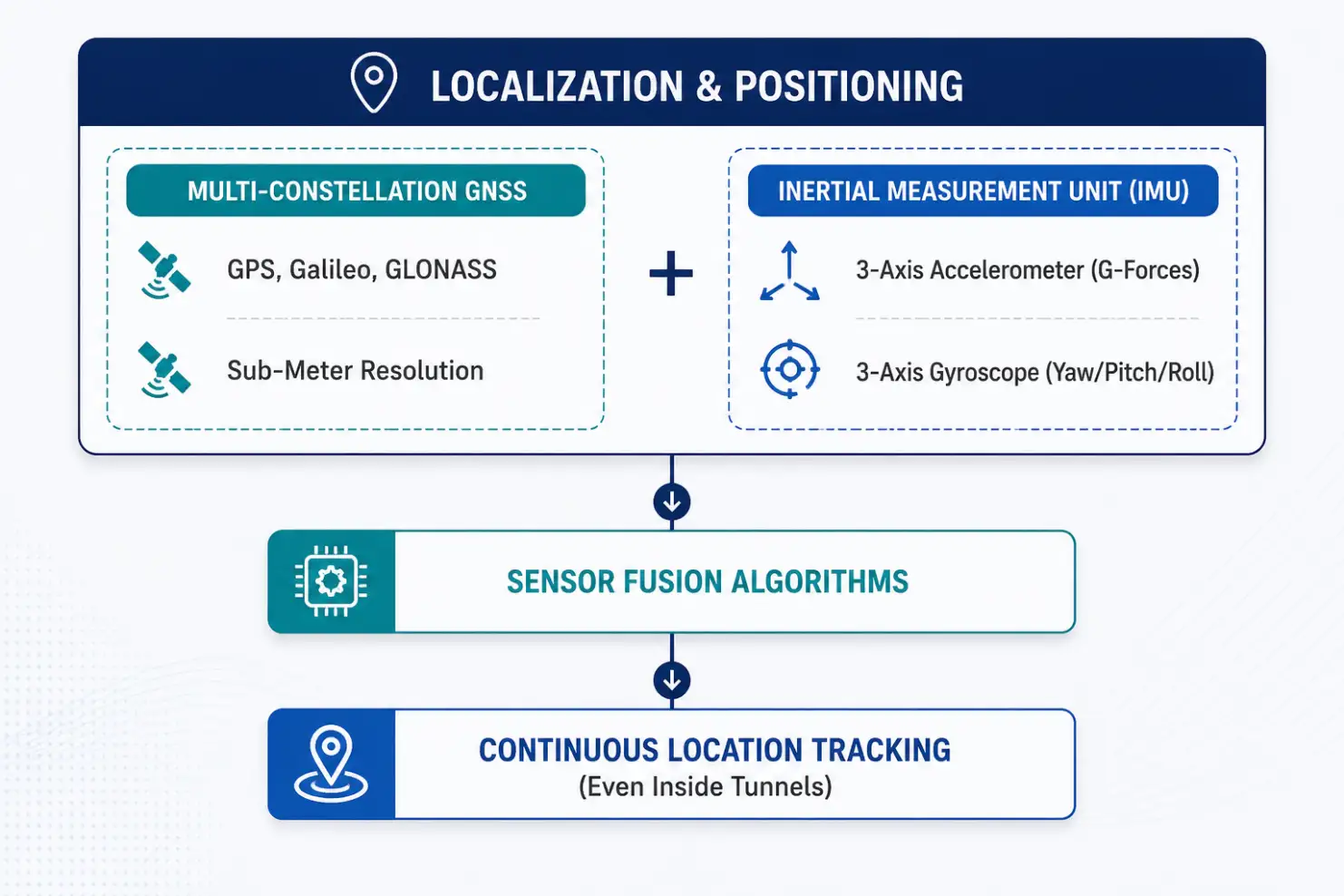
Legacy telematics systems relied solely on the American GPS network. If a truck entered an urban canyon with tall buildings, positioning accuracy would drift significantly. Modern automotive gateways resolve this by integrating multi-constellation Global Navigation Satellite System (GNSS) receivers.
These chips track multiple satellite arrays simultaneously, including GPS (United States), GLONASS (Russia), Galileo (Europe), and BeiDou (China). By locking onto upwards of 20 satellites at one time, the receiver drops its positional margin of error down to sub-meter resolution while significantly speeding up the "Time to First Fix" (TTFF) after starting the vehicle.
The Inertial Measurement Unit (IMU)
The IMU is a microchip containing a 3-axis accelerometer and a 3-axis gyroscope. It measures physical forces:
- 3-Axis Accelerometer: Measures linear forces, detecting sudden braking events, aggressive acceleration forward, or severe sideways shifts caused by an accident or an emergency lane change.
- 3-Axis Gyroscope: Measures angular velocity, tracking the vehicle's rotation, yaw rate (spinning), pitch (tilt during hill climbs), and roll (detecting if a commercial vehicle has flipped over).
Dead Reckoning Software Interfacing
The ultimate benefit of this positioning layout occurs when the GNSS module and the IMU work together through localized code. To learn more about this integration, read our detailed guide on Telematics Control Unit Working.
When a vehicle enters a subterranean tunnel, satellite signals vanish completely. Instead of freezing, the system engages Dead Reckoning. It takes the last verified satellite coordinate and uses the IMU's physical movement data, combined with wheel speed pulses pulled from the vehicle's network bus, to continuously compute the car's position in real-time until it exits the tunnel.
4. In-Vehicle Network Interfaces and Transceivers
A TCU cannot operate in isolation; it must communicate directly with the engine control module, battery management systems, and safety systems inside the vehicle. This interaction is handled by physical transceivers on the PCB.
CAN and CAN-FD Transceivers
The Controller Area Network (CAN) bus remains the standard communication protocol for modern automotive manufacturing.
- Physical Transceivers: These specialized chips sit between the vehicle's copper wiring harness and the TCU's digital microcontroller. They translate high and low differential voltages from the physical wires into basic digital logic bits (ones and zeros) that the processor can handle.
- CAN-FD (Flexible Data-rate) Compatibility: Standard CAN is capped at 1 Mbps. Modern implementations deploy CAN-FD transceivers, which scale data speeds up to 8 Mbps. This expanded bandwidth allows the TCU to ingest complex telemetry packages from advanced sensor suites without clogging the internal network lanes.
LIN, SAE J1939, and Automotive Ethernet Nodes
To support diverse vehicle classes and advanced ADAS computing, additional interface chips are integrated into the circuit design:
- SAE J1939 Controllers: Indispensable for heavy-duty commercial trucks, construction machinery, and agricultural vehicles. These components decode extended 29-bit message identifiers, pulling diagnostic trouble codes, diesel exhaust fluid tracking metrics, and axle load parameters natively.
- Local Interconnect Network (LIN) Bus: A low-cost, low-speed single-wire transceiver block used for non-critical peripheral status tracking, such as confirming door lock positioning, mirror adjustments, or simple cabin climate settings.
- Automotive Ethernet Transceivers (100Base-T1 / 1000Base-T1): As vehicles deploy high-bandwidth LiDAR, radar, and camera arrays, standard CAN lines quickly become a bottleneck. Automotive Ethernet transceivers use a single twisted pair of copper wires to move gigabits of raw data per second, allowing the TCU to handle raw sensor streams and coordinate advanced vehicle safety features.
5. Power Management and Protection Circuitry
Vehicles are incredibly hostile electrical environments. The raw 12V or 24V power clean-delivery lines running from an automotive battery or alternator are filled with severe electrical noise, voltage drops, and destructive power surges. The power block of the TCU serves as a protective shield for the sensitive digital processors and radio modems.
Automotive-Grade PMICs (Power Management ICs)
The PMIC is the electrical traffic controller of the TCU. It takes the fluctuating incoming voltage from the vehicle battery and converts it into highly stable, lower voltages (such as 1.2V, 1.8V, and 3.3V) required by the core processor, RAM, and wireless modems.
The PMIC also coordinates the sleep and wake cycles of the device. When the vehicle's ignition is turned off, the PMIC cuts power to the power-hungry 5G modem and host application processor, entering a low-power deep sleep mode to prevent vehicle battery drain. It leaves only a tiny, low-power monitoring circuit active to watch for incoming remote wake-up commands or sudden security sensor alerts.
Advanced Circuit Protection
To survive continuous years of road operation, the power input stage is fortified with specialized protection components:
- Transient Voltage Suppressors (TVS Diodes): These components act as lightning rods on the circuit board. If a massive voltage spike occurs—such as a "load dump" caused by an alternator disconnecting while running—the TVS diodes instantly shunt the excess energy safely to the ground plane, preventing it from frying the internal microchips.
- Common-Mode Chokes and EMI Filters: These inductive coils clean up high-frequency electromagnetic interference (EMI) generated by the engine, electric motors, and vehicle cabling, ensuring that dirty electrical noise does not compromise the accuracy of data computing or cellular radio performance.
Back-up Battery Cells
If a vehicle undergoes a catastrophic collision, the main car battery can be instantly destroyed or disconnected. To ensure the TCU can still execute its life-saving emergency safety protocols, it integrates a localized back-up battery cell directly on the board. Typically utilizing lithium-iron-phosphate (LiFePO4) or specialized automotive-grade lithium-ion chemistry, this small backup battery provides enough power to keep the GNSS module and cellular modem running long enough to send critical crash alerts and vehicle location packages to emergency services.
6. Embedded Security and Cryptographic Hardware
Because the TCU connects internal vehicle computers directly to the public internet, it represents a primary entry point for cyber threats. To learn more about these risks, understanding Cybersecurity Challenges in Telematics Control Unit Development is crucial. To protect the vehicle, modern hardware shifts the responsibility of encryption away from software and places it into physically isolated silicon components.
The Hardware Security Module (HSM)
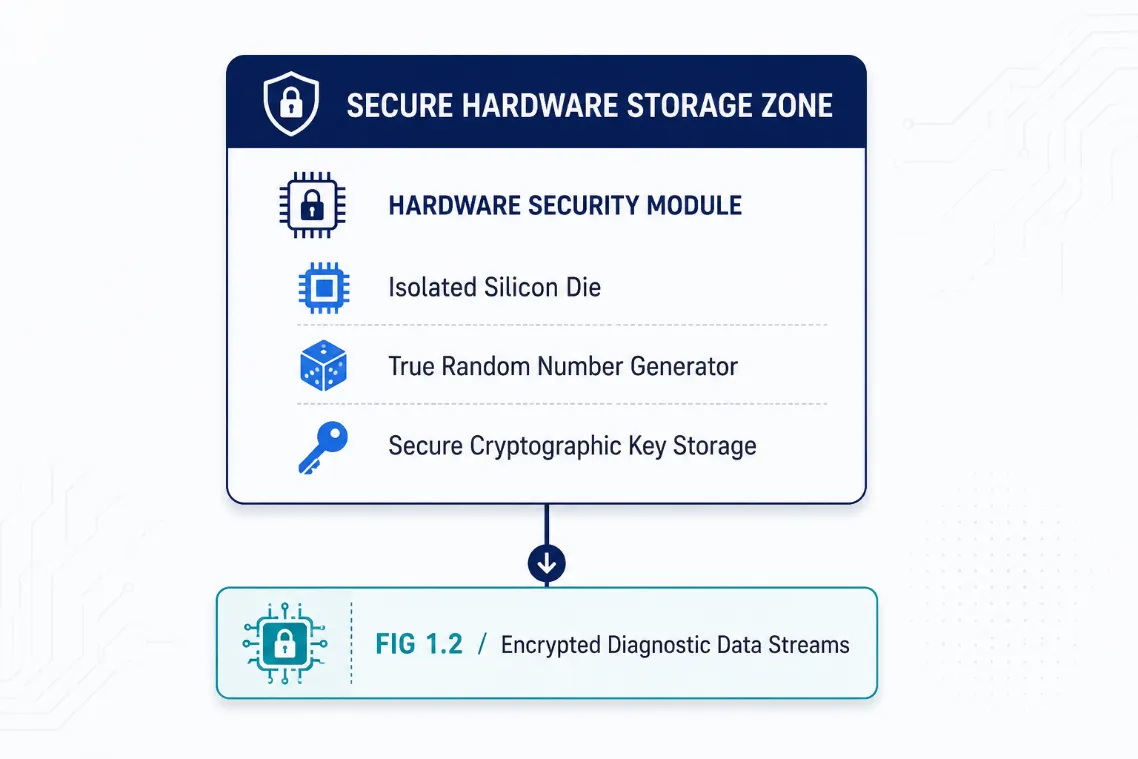
The HSM is a physically isolated, tamper-resistant chip embedded directly onto the TCU's circuit board. It acts as an onboard vault, completely separated from the main application processor. The HSM performs three non-negotiable functions:
- Secure Key Storage: It holds the unique digital certificates, public/private encryption keys, and root-of-trust tokens injected by the automaker during manufacturing. These keys never leave the HSM silicon die, ensuring they cannot be read or stolen by malicious software running on the main processor.
- Cryptographic Acceleration: It features dedicated hardware engines designed to encrypt and decrypt data payloads at lightning speeds. When the TCU needs to package telemetry, the HSM encrypts the data using advanced algorithms (like AES-256 or ECC) and applies a digital signature to prevent packet tampering or vehicle identity spoofing.
- True Random Number Generator (TRNG): Uses ambient physical noise to generate high-entropy, unpredictable random numbers, ensuring that cryptographic communication sessions cannot be predicted or breached by external malicious actors.
Secure Boot Flash Devices
The non-volatile storage housing the TCU's operating system is paired with secure boot verification mechanics. During initial power-up, the HSM checks the cryptographic signature of the operating system code against its internal keys. If a hacker has modified the firmware or injected malicious code, the secure boot sequence fails, blocking execution and preventing unauthorized access to the vehicle's internal networks.
7. Structural Layout: Component Reference Matrix
To summarize how these independent sub-systems interact across different operational scenarios, review this structural reference matrix:
| Component Sub-System | Primary Components Included | Key Business/Operational Value Provided |
|---|---|---|
| Core Processing Block | Host Application MPU, Low-power MCU, LPDDR4 RAM, eMMC Storage | Drives edge data aggregation, executes local code, and prevents system data loss. |
| Wireless RF Sub-System | Baseband Modem, RFFE Amplifiers, Wi-Fi 6/BLE Transceivers | Achieves low-latency 5G cloud connectivity and handles secure mobile key entry. |
| Positioning Block | Multi-Constellation GNSS chip, 3-Axis Accelerometer, 3-Axis Gyroscope | Delivers precise sub-meter vehicle location tracking and captures driver safety metrics. |
| Vehicle Interface Block | CAN-FD Transceivers, J1939 Controllers, Automotive Ethernet Switches | Ingests real-time diagnostic error codes and manages heavy sensor data pipelines. |
| Power & Protection Block | Automotive PMIC, TVS Diodes, Internal Back-up Battery | Protects sensitive chips against voltage surges and ensures emergency crash notifications. |
| Security Vault Block | Hardware Security Module (HSM), Secure Boot Flash | Provides a hardware root-of-trust, blocks cyberattacks, and prevents data spoofing. |
The OptM Engineering Advantage: Industrial Component Selection
Every component selected for an automotive-grade telematics gateway must be chosen with absolute precision. Opting for cheap consumer-grade chips or sub-optimal circuit layout patterns results in high warranty costs, overheating hardware, and dropped cellular packets on the road.
At OptM Solutions, our embedded electronics and product engineering teams specialize in selecting and optimizing high-reliability components for complex transportation environments. We build our platforms using advanced, multi-layer PCBs featuring automotive-grade PMICs, multi-constellation GNSS engines, and dedicated Hardware Security Modules to guarantee absolute data sovereignty and operational uptime.
Our hardware architectures utilize optimized Embedded Linux environments, allowing high-speed 5G connectivity and CAN-FD vehicle bus systems to execute concurrently with zero processor thermal throttling or data frame drops. By choosing components designed for industrial endurance, OptM delivers gateways that protect your vehicle assets, streamline regulatory compliance, and maximize your fleet tracking investments.
Conclusion
The modern Telematics Control Unit is a masterpiece of embedded engineering. Its performance depends entirely on the quality and configuration of its internal components—from the core application processors processing edge analytics, to the protection circuitry surviving severe voltage surges, all the way to the HSM protecting the vehicle against cyber threats.
As automakers and fleet operators transition fully to software-defined mobility ecosystems, choosing the right hardware components is the single most critical step to securing long-term operational success.
For engineering executives, OEM’s, Tier 1 suppliers, and EV mobility startups seeking to deploy a reliable, robust, and low-latency communication gateway, selecting the right hardware partner is essential to long-term scalability. Explore the detailed technical specifications and component layout options of our production-ready connectivity platforms on the OptM Telematics Control Unit Product Page.
Frequently Asked Questions
Why do high-end TCUs use both an RTOS and an Application Processor?
The Application Processor handles heavy tasks like 5G routing and cloud encryption. The RTOS (running on a low-power MCU) guarantees real-time, deterministic execution for safety-critical tasks, ensuring crash detection algorithms never freeze.
What role does the automotive-grade PMIC play on the circuit board?
The Power Management IC (PMIC) conditions the dirty, fluctuating voltage from the alternator into clean power. It also strictly orchestrates deep-sleep and wake-up cycles to protect the vehicle's 12V battery when parked.
Why are standard smartphone GPS chips insufficient for TCUs?
Standard GPS drifts in urban canyons. TCUs use multi-constellation GNSS chips that track GPS, Galileo, GLONASS, and BeiDou simultaneously to maintain sub-meter accuracy in dense cities and speed up satellite locking.
How do engineers prevent the 5G modem from interfering with the GPS?
They use physical Faraday cages, selective Surface Acoustic Wave (SAW) filters, and microsecond-level software scheduling. This ensures the powerful 5G transmitter does not "desense" or blind the highly sensitive GNSS receiver nearby.
Why do some TCUs contain an internal LiFePO4 backup battery?
In a severe collision, the main vehicle battery is frequently destroyed or severed. The small, localized backup battery ensures the TCU stays alive long enough to transmit the final eCall emergency location and crash telemetry.
What is the function of the Hardware Security Module (HSM)?
The HSM is an isolated silicon vault that stores cryptographic keys and handles encryption math. Because the private keys never leave the hardware vault, hackers cannot steal them using remote software exploits.
Why are CAN-FD transceivers replacing standard CAN transceivers?
Standard CAN is capped at 1 Mbps, which chokes under the data weight of modern sensors. CAN-FD (Flexible Data-rate) scales up to 8 Mbps, allowing the TCU to ingest the larger diagnostic payloads required by advanced vehicle architectures.