
Content Writer & SEO Specialist
Content Writer & SEO Specialist
Aditya Sharma is a content writer at OptM Solutions specializing in automotive electronics, embedded systems, telematics, electric vehicle technologies, connected mobility, and autonomous driving technologies.
LinkedIn ProfileThe threat landscape of the automotive industry shifted permanently the moment vehicles transformed from isolated mechanical machines into hyper-connected, software-driven nodes. Historically, a software vulnerability in an electronic device resulted in data theft, financial fraud, or a corrupted operating system. In the context of modern automotive design, a compromised system does not just risk digital privacy—it creates a multi-ton kinetic weapon capable of catastrophic physical damage.
At the center of this risk vector sits the Telematics Control Unit (TCU). As the literal digital gatekeeper between the public cellular internet and the vehicle's internal, safety-critical mechanical architecture, the TCU is the most highly targeted entry point for remote malicious exploits. It simultaneously runs public-facing wireless stacks and interfaces directly with private vehicle networks, making it the primary perimeter wall that must be defended at all costs. To grasp how this critical component interfaces with broader transit networks, a comprehensive overview can be found in our core guide on what is a telematics control unit.
Engineering a TCU that can withstand sophisticated cyberattacks over a fifteen-year vehicle lifecycle is an immense technical challenge. Designers must balance military-grade cryptographic authentication and complex intrusion detection algorithms against strict automotive limitations: ultra-low micro-amp power budgets when parked, extreme thermal dissipation boundaries, and single-digit millisecond latency tolerances for safety-critical data routing.
This guide provides an exhaustive engineering deep dive into the specific cybersecurity challenges encountered during TCU development. We will unpack wireless exploit vectors, physical board-level tampering, internal network pivot attacks, cryptographic processing overhead, and the regulatory frameworks required to design an unbreachable connected gateway.
1. Mapping the Automotive Attack Surface: The TCU Vulnerability Matrix
To build a secure embedded system, development teams must shift their perspective from defending a single box to mapping an extensive, multi-dimensional attack surface. Because the TCU links external global wireless infrastructure directly to internal copper wire vehicle communications, its vulnerabilities are naturally categorized into three distinct entry zones.
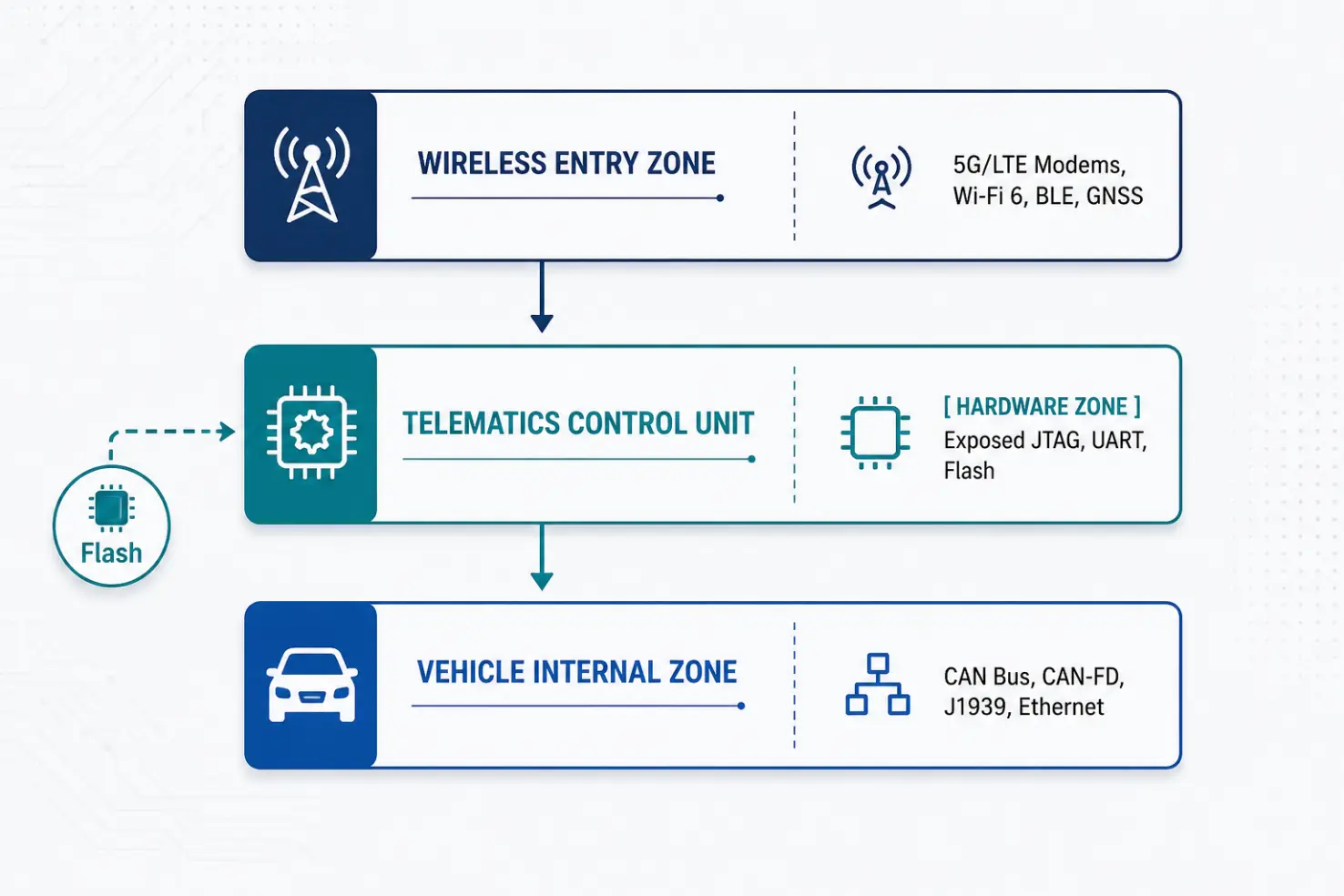
The Wireless Entry Zone
This layer includes all over-the-air interfaces exposed to the public environment. The integrated multi-band cellular modems (LTE/5G), Wi-Fi 6 offloading modules, Bluetooth Low Energy (BLE) transceivers, and Global Navigation Satellite System (GNSS) positioning chips represent continuous wireless doors that are constantly listening for incoming radio waves. Hackers exploit these interfaces using remote code execution (RCE) bugs, memory overflows in the wireless stack, or signal manipulation.
The Hardware and Physical Entry Zone
This zone focuses on physical board-level tampering. If a malicious actor, a corrupt fleet employee, or a reverse-engineering competitor gains physical access to the vehicle, the TCU housing itself becomes a target. Attackers dismantle the enclosure to locate exposed copper test points, unencrypted non-volatile flash memory chips, and diagnostic debugging ports left active on the printed circuit board (PCB) from the development phase.
The Vehicle Internal Zone
The final zone is the internal bridging vector. If an attacker successfully breaches the wireless or hardware entry zone, their primary goal is to "pivot"—escalating their privileges from a compromised internet-connected media player or diagnostics engine and forcing the TCU's transceivers to inject malicious commands straight into the vehicle’s driving networks.
Developing an architecture capable of containing a breach at any one of these entry zones requires moving past single software firewalls. It demands a highly disciplined approach to isolating and decoupling processing domains, which forms the core foundation of a resilient telematics control unit architecture.
2. Wireless Threat Vectors: Securing the Cellular and RF Gateways
The wireless modems integrated into the TCU are designed to connect to cellular towers, localized satellites, and driver smartphones. However, the open nature of radio frequency (RF) communications means these gateways are highly susceptible to advanced network manipulation.
Rogue Base Stations and IMSI Catching
One of the most sophisticated wireless challenges is the deployment of Rogue Base Stations, frequently referred to as IMSI Catchers or "Stingrays." These devices mimic legitimate cellular towers operated by telecom providers.
When a vehicle drives within range of an IMSI Catcher, the rogue station broadcasts a cellular signal that overrides local towers. It exploits standard cellular handover rules, forcing the TCU’s cellular modem to connect to the fake network. Once connected, the rogue station can execute a "downlink capabilities downgrade," forcing the TCU to drop from a highly secure, fully encrypted 5G network down to an unencrypted legacy 2G or 4G LTE state.
Once the encryption is dropped, the attacker executes a Man-in-the-Middle (MitM) attack. They intercept outbound diagnostic payloads, alter incoming remote commands, or feed malicious code blocks into the update stream, entirely bypassing basic cloud-level web application firewalls.
GNSS/GPS Spoofing and Meaconing
Positioning chips inside the TCU are designed to process low-power microwave signals broadcast by global satellite constellations. Because these satellite signals travel thousands of miles through the atmosphere, they arrive at the vehicle's roof-mounted antenna with an incredibly low signal strength.
This low power threshold makes GNSS modules vulnerable to GPS Spoofing. An attacker uses a software-defined radio (SDR) to generate a localized radio signal that mimics real satellite frequencies but contains slightly altered timing data. Because the spoofed signal is generated close to the vehicle, its signal strength completely overpowers the real satellite signals.
The TCU’s positioning engine locks onto the fake coordinates without realizing it has been manipulated. In commercial logistics, this allows thieves to spoof a truck's location, making it appear safely on its route on the dispatcher's dashboard while the vehicle is actually being diverted to an unauthorized warehouse.
3. Hardware-Level Exploitation: The Physical Threat
Cybersecurity is frequently misunderstood as a purely software-based challenge. In B2B fleet operations or heavy machinery environments, physical security is an equally critical vector. If a bad actor can access the physical circuit board, software-only encryption models can be completely bypassed.
Debug Port Vulnerabilities (JTAG and UART)
During the prototyping and initial code deployment phases of TCU development, engineers rely on physical hardware debugging ports built directly into the silicon of the microprocessors. The most common are JTAG (Joint Test Action Group) and UART (Universal Asynchronous Receiver-Transmitter) serial lines. These ports allow engineers to pause CPU execution, inspect RAM variables, and flash raw bootloader code.
A major development flaw is leaving these physical ports active or accessible on production-grade boards. If an attacker connects a hardware debugger to an active JTAG port, they gain absolute control over the processor. They can read out the entire compiled firmware binary, locate hardcoded cryptographic API endpoints, or patch the operating system kernel to disable internal firewalls entirely.
Side-Channel Attacks and Fault Injection
For high-security operations, attackers deploy Side-Channel Attacks. Instead of trying to break encryption mathematically, they monitor the physical side-effects of the TCU during processing.
Using ultra-precise oscilloscopes, attackers measure the minute power fluctuations (Differential Power Analysis) or electromagnetic emissions generated by the chip while it executes a cryptographic handshake. Because different chunks of binary code consume different amounts of electrical current, the attacker can visually map the power signatures and deduce the private master encryption keys locked in the system.
Defending against this physical exploitation requires moving past standard industrial silicon. It forces development teams to select specialized, ruggedized microcontrollers that feature hardware-level anti-tampering defenses, which is a core design criterion when sourcing high-quality components for a telematics control unit.
4. The Internal Bridging Threat: Weaponizing the CAN Bus
The ultimate goal of an automotive cyberattacker is to move horizontally. They do not want to just crash the TCU; they want to use the TCU as a stepping stone to gain control of the vehicle's steering, acceleration, and braking networks.
The Inherent Weakness of Legacy CAN Protocols
The fundamental challenge of automotive cybersecurity stems from a historical reality: the Controller Area Network (CAN bus) protocol, designed in the 1980s, has absolutely zero native security features.
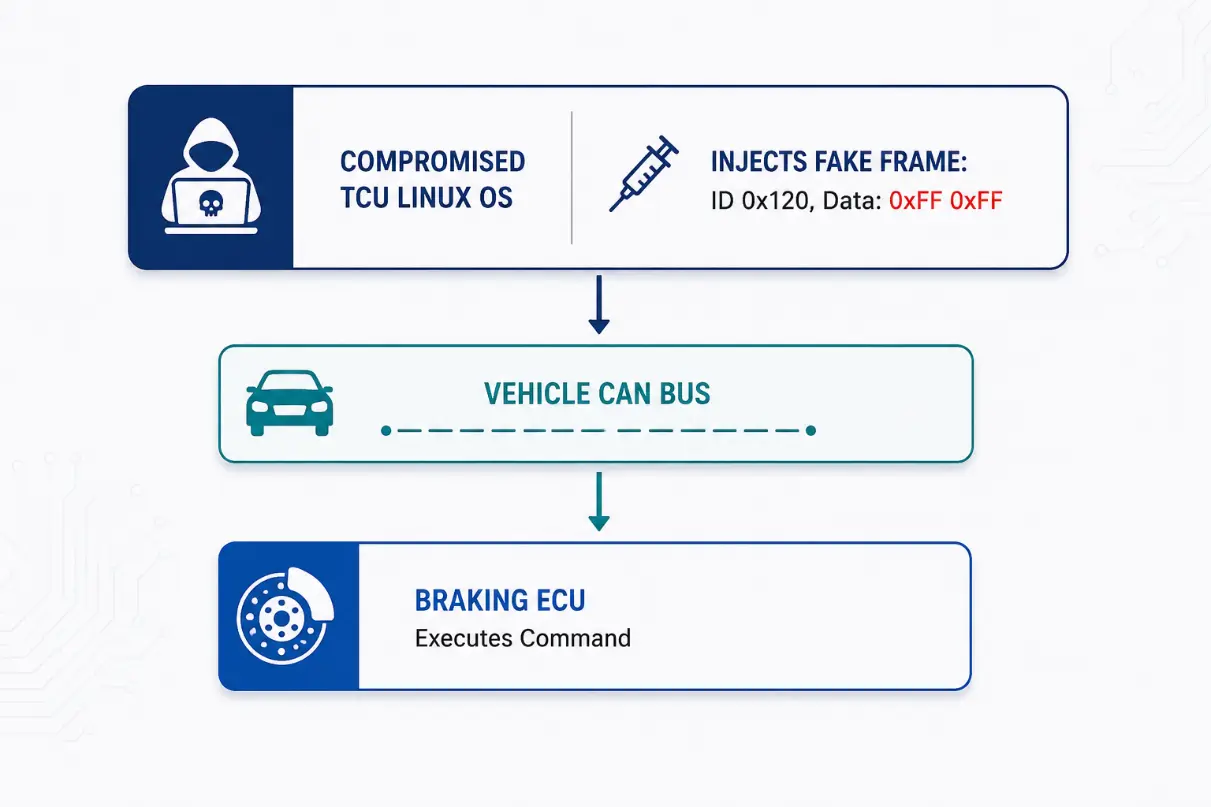
On a standard vehicle CAN bus, messages are broadcast globally across two wires, and there is no concept of sender authentication or data encryption. Every frame consists simply of an Identifier and a Data Payload. If the braking ECU sees a message frame with ID 0x120 that reads 0xFF 0xFF, it does not check who sent it. It assumes the message is valid, trusts the command, and activates the brakes immediately.
Pivot Attacks and Frame Spoofing
If a hacker leverages a remote code execution exploit to compromise the TCU's internet-facing Embedded Linux operating system, they can weaponize this structural CAN bus vulnerability.
The hacker gains root privileges on the Linux domain and takes control of the physical internal transceivers. They instruct the transceiver to start broadcasting malicious, high-priority frame streams directly onto the powertrain network. They can execute a Denial of Service (DoS) attack by flooding the bus with zero-ID frames, completely clogging the network wires and preventing valid safety data from traveling between the ECUs. Alternatively, they can inject precise Frame Spoofing payloads, sending false speed readings to disable the airbags or falsifying engine commands to cut power at highway speeds.
Eliminating this structural vulnerability requires configuring advanced boundary filters and strict hardware firewalls at the point where the cellular modem meets the internal copper wiring harness. This data filtering process is explored in our technical architecture guide on system integration between CAN bus and cellular interfaces.
5. Cryptographic Overhead: The Engineering Compromise
To fix the inherent vulnerabilities of the CAN bus and secure wireless communications, engineers deploy cryptographic encryption. However, implementing military-grade security inside an embedded automotive environment introduces a difficult engineering trade-off: Latency versus Security.
The Latency vs. Security Dilemma
In standard IT systems, adding 50 milliseconds of processing latency to encrypt an email is completely unnoticeable to a user. In safety-critical automotive systems, a 50-millisecond processing delay can cause a fatal accident.
If an engine controller or an active collision-avoidance system has to wait for a low-power microcontroller to execute complex asymmetric mathematical algorithms (like RSA-3072) to decrypt an incoming message frame, the processing delay will cause the vehicle to travel several feet before responding to a hazard. The security mechanism itself becomes the failure point, causing the system to drop real-time data frames.
Hardware Security Modules (HSMs) and Secure Onboard Communication
Modern TCU architectures resolve this processing bottleneck by moving encryption out of the main software stack and embedding it directly into dedicated, physically isolated hardware known as a Hardware Security Module (HSM).
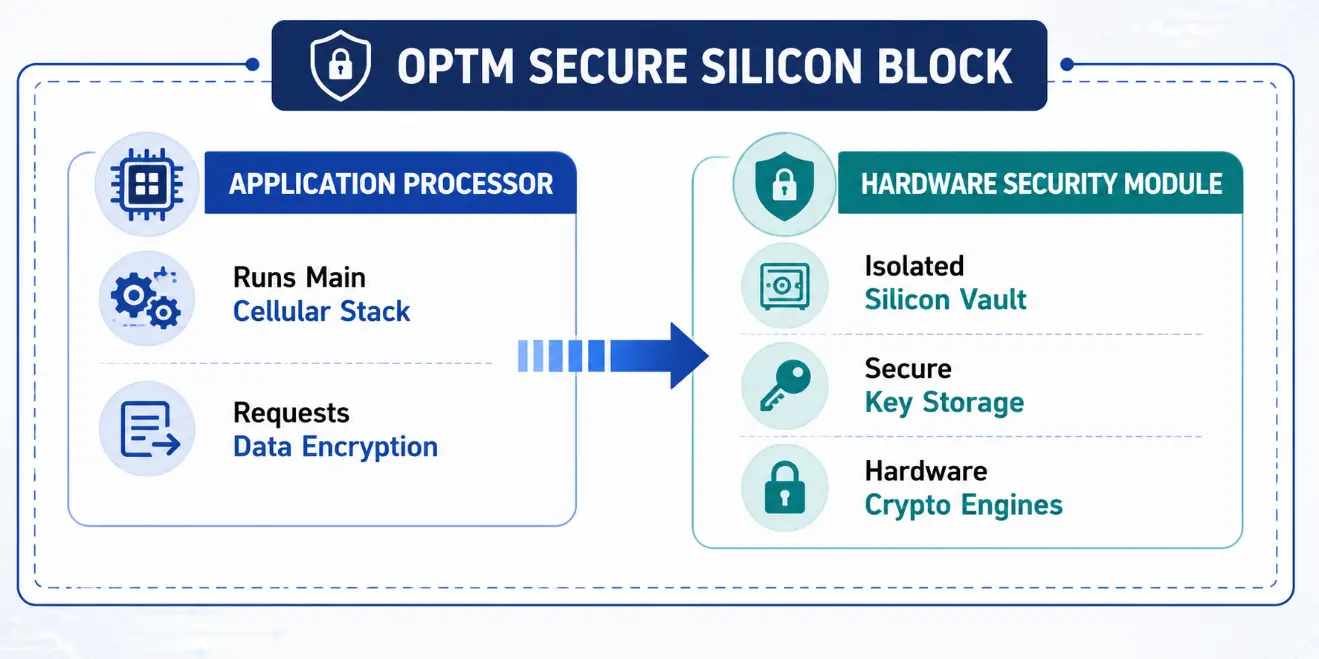
The HSM is a separate silicon vault on the microchip that features its own dedicated processor, secure memory partitions, and hardware-accelerated cryptographic engines.
- Secure Key Storage: The HSM locks away the unique public/private keys injected during manufacturing. These keys are physically unreadable by the main operating system, preventing software exploits from stealing them.
- True Random Number Generation (TRNG): Uses physical atomic noise inside the silicon to generate truly unpredictable cryptographic tokens, ensuring communication sessions cannot be intercepted.
- AUTOSAR SecOC Integration: To protect the CAN bus without introducing lag, engineers deploy AUTOSAR Secure Onboard Communication (SecOC). Instead of encrypting the entire message frame, SecOC appends a lightweight Freshness Value and a truncated Message Authentication Code (MAC) to the end of the data. The HSM uses its hardware acceleration to verify this MAC in single-digit microseconds, confirming the authenticity of the sender without delaying the execution of the command.
6. Over-The-Air (OTA) and Cloud Backend Vulnerabilities
Because the TCU acts as the remote receiver for wireless software distribution, it represents an incredibly high-value target for supply-chain attacks. Defending the vehicle requires securing the entire pipeline that writes code down to the car.
Systemic Risks of Compromised Cloud Repositories
The greatest nightmare for an automotive cybersecurity architect is a cloud-level supply chain exploit. If a malicious group compromises the central OEM cloud repository or steals the automaker's private signing keys, they do not need to hack individual vehicles one by one.
The hackers can inject a malicious firmware image straight into an authorized cloud update campaign. The central servers will push this corrupted file to millions of vehicles simultaneously. The TCUs will receive the file from what appears to be an authorized source and begin flashing it directly into the sub-computers of the vehicles.
Secure Boot and Digital Code Signing
To mitigate this existential threat, the TCU must implement an un-bypassable Secure Boot sequence anchored by a hardware Root-of-Trust.
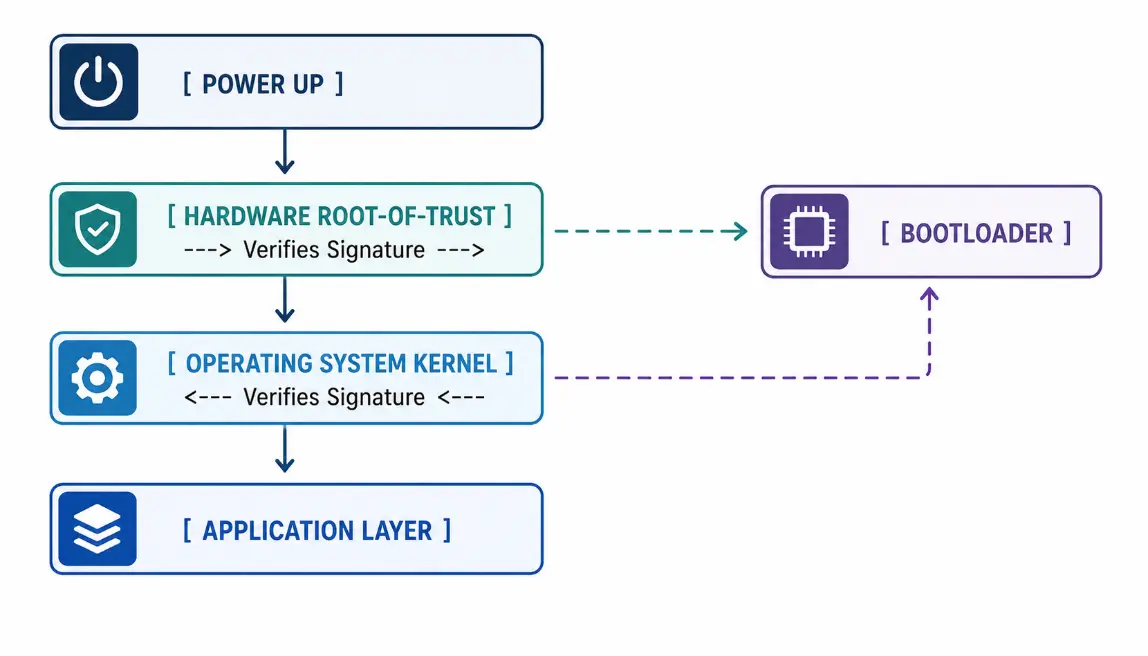
When the TCU powers up or receives a wireless file package, it executes a strict cryptographic verification chain:
- The unalterable hardware Root-of-Trust boots first and verifies the digital signature of the primary bootloader.
- The bootloader then initializes and cryptographically checks the signature of the operating system kernel.
- The kernel verifies the digital code signatures of all upper-layer applications before allowing them to execute.
If a hacker has altered even a single bit of code within the update package, the cryptographic signature verification fails. The TCU instantly locks down the partition, rejects the installation, and rolls back to a safe, original backup image. This secure boot validation is mandatory whenever executing remote diagnostics and OTA firmware deployments.
7. Compliance and Regulatory Mandates (UN R155/R156 & ISO 21434)
In the current automotive landscape, building a secure telematics gateway is no longer just an engineering best practice—it is a strict legal requirement for vehicle homologation. Automakers cannot legally sell a vehicle in participating global markets if their systems fail to pass rigorous international security certifications.
UNECE WP.29 (Regulations R155 and R156)
The United Nations Economic Commission for Europe (UNECE) established two landmark regulations that have rewritten the rules of automotive product design:
- UN Regulation No. 155 (R155): Mandates that automakers implement a certified Cyber Security Management System (CSMS). This framework requires continuous threat monitoring across the vehicle lifecycle and explicit defense strategies against an exhaustive list of 30+ defined threat vectors.
- UN Regulation No. 156 (R156): Mandates a Software Update Management System (SUMS). It requires absolute traceability and security during wireless updates, ensuring that software versions are documented and rollback mechanisms are fail-safe.
ISO/SAE 21434: Security by Design
To meet these regulatory mandates, TCU development must strictly follow the ISO/SAE 21434 standard. This standard moves cybersecurity out of the post-production verification phase and embeds it directly into the conceptual architecture stage.
A core component of ISO 21434 compliance is the execution of a TARA (Threat Analysis and Risk Assessment). Before a single line of code is written, engineers must systematically map out every component of the TCU, assign a "Feasibility Rating" to potential attack vectors, calculate the "Impact Rating" of a successful exploit (Safety, Financial, Operational, and Privacy impacts), and build explicit hardware or software countermeasures directly into the design specification sheet.
8. Intrusion Detection and Zero Trust Automotive Networks
As hackers become more sophisticated, static firewalls are no longer sufficient to guarantee safety. Modern TCU engineering is moving toward active, intelligent defense models that assume a breach can and will occur.
Automotive IDPS (Intrusion Detection and Prevention Systems)
An automotive IDPS is a software engine running at the network edge that continuously audits internal data packets.
Instead of simply passing data back and forth, the TCU analyzes the behavioral rhythm of the CAN bus or internal Automotive Ethernet switches. It checks if a specific ECU is transmitting messages at an abnormally high frequency, or if the radio module is suddenly trying to broadcast powertrain commands. The moment an anomaly is detected, the IDPS blocks the rogue frames, quarantines the compromised interface, and transmits an urgent incident report to the automaker's cloud-based Vehicle Security Operations Center (vSOC) for fleet-wide isolation.
The Shift to Zero Trust Architecture
The future of connected mobility depends on abandoning the legacy "trusted internal network" model. In older designs, once an engineer accessed the internal wires, they had full control over everything.
Modern TCU development utilizes a "Zero Trust" framework. Every ECU, every processing core, and every application layer must continuously authenticate itself before sending or executing a command. By forcing continuous, cryptographic verification at every junction, the architecture ensures that even if a hacker manages to compromise one component, they remain trapped inside an isolated sandbox, completely unable to cause physical harm to the rest of the vehicle.
The OptM Defense Strategy: Securing Connected Mobility
Designing a communication gateway capable of processing high-frequency data streams while simultaneously running HSM cryptography, secure boot chains, and advanced intrusion detection systems requires expert product engineering. Secondary, off-the-shelf components are completely incapable of surviving this hostile threat landscape.
At OptM Solutions, our embedded systems engineering teams build security directly into the silicon foundation of our platforms. We design and deliver production-ready Telematics Control Units fully compliant with ISO/SAE 21434 standards and Adaptive AUTOSAR frameworks.
Our hardware implementations utilize advanced multi-core processors running isolated Asymmetric Multiprocessing (AMP) layers, pairing internet-facing Embedded Linux environments with secure, dedicated Hardware Security Modules. This guarantees absolute cryptographic separation, secure code execution, and zero-fault data transmission. OptM builds the digital fortresses that give automotive manufacturers and fleet operators the complete confidence to scale their connected vehicle ecosystems safely.
Conclusion
Cybersecurity in Telematics Control Unit development is not a feature to be added to a product right before launch; it is an ongoing engineering commitment that defines the structural validity of the modern software-defined vehicle. As vehicles become more reliant on global cloud interactions, the TCU must serve as an impenetrable barrier that keeps the public internet separated from safety-critical mechanical controls.
Mastering physical port deactivation, multi-constellation RF protection, HSM-accelerated SecOC integration, and secure boot verification is the only way to protect connected vehicle fleets from catastrophic remote attacks. Overcoming these strict parameters remains one of the primary challenges in telematics control unit development.
Securing the modern vehicle requires an engineering foundation where cryptographic integrity and threat mitigation are built directly into the silicon. For automotive engineering leads, Tier 1 suppliers, and fleet operators looking to deploy highly resilient, compliance-ready connected platforms, explore how our secure embedded architectures protect your digital assets by reviewing OptM’s Advanced Automotive Telematics Solutions.
Frequently Asked Questions
What is an IMSI Catcher / Rogue Base Station attack?
An attacker uses a fake cell tower to mimic a legitimate network. It forces the TCU to connect to it and executes a downgrade attack, dropping the secure 5G connection to an unencrypted 2G signal to execute Man-in-the-Middle intercepts.
Why is the standard CAN bus vulnerable to Pivot Attacks?
Standard CAN has zero built-in encryption or sender authentication. If a hacker breaches the TCU's internet connection and "pivots" to the internal transceivers, they can inject spoofed braking frames, and the vehicle will obey them without question.
What are JTAG/UART hardware debugging vulnerabilities?
If physical debug ports are left active on a production circuit board, attackers can plug in hardware debuggers to extract firmware, reverse-engineer proprietary code, and locate hardcoded cryptographic keys directly from the processor.
How does AUTOSAR SecOC protect internal vehicle networks?
Secure Onboard Communication (SecOC) appends a lightweight Message Authentication Code (MAC) to standard CAN frames. The TCU verifies this MAC in microseconds to confirm the sender's identity without adding dangerous latency to the network.
Why does applying heavy encryption to CAN frames cause latency issues?
If a low-power microcontroller has to execute complex math (like RSA-3072) to decrypt a braking message, the microsecond processing delay can cause the vehicle to travel several feet before applying the brakes, creating a safety hazard.
What is a Side-Channel Attack on a TCU?
Instead of breaking software encryption mathematically, attackers use oscilloscopes to monitor the minute physical power fluctuations (Differential Power Analysis) of the chip during processing, visually deducing the private encryption keys.
What does UN R155 compliance require from an automaker?
It legally mandates a certified Cyber Security Management System (CSMS). Automakers must prove active threat monitoring and implement explicit hardware/software countermeasures against 30+ defined attack vectors, or the vehicle cannot be sold.