
Content Writer & SEO Specialist
Content Writer & SEO Specialist
Aditya Sharma is a content writer at OptM Solutions specializing in automotive electronics, embedded systems, telematics, electric vehicle technologies, connected mobility, and autonomous driving technologies.
LinkedIn ProfileDeploying a reliable, scalable, and secure centralized computing unit in a vehicle is no longer a luxury; it is a fundamental requirement for the software-defined mobility era. As original equipment manufacturers (OEMs) and Tier-1 suppliers transition from isolated electronic control units (ECUs) to domain-controller architectures, the core of this transformation resides in the dashboard. According to a recent industry analysis by Global Market Insights Inc., the global automotive infotainment market size was valued at USD 30.9 billion in 2025 and is projected to expand to USD 60.9 billion by 2035, accelerating at a CAGR of 7.1%. This aggressive growth is directly driven by the rapid integration of connected electric vehicle (EV) ecosystems and software-defined vehicle (SDV) architectures.
In production-grade automotive environments, modern cockpits have completely transitioned away from being simple multimedia players. Today, they function as high-performance centralized domain controllers tasked with orchestrating vehicle diagnostics, Advanced Driver Assistance Systems (ADAS), battery management telemetry, and cloud-native services in real time. For procurement teams and engineering leaders aiming to optimize their next-generation mobility ecosystems, deeply understanding What Is Infotainment System architectures is the first critical step toward building a highly functional, compliant, and premium in-cabin experience.
What Is an Automotive Infotainment System?
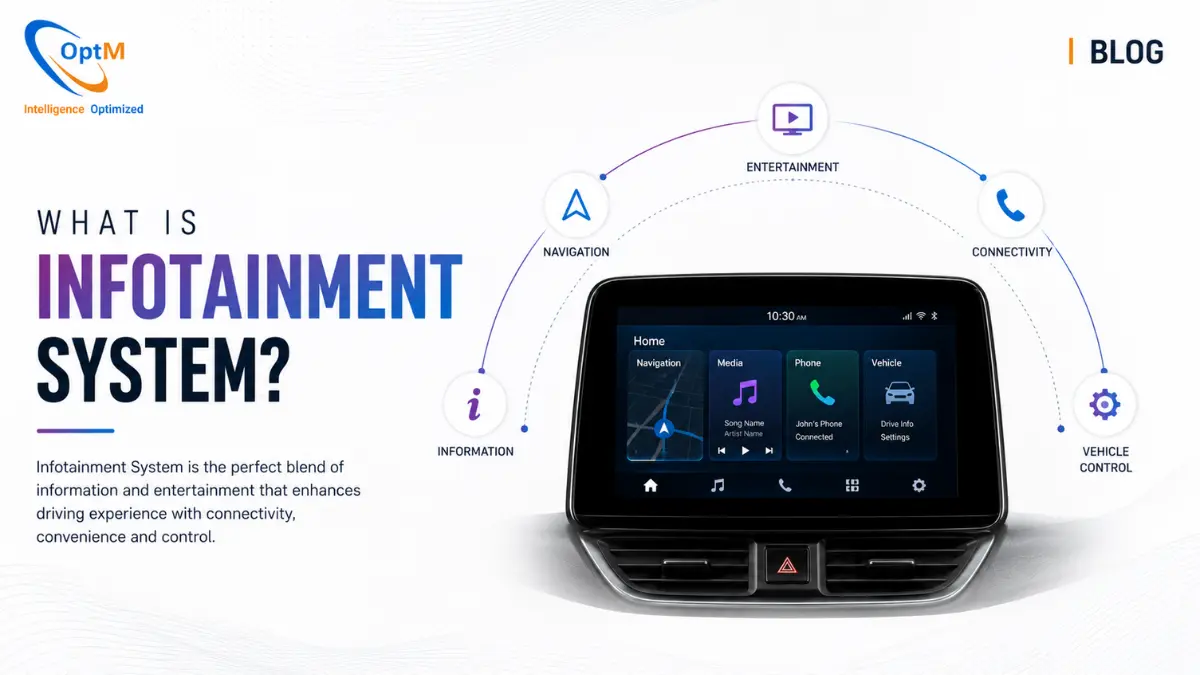
An automotive infotainment system is a centralized embedded computing platform that integrates vehicle control, multimedia, connectivity, and navigation into a single interactive interface. By leveraging high-performance System-on-Chips (SoCs) and Real-Time Operating Systems (RTOS), it bridges the driver with telematics, ADAS, and in-cabin networks to deliver real-time data and entertainment safely.
From an OEM integration perspective, this system acts as the primary Human-Machine Interface (HMI). It is the central nervous system of the cabin, managing inputs from touch panels, voice recognition modules, and steering wheel controls, and translating them into actionable commands across the vehicle's internal networks (such as the Controller Area Network, or CAN bus). Rather than operating in a silo, it serves as the aggregation point where critical diagnostic alerts merge with edge-processed media streaming and intelligent routing.
How Does an Infotainment System Work?
To fully grasp this data exchange, engineering teams must understand exactly How Does Infotainment System Work at the fundamental processing level. At its core, the system relies on a seamless, millisecond-latency handshake between the hardware abstraction layer (HAL) and the overlying operating systems.
When a driver interacts with a Qt-based HMI to adjust the cabin temperature or check the EV battery charging status, the request initiates a complex sequence of micro-events:
-
Input Recognition: The capacitive touch panel or voice DSP (Digital Signal Processor) registers the analog input and converts it into a digital signal.
-
Middleware Routing: The operating system (often an embedded Android or Linux framework) processes this signal through its middleware layer.
-
Hardware Abstraction Layer (HAL) Execution: The HAL translates the software command into a hardware-specific language that the vehicle’s ECUs can understand.
-
Network Transmission: The command is pushed across the vehicle's CAN or J1939 communication protocols to the designated subsystem (e.g., the thermal management ECU).
-
Real-Time Feedback: The subsystem executes the command and sends telemetry back through the network, which the graphics processor instantly renders on the display panel without dropping a single frame.
In safety-critical automotive systems, this entire workflow must happen with zero perceived latency. A delay in rendering a diagnostic warning or a blind-spot alert is unacceptable, which is why engineering teams strictly partition media processing from critical safety operations using hypervisors.
Core Components of an Infotainment System
The baseline reliability of the entire dashboard relies heavily on the specific Components of an Infotainment System chosen during the initial OEM procurement and architecture phase. An industrial-grade setup abandons consumer-grade electronics in favor of components hardened against extreme thermal cycles, constant vibration, and electromagnetic interference.
1. High-Performance SoCs (System-on-Chip)
The computing engine of the system. In 2026, automotive-grade SoCs incorporate multiple processing cores (CPUs for logic, GPUs for rendering, and NPUs for AI inferencing). These chips handle simultaneous heavy workloads, such as rendering 3D navigation maps while edge-processing natural language voice commands.
2. Automotive-Grade Display Panels
The visual interface must deliver high contrast, anti-glare readability, and rapid touch response under direct sunlight. Engineering teams typically evaluate Liquid Crystal Displays (LCDs) or Organic Light Emitting Diodes (OLEDs) bonded to industrial glass, ensuring they meet IP65 or IP67 ratings against dust and moisture ingress. For premium B2B applications, visual diagrams and interface mockups intentionally reject overly "futuristic" neon tropes in favor of strict, professional brand-aligned aesthetics (utilizing minimalist hex codes like #0278A0 and #001941) to maintain executive readability and a high-end luxury feel.
3. Memory and Storage (eMMC / UFS)
Embedded Multi-Media Controller (eMMC) and Universal Flash Storage (UFS) dictate how fast the operating system boots and how quickly applications load. Automotive memory must endure thousands of read/write cycles across severe temperature ranges (-40°C to +85°C) without data corruption.
4. Connectivity Modules
Robust wireless communication hardware is non-negotiable. Modern infotainment integrates LTE/5G modems, Bluetooth Low Energy (BLE), and dual-band Wi-Fi routers. These modules enable high-bandwidth data transfers required for over-the-air (OTA) updates and cloud-native synchronization.
Infotainment System Architecture
Scaling these platforms across different commercial and passenger vehicle models requires a highly modular Infotainment System Architecture that isolates critical driving functions from secondary media applications.
A modern, production-ready architecture operates across four distinct layers:
| Layer | Functionality & Engineering Scope |
|---|---|
| Hardware Layer | Comprises the physical SoC, memory banks, thermal sinks, LTE/5G modems, and the touchscreen interface. This is the bedrock of system stability. |
| OS & Hypervisor Layer | Utilizes a Type-1 hypervisor to run multiple operating systems concurrently on a single SoC. For instance, a safety-critical RTOS (like QNX) handles CAN bus warnings, while a secondary OS (like Android Automotive) manages media and navigation. |
| Middleware & HAL | The translation bridge. This layer includes Qt framework binaries, graphics acceleration libraries (OpenGL ES), and the Hardware Abstraction Layer that standardizes communication between the OS and vehicle ECUs. |
| Application Layer | The user-facing software. This includes the custom HMI, navigation systems, multimedia streaming apps, and EV charging software stacks (like OCPP protocols). |
By maintaining strict boundaries within this architecture, developers ensure that if a media streaming application crashes in the App Layer, the RTOS in the underlying layer continues to display critical speed and safety metrics flawlessly.
Primary Functions of an Infotainment System
When evaluating system capabilities, engineering leaders look far beyond simple Bluetooth pairing. Integrating these core Functions of Infotainment System without causing driver cognitive overload is the primary goal of modern HMI engineering.
-
Vehicle Telemetry and Diagnostics: Rendering real-time data from the vehicle's central nervous system. In EVs, this includes precise battery state-of-charge (SoC), thermal management metrics, and regenerative braking analytics.
-
Intelligent Navigation: Moving past static GPS, current systems utilize edge-connected mapping modules that factor in live traffic density, dynamic routing, and charging station availability natively integrated via the OCPP stack.
-
ADAS Interfacing: The infotainment screen frequently serves as the visual output for the vehicle’s Advanced Driver Assistance Systems. When an external Anti-lock Braking System (ABS) module engages or a computer-vision camera detects lane drift, the system prioritizes these alerts above all other media.
-
Multimedia and Voice Processing: Handling secure, hands-free communications and media streaming utilizing natural language processing algorithms tailored for noisy cabin environments.
Business and Operational Benefits of an Infotainment System
Beyond elevating the user experience, the commercial Benefits of Infotainment System deployments are transformative for both OEMs and commercial fleet operators.
For Tier-1 suppliers and automakers, the shift to software-defined digital cockpits unlocks entirely new streams of recurring revenue through Feature-on-Demand (FoD) subscription models and connected cloud services. By deploying a system equipped with high-speed connectivity and a robust hypervisor, OEMs can push OTA updates that unlock enhanced navigation, autonomous driving features, or improved battery management algorithms long after the vehicle has left the dealership lot.
For fleet operators, integrating a telematics-enabled infotainment platform directly correlates to enhanced operational efficiency. Embedded telematics control units (TCUs) within the infotainment architecture securely transmit driver behavior, idle times, and diagnostic trouble codes (DTCs) back to centralized enterprise dashboards. This enables predictive maintenance scheduling, significantly reducing unexpected downtime for heavy commercial vehicles.
The Role of Embedded Software in Infotainment Systems
Hardware is only as capable as the code orchestrating it. The absolute necessity of zero-latency processing for safety-critical dashboard warnings is why the Role of Embedded Software in Infotainment System stability cannot be overstated.
In automotive engineering, consumer operating systems cannot simply be ported over to a vehicle. They must be stripped down, hardened, and rebuilt for deterministic execution.
-
Embedded Linux: Often utilized for its open-source flexibility and extreme stability. It forms the backbone of many custom OEM platforms, offering deep control over system kernels and device drivers.
-
Android Automotive OS (AAOS): Different from Android Auto (which simply mirrors a phone), AAOS runs natively on the vehicle's hardware, controlling HVAC systems, media, and navigation without requiring a connected mobile device.
-
Real-Time Operating Systems (RTOS): For functions where processing delays are a matter of life and death, an RTOS guarantees execution within strict microsecond deadlines.
During our system architecture optimization workflows, balancing the integration of heavy graphical Linux environments with the strict microsecond polling demands of an RTOS is a frequent engineering challenge we solve utilizing custom hardware abstraction scaling.
Infotainment System UI/UX Design Principles
Achieving a seamless driver experience requires rigorous Infotainment System UI/UX Design that prioritizes glanceability, rapid touch response, and low cognitive load.
The automotive cockpit is a high-stakes environment. B2B design principles dictate a minimalist, luxury approach. Using the Qt Framework, engineers build user interfaces that render at a consistent 60 frames per second. Visual hierarchies must be crystal clear; critical safety data is presented using high-contrast, primary brand colors (such as #0278A0), while secondary media controls are subdued.
The UX strategy must also accommodate voice-first interaction. By intelligently processing natural language commands, the system allows the driver to maintain their gaze on the road, minimizing physical interaction with the touch panel during active driving scenarios.
System Integration: ECUs, Sensors, Displays, and Connectivity Modules
A standalone screen provides zero value; the true engineering challenge lies in Infotainment System Integration with ECUs, Sensors, Displays and Connectivity Modules to create a unified vehicle network.
The integration matrix involves mapping varied communication protocols into a singular processing hub.
-
CAN / J1939 Handshakes: The infotainment unit must securely subscribe to CAN bus messages to read vehicle speed, gear position, and engine temperature, while isolating its own multimedia traffic from saturating the network.
-
Sensor Fusion: Modern setups pull telemetry from external edge devices. For instance, an AI-powered driver monitoring system (DMS) detecting driver fatigue will immediately trigger the infotainment system to emit auditory warnings and display visual alerts to pull over.
-
Telematics Bridging: By linking the main SoC with the internal Telematics Control Unit (TCU), the system continuously offloads encrypted vehicle data via LTE/5G back to the OEM's cloud infrastructure, ensuring continuous monitoring and OTA readiness.
Infotainment System Testing and Validation
To prevent costly OEM recalls and software failures in production, rigorous Infotainment System Testing and Validation protocols are strictly enforced prior to deployment.
Testing an automotive computing platform requires simulating years of physical and digital abuse.
-
Hardware-in-the-Loop (HIL) Testing: Engineers connect the infotainment ECU to a simulated vehicle environment, testing how the software responds to thousands of injected fault codes and network overloads.
-
Thermal and Vibration Profiling: The hardware is subjected to extreme thermal shock chambers and multi-axis vibration tables to ensure the display bonding and PCB solder joints do not fail.
-
Cybersecurity Penetration Testing: With vehicles connected to the cloud, testing teams execute extensive vulnerability assessments to ensure hackers cannot pivot from a compromised Bluetooth connection into the vehicle's critical steering or braking ECUs.
Overcoming Challenges in Infotainment System Development
Navigating hardware fragmentation, rapid software iteration, and cybersecurity threats represent the most pressing Challenges in Infotainment System Development for modern Tier-1 suppliers.
From an engineering floor perspective, optimizing thermal profiles during high-output processing is a massive hurdle. Rendering 3D maps while compiling OTA updates generates significant heat. In tightly packed EV dashboards, utilizing passive cooling solutions (heatsinks) instead of mechanical fans requires masterful PCB layout and thermal throttling algorithms. Furthermore, maintaining strict compliance with evolving international safety standards (like ISO 26262) while continuously pushing new software features requires an agile, yet highly disciplined CI/CD (Continuous Integration/Continuous Deployment) pipeline tailored specifically for embedded systems.
Securing the Next-Generation Cockpit
The transition toward intelligent mobility dictates that the infotainment unit is no longer a peripheral accessory; it is the command center of the software-defined vehicle. For engineering teams, the mandate is clear: the underlying architecture must be secure, modular, visually minimalist, and relentlessly reliable under extreme automotive conditions.
For OEMs and Tier-1 suppliers looking to integrate highly responsive, embedded mobility ecosystems—from robust digital instrument clusters to comprehensive media platforms—explore the engineering capabilities of the Automotive Infotainment System by OptM.
Frequently Asked Questions (FAQs)
How does a cockpit domain controller differ from a traditional infotainment head unit?
A traditional head unit is a decentralized ECU focused solely on media and radio. A cockpit domain controller is a centralized computing hub that utilizes a hypervisor to manage multiple operating systems, handling media, digital instrument clusters, and ADAS telemetry simultaneously on a single SoC.
What role does a hypervisor play in modern infotainment systems?
The hypervisor sits on the bare-metal silicon and creates isolated Virtual Machines (VMs). It ensures that a crash in a consumer-facing OS (like Android) cannot interfere with the Real-Time Operating System (RTOS) running safety-critical functions like the speedometer.
Are infotainment systems responsible for autonomous driving features?
While they do not execute the core autonomous driving algorithms (which are handled by a dedicated ADAS domain controller), the infotainment system is responsible for the crucial HMI layer—rendering the autonomous visualizations, sensor fusion overlays, and critical handover warnings to the driver.
How do modern infotainment systems handle cybersecurity threats?
They rely on embedded Hardware Security Modules (HSMs). The HSM acts as an isolated cryptographic vault that validates secure boot sequences, encrypts telematics data, and authenticates the digital signatures of incoming Over-the-Air (OTA) updates.
What is the lifespan of an automotive-grade infotainment SoC?
Automotive-grade SoCs are engineered to endure extreme thermal cycles (-40°C to +85°C) and vibration for a 10-to-15-year lifecycle, significantly longer than the 2-to-3-year lifespan of consumer smartphone processors.
Can an infotainment system be upgraded after vehicle purchase?
Yes, through Over-the-Air (OTA) updates enabled by the Telematics Control Unit (TCU). OEMs can push firmware patches, UI enhancements, and new Feature-on-Demand (FoD) capabilities without requiring a hardware change.
How does 5G integration change the capability of the infotainment unit?
5G enables ultra-reliable low-latency communication (URLLC), allowing the infotainment unit to utilize cloud-native voice processing, real-time V2X (Vehicle-to-Everything) hazard mapping, and rapid downloading of massive OS updates.