
Content Writer & SEO Specialist
Content Writer & SEO Specialist
Aditya Sharma is a content writer at OptM Solutions specializing in automotive electronics, embedded systems, telematics, electric vehicle technologies, connected mobility, and autonomous driving technologies.
LinkedIn ProfileThe automotive industry is undergoing a profound structural transformation. We are officially moving away from traditional, hardware-centric vehicle design and accelerating into the era of the Software-Defined Vehicle (SDV). As this transition takes hold, the physical dashboard has completely evolved from a fragmented collection of radio modules and analog gauges into a centralized, high-performance computing environment. According to recent mobility research by McKinsey & Company, the automotive software and electronics market is rapidly transitioning to central and zonal computing architectures, which are required to support advanced features like over-the-air (OTA) updates, gen AI integration, and enhanced connectivity.
To build intelligent, responsive, and functionally safe cockpits in 2026, original equipment manufacturers (OEMs) and Tier-1 suppliers cannot rely on legacy electrical/electronic (E/E) topologies. Achieving zero-latency data processing while executing heavy 3D rendering and safety-critical edge inferencing demands a masterful approach to system design. Before diving into the deep structural layers of this paradigm, engineering teams must establish a firm baseline of exactly What Is Infotainment System technology within the modern SDV context. It is no longer a peripheral accessory; it is the command center of the vehicle.
In this deep-dive, we are pulling back the curtain on the complete software and hardware stack. We will explore how modern data pipelines are orchestrated, how hypervisors isolate critical tasks, and how Service-Oriented Architectures (SOA) are redefining in-cabin capabilities for the future of mobility.
What is Infotainment System Architecture?
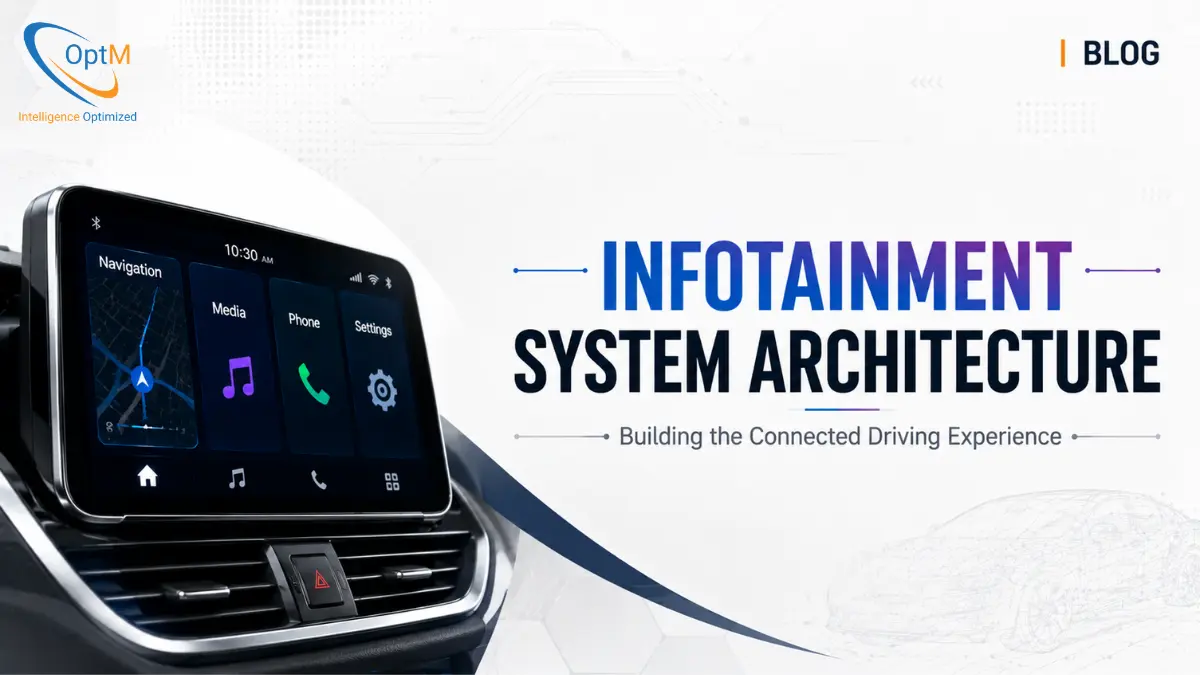
Infotainment System Architecture is the structural and logical framework that defines how a vehicle's central computing hardware, operating systems, middleware, and application software interact. It utilizes high-performance System-on-Chips (SoCs), Type-1 hypervisors, and Service-Oriented Middleware (like AUTOSAR Adaptive) to securely process multimedia, telematics, and safety-critical vehicle diagnostics across centralized and zonal vehicle networks.
Understanding this structural blueprint is the prerequisite to mastering exactly How Does Infotainment System Work at the microscopic, computational level.
The Structural Shift: From Decentralized ECUs to Zonal Control
To fully appreciate the architecture of a 2026 infotainment unit, one must understand the legacy constraints it was built to overcome. Historically, vehicles relied on a decentralized, "flat" architecture. If an OEM wanted to add a new feature—such as a driver monitoring system or a digital radio—they integrated a dedicated Electronic Control Unit (ECU) for that specific task. Over time, luxury vehicles became bloated with over 100 individual ECUs, connected by miles of heavy, complex copper wiring harnesses. This made software integration virtually impossible and severely limited cross-functional updates.
The modern SDV revolution lies in a fundamental shift from these disparate ECUs to highly centralized, zonal control systems. Today's Infotainment System Architecture is built upon the "Cockpit Domain Controller" (CDC) model.
In a CDC topology, a single, incredibly powerful computing unit absorbs the tasks previously handled by dozens of separate modules. The central unit is connected to localized "zonal controllers" via high-speed Automotive Ethernet. These zonal controllers act as regional data aggregators, managing specific physical quadrants of the vehicle (e.g., the front-left zone) and passing only necessary, synthesized data back to the central infotainment unit. This approach drastically reduces the weight of the wiring harness, consolidates processing power, and allows the system to act as a unified intelligence hub.
The Hardware Layer: Silicon and Processing Domains
The foundation of the architecture rests entirely on the physical silicon. However, the [Components of an Infotainment System](/blog/components-of-infotainment-system/sed in a domain controller are vastly different from standard consumer electronics. The core System-on-Chip (SoC) must manage a heterogeneous processing environment.
-
Application Processing Cores: High-performance, 64-bit ARM Cortex-A cores handle the heavy lifting. They execute the rich, consumer-facing operating systems, run complex multimedia decoding algorithms, and drive the high-level web engines required for connected navigation.
-
Safety-Critical Microcontrollers: Deeply embedded alongside the application cores are ARM Cortex-R or M-series real-time processing units. These exist to ensure that the core Functions of Infotainment System related to safety—such as interpreting CAN bus brake signals or deploying immediate diagnostic telltales—are executed without delay, regardless of what the application cores are doing.
-
Hardware Virtualized GPUs: The graphics pipelines are physically capable of being sliced into independent virtual contexts, allowing one GPU die to simultaneously render a 4K media display and a high-framerate digital instrument cluster with complete isolation.
-
Hardware Security Modules (HSM): To defend against cybersecurity threats, the silicon architecture integrates an HSM. This dedicated cryptographic enclave manages secure boot sequences, authenticates incoming OTA payloads, and isolates the vehicle's secure cryptographic keys from the main application processors.
The Hypervisor Layer: Achieving Hardware Virtualization
If a central SoC is running both a consumer media application and a critical speedometer display, a software crash in the media app cannot be allowed to freeze the driver's instrument cluster. This is where the hypervisor layer becomes the most critical architectural boundary in the system.
A Type-1 Hypervisor (such as QNX Hypervisor) sits directly on the bare metal of the SoC. Its singular job is to completely abstract the physical hardware and partition it into isolated Virtual Machines (VMs).
-
The Unsecure Domain: One virtual machine is allocated to run rich, feature-heavy operating systems that connect to the outside world. This domain is firewalled so that even if it is compromised by a malicious application, the threat cannot pivot into the rest of the vehicle.
-
The Secure Domain: The other virtual machine runs a highly deterministic Real-Time Operating System (RTOS). The hypervisor enforces strict hardware-level memory boundaries (using an IOMMU) and hard-schedules CPU time, guaranteeing that the secure domain always has the processing resources required to maintain functional safety.
By managing the Inter-Process Communication (IPC) via zero-copy shared memory bridges, the hypervisor allows these two isolated domains to safely share data—such as passing song metadata from the unsecure domain to the secure instrument cluster—without introducing latency or security vulnerabilities.
Operating Systems: The Backbone of Software Architecture
The execution of the user experience relies heavily on the OS layer. In modern cockpits, the Role of Embedded Software in Infotainment System development is paramount because it dictates how efficiently the hardware resources are utilized.
Within the unsecure domain, OEMs heavily leverage Android Automotive OS (AAOS) or heavily customized Yocto-based Embedded Linux. AAOS provides a massive ecosystem of native applications, but it requires a specialized native service layer known as the CarService to interface with the vehicle's unique properties (like climate controls and window states).
Within the secure domain, the RTOS (like QNX Neutrino) executes with absolute determinism. It handles the low-level diagnostic routines, immediate boot-up animations, and localized CAN network gateways.
Bridging the operating systems with the physical hardware is the Vehicle Hardware Abstraction Layer (VHAL). The VHAL translates the high-level API calls from the operating systems into the specific binary protocols required by the underlying electronic control units, allowing software engineers to write code once and deploy it across entirely different vehicle chassis architectures.
Middleware and Service-Oriented Architecture (SOA)
As software complexity skyrockets, hard-wiring direct communication links between every software component is no longer viable. The modern architectural standard relies on a Service-Oriented Architecture (SOA), frequently implemented through frameworks like the AUTOSAR Adaptive Platform.
In a traditional Classic AUTOSAR environment, communication is signal-based and statically configured during the vehicle's initial build. In contrast, the AUTOSAR Adaptive Platform implements a dynamic, service-oriented middleware environment suitable for high-performance computing. Instead of hard-coded communication pathways, software components are encapsulated as interoperable, loosely coupled services.
When an application (the "Service Consumer") needs data—such as the current vehicle speed—it queries a Service Broker over the IP network using SOME/IP (Scalable service-Oriented MiddlewarE over IP). The broker dynamically connects the consumer to the "Service Provider" application. This modular approach allows OEMs to add, remove, or update individual software components via OTA updates without having to recompile the entire system architecture. It provides the ultimate flexibility, enabling rapid personalization and continuous feature evolution over the lifetime of the vehicle.
UI/UX Architecture: The Presentation Layer
The presentation layer of the architecture is where complex engineering meets human psychology. The foundational Infotainment System UI/UX Design relies on sophisticated graphics frameworks, primarily the Qt / QML ecosystem.
The software architecture separates the backend logic from the frontend visual rendering. Using the Qt Scene Graph, the system compiles UI elements into a highly optimized node tree. When the system state changes, the Scene Graph batches these updates and passes them directly to the GPU via low-level APIs like OpenGL ES or Vulkan.
In B2B and premium SDV implementations, the visual architecture is strictly governed by cognitive load reduction principles. Automotive UX architects avoid high-latency 3D bloat. Instead, they rely on clean, minimalist matrix layouts. By leveraging distinct brand colors for indivisual companies—such as rendering critical menus against a deep #001941 background, utilizing #0278A0 for primary navigation paths, and reserving #C2FB81 strictly for success states and EV charging confirmations—the architecture ensures that the driver receives high-contrast, instantly readable information without suffering visual distraction.
Triple buffering and hardware V-Sync interrupts are structurally mandated within this graphics pipeline to ensure flawless 60fps transitions without any visual screen tearing.
Integration Architectures: Sensors, Telematics, and Cloud Connectivity
An isolated domain controller is functionally blind. The true power of the SDV is unlocked through comprehensive Infotainment System Integration with ECUs, Sensors, Displays and Connectivity Modules.
The architecture manages this integration through a highly orchestrated networking topology:
-
The CAN FD Backbone: The system interfaces with legacy body and powertrain ECUs via Controller Area Network Flexible Data-Rate (CAN FD) transceivers, parsing low-bandwidth sensor data (like wheel speed or cabin temperature) in real-time.
-
Automotive Ethernet and TSN: For heavy data payloads—such as routing raw 4K video from surround-view ADAS cameras directly to the display—the architecture utilizes Automotive Ethernet (IEEE 802.3bw). To ensure that a video stream does not choke out a safety-critical braking signal, the network layer implements Time-Sensitive Networking (TSN) and Audio Video Bridging (AVB) standards, prioritizing packets with microsecond accuracy.
-
The Telematics Control Unit (TCU): The architecture extends into the cloud via the TCU. Using MQTT or secure WebSockets protocols over 5G networks, the system continuously offloads encrypted edge-processed telemetry to the OEM's enterprise backend. This creates a bidirectional pipeline that not only reports vehicle health but serves as the ingress point for cloud-native voice assistants and remote software updates.
The Validation Architecture: Ensuring Functional Safety
Because the infotainment system now interacts directly with the vehicle's driving dynamics, the architectural development process cannot proceed without rigorous safety verification. Extensive Infotainment System Testing and Validation frameworks are baked into the core engineering lifecycle.
System architects must comply with the ISO 26262 standard for functional safety. During the design phase, engineers conduct a Hazard Analysis and Risk Assessment (HARA) to assign an Automotive Safety Integrity Level (ASIL) to every architectural component. While a media player might be rated ASIL-A or Quality Management (QM), the software pipeline rendering the digital speedometer is often rated ASIL-B, requiring redundant code paths, separate memory allocations, and intense static code analysis.
Before the software is ever flashed to a physical vehicle, it runs through automated Software-in-the-Loop (SIL) pipelines, followed by intense Hardware-in-the-Loop (HIL) testing. In HIL testbenches, the physical SoC is bombarded with simulated CAN bus faults, network overloads, and extreme thermal conditions to ensure the hypervisor isolation and RTOS scheduling remain flawless under catastrophic stress.
Architectural Bottlenecks: Overcoming Deployment Challenges
Designing this architecture on a whiteboard is one thing; deploying it into a mass-market vehicle involves overcoming severe physical and logical hurdles.
Navigating stringent thermal dissipation limits, managing sprawling software supply chains, and preventing cybersecurity intrusions represent the most complex Challenges in Infotainment System Development. Because a high-performance SoC generates massive amounts of heat, the physical PCB layout must utilize High-Density Interconnect (HDI) manufacturing to optimize passive cooling via heavy aluminum heat sinks.
Furthermore, as the industry adopts Service-Oriented Architectures, managing the interoperability of software components supplied by dozens of different Tier-1 and Tier-2 vendors requires incredibly strict interface definitions and continuous, automated integration testing to ensure that a software update from one vendor does not break the API endpoints relied upon by another.
Real-World Architectural Workflow: An Over-The-Air (OTA) Update Executing Across the Stack
To visualize how all these architectural layers collaborate, we can map the execution of a real-world, high-stakes scenario: A vehicle receiving and installing a critical Over-The-Air (OTA) firmware update to patch an ADAS sensor vulnerability while driving.
Cloud Ingress (Telematics Layer): The vehicle's external 5G TCU receives a secure ping from the OEM's cloud server indicating a mandatory update is available. The system establishes a secure TLS tunnel.
Cryptographic Validation (Hardware Security Layer): As the encrypted binary payload streams into the vehicle's Universal Flash Storage (UFS), the SoC's embedded Hardware Security Module (HSM) intercepts the file headers. It executes a rapid ECDSA hash verification against the OEM's master certificate stored in immutable silicon, proving the update is authentic.
Background Processing (Hypervisor & SOA Layer): The Type-1 Hypervisor allocates background CPU cycles to the Embedded Linux middleware. The AUTOSAR Adaptive service broker coordinates the unpacking of the payload without disrupting the foreground Android media applications.
A/B Partition Writing (OS Layer): The architecture utilizes an A/B partition scheme. The vehicle is currently running perfectly on Partition A. The system silently unpacks and installs the new firmware onto the hidden Partition B, ensuring zero downtime for the driver.
HMI Notification (Presentation Layer): Once fully staged, the VHAL triggers a system event. The Qt Scene Graph renders a non-intrusive, high-contrast visual prompt on the display asking the driver to confirm the installation upon their next vehicle shutdown.
Network Distribution (Integration Layer): Upon driver confirmation and vehicle shutdown, the central domain controller acts as the OTA master. It routes the specific ADAS sensor patches via SOME/IP over Automotive Ethernet directly to the targeted zonal controllers and peripheral ECUs, completing the architectural loop flawlessly.
This seamless choreography highlights the tremendous commercial and operational Benefits of Infotainment System technology. By leveraging a centralized, service-oriented architecture, OEMs transform the vehicle from a depreciating hardware asset into an evolving, scalable digital platform that improves continuously over time.
Driving the Future with Advanced System Architectures
The architecture of a modern digital cockpit is not just a diagram of chips and wires; it is the structural foundation of the software-defined mobility era. By moving from legacy, decentralized ECUs to powerful, virtualized domain controllers connected via service-oriented middleware, the automotive industry has unlocked unprecedented levels of performance, safety, and personalization.
Executing this level of architectural integration requires an engineering partner who understands the deep interconnected realities of silicon virtualization, secure network topologies, and flawless Qt-based UI execution.
For original equipment manufacturers and Tier-1 suppliers aiming to architect, validate, and deploy the next generation of highly scalable, structurally secure in-cabin computing environments, explore the comprehensive engineering expertise behind the Automotive Infotainment System by OptM.
Frequently Asked Questions (FAQs)
What is the difference between Service-Oriented Architecture (SOA) and signal-based architecture?
In legacy signal-based architectures, communication paths between ECUs are statically hardcoded. In SOA (like AUTOSAR Adaptive), software components act as decoupled services. Applications dynamically "subscribe" to the data they need via a Service Broker, allowing for infinite scalability.
How does a zonal architecture reduce wiring harness complexity?
Instead of running a wire from every sensor directly to the central dashboard, zonal architecture routes local sensors to a nearby "Zonal Controller." This controller aggregates the data and sends a single, high-speed Ethernet cable to the central domain controller, slashing copper weight.
Why are Type-1 hypervisors used instead of Type-2 in automotive?
Type-2 hypervisors run on top of a host operating system, introducing unacceptable latency and a massive attack surface. Type-1 hypervisors run directly on the bare-metal silicon, providing hardware-enforced isolation and deterministic performance.
What is the function of the SOME/IP protocol in the middleware layer?
SOME/IP (Scalable service-Oriented MiddlewarE over IP) is the primary protocol used in automotive SOA. It allows applications to dynamically discover, subscribe to, and request data from remote services across the vehicle's Automotive Ethernet network.
How is memory isolation achieved between different virtual machines?
The hypervisor utilizes the hardware’s Input-Output Memory Management Unit (IOMMU). It maps specific physical RAM blocks to specific virtual machines. If one VM tries to read or write to another VM's memory space, the hardware instantly blocks the transaction.
How does the architecture ensure ISO 26262 ASIL-B compliance?
By physically isolating safety-critical tasks (ASIL-B) into a separate RTOS domain, enforcing strict temporal scheduling so the RTOS is never starved of CPU cycles, and utilizing End-to-End (E2E) mathematical validation on all incoming safety network packets.
How does the VHAL simplify cross-platform deployment for OEMs?
The Vehicle Hardware Abstraction Layer decouples the software from the hardware. An OEM can use the exact same Android OS across an EV and a gas truck; they simply rewrite the VHAL to translate the OS commands into the specific CAN bus payloads required by each chassis.