
Content Writer & SEO Specialist
Content Writer & SEO Specialist
Aditya Sharma is a content writer at OptM Solutions specializing in automotive electronics, embedded systems, telematics, electric vehicle technologies, connected mobility, and autonomous driving technologies.
LinkedIn ProfileThe automotive industry's transition from hardware-centric to software-defined vehicle (SDV) architectures represents the single most powerful growth driver for embedded software. According to a comprehensive industry analysis by Dataintelo, the global embedded software market was valued at $18.6 billion in 2025 and is projected to reach $40.5 billion by 2034, expanding at a compound annual growth rate (CAGR) of 9.0%. Modern electric and autonomous vehicles require deeply integrated embedded software stacks spanning powertrain control modules, battery management systems, ADAS sensor fusion algorithms, and over-the-air (OTA) update frameworks. Industry analysts estimate that software now accounts for more than 40% of a premium vehicle's total value, up from under 10% in 2010.
In the context of the digital cockpit, the central computing unit is completely useless without the microscopic lines of code dictating its behavior. The physical screens, the multi-core System-on-Chips (SoCs), and the high-speed networking transceivers are merely dormant silicon until the embedded software stack breathes life into them. To build robust, functionally safe domain controllers, Tier-1 suppliers and original equipment manufacturers (OEMs) must shift their engineering focus from simply sourcing hardware to mastering the complex, multi-layered codebases that govern that hardware.
Before exploring the highly intricate execution pipelines of these operating systems, we highly recommend establishing a firm structural baseline by reading our definitive pillar guide on exactly What Is Infotainment System technology within the 2026 mobility ecosystem.
In this exhaustive engineering deep-dive, we will strip away the consumer-facing user interfaces to reveal the foundational code beneath. We will explore how hypervisors partition physical memory, how real-time operating systems guarantee microsecond execution deadlines, and how hardware abstraction layers allow automakers to deploy a single codebase across entirely different vehicle chassis.
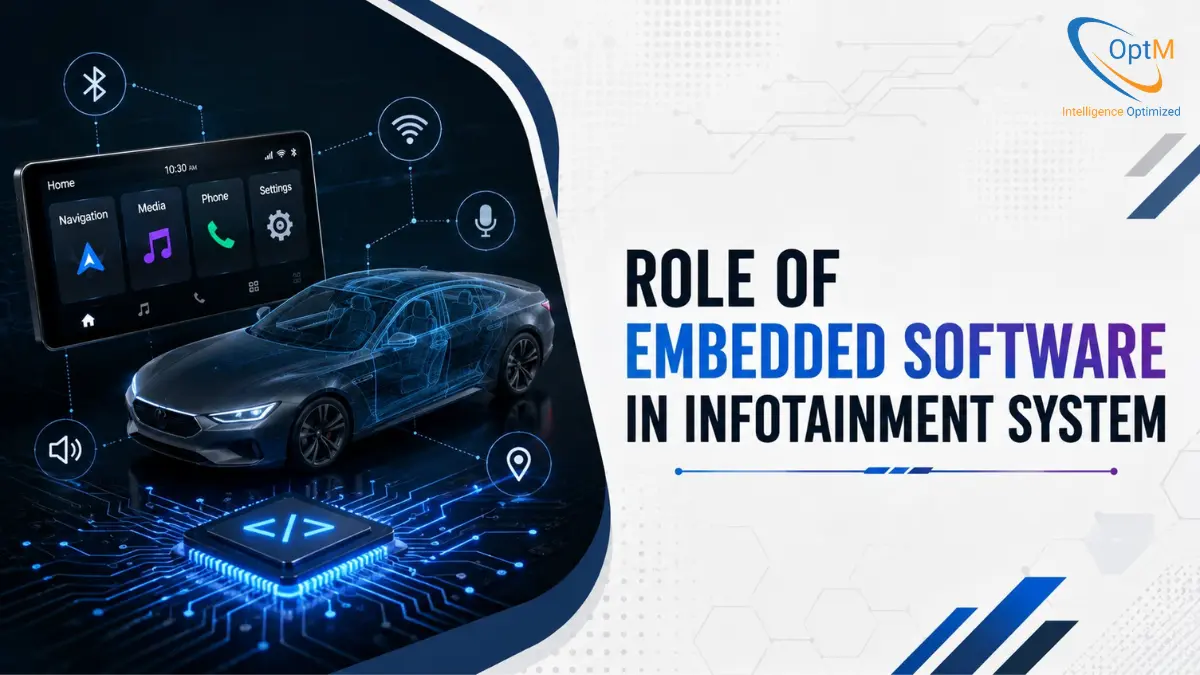
What is the Role of Embedded Software in an Infotainment System?
Embedded software is the foundational codebase that dictates the deterministic behavior of an infotainment system's hardware. It operates below the application tier, encompassing bootloaders, Board Support Packages (BSPs), Type-1 hypervisors, middleware, and Real-Time Operating Systems (RTOS). Its primary role is to orchestrate hardware virtualization, ensure zero-latency execution of safety-critical Advanced Driver Assistance Systems (ADAS) alerts, and translate high-level user interface commands into low-level vehicular network protocols.
1. The Foundational Layer: Bootloaders and Silicon Initialization
The role of embedded software begins the absolute millisecond the driver initiates the vehicle's ignition sequence. Before an operating system can even load, the raw silicon must be initialized. This is the domain of the boot sequence and the Board Support Package (BSP).
The Primary and Secondary Bootloaders
When power is applied to the SoC, the hardware executes a hardcoded Primary Bootloader (PBL) located in the silicon's immutable Read-Only Memory (ROM). The PBL's sole job is to initialize the basic clocks and load the Secondary Bootloader (SBL), such as U-Boot, from the non-volatile Universal Flash Storage (UFS) into the SoC's static RAM (SRAM).
The SBL executes a massive cascade of hardware initializations. It configures the Phase-Locked Loops (PLLs) to ramp up the CPU clock speeds, initializes the DDR memory controllers, and establishes the basic physical layer routing for the primary communication buses. In an automotive environment, this sequence must be ruthlessly optimized. A driver expects the digital instrument cluster to illuminate and display the current battery state-of-charge within less than two seconds of pressing the start button. If the bootloader takes five seconds to initialize the memory controllers, the entire user experience is immediately compromised.
The Board Support Package (BSP) and Device Trees
Because OEMs use custom printed circuit boards (PCBs) with unique configurations of memory chips, networking transceivers, and display serializers, the operating system kernel cannot intuitively know how to communicate with the physical hardware.
The embedded software solves this via the Board Support Package (BSP). The BSP contains the low-level device drivers and the Device Tree Blob (DTB). The Device Tree acts as a physical map of the hardware, telling the operating system kernel exactly which memory addresses map to the GPU, which interrupt lines are connected to the CAN transceiver, and how to initialize the thermal management sensors.
Without a perfectly optimized BSP, the operating system will suffer from kernel panics, random reboots, and severe memory leaks. The engineering investment at this layer defines the stability of the entire digital cockpit.
2. Hardware Virtualization: The Domain of the Type-1 Hypervisor
In a modern Infotainment System Architecture, a single high-performance SoC must run multiple operating systems concurrently. It must run a rich, internet-connected media OS alongside a deterministic, safety-critical OS handling the speedometer and ADAS warnings.
If the media OS suffers a fatal crash due to a memory leak in a third-party application, it cannot be allowed to take down the safety-critical OS. Ensuring this absolute isolation is the role of the Type-1 Hypervisor.
Bare-Metal Execution
Unlike a Type-2 hypervisor (which runs on top of a host operating system like a desktop application), an automotive Type-1 hypervisor runs directly on the "bare metal" of the SoC. It executes at the highest hardware privilege level (such as ARM Exception Level 2) and takes total control of the physical silicon.
Spatial Isolation via the IOMMU
The hypervisor partitions the physical resources into completely isolated Virtual Machines (VMs). To achieve spatial isolation, it manipulates the hardware's Input-Output Memory Management Unit (IOMMU). The hypervisor maps specific physical RAM pages exclusively to specific VMs. If a malicious process running in the unsecure media domain attempts to execute a buffer overflow attack or read memory belonging to the secure instrument cluster domain, the IOMMU triggers an immediate hardware exception, blocking the transaction entirely and preventing cross-domain corruption.
Temporal Partitioning and Hard Scheduling
Spatial isolation is not enough; the hypervisor must also guarantee temporal isolation to prevent resource starvation. If the unsecure media domain attempts to consume 100% of the CPU cycles to render a massive 3D navigation map, it could delay the rendering of an emergency brake warning in the secure domain.
The embedded hypervisor utilizes strict, fixed-priority scheduling algorithms. It enforces "hard scheduling" slices, guaranteeing that the secure VM always receives its mandated CPU cycles and memory bandwidth every single millisecond, regardless of the workload occurring in the unsecure VM.
3. The Secure Domain: Real-Time Operating Systems (RTOS)
The virtual machine responsible for functional safety and localized vehicle networks runs a specialized piece of embedded software known as a Real-Time Operating System (RTOS), such as QNX Neutrino or Green Hills INTEGRITY.
Determinism Over Throughput
General-Purpose Operating Systems (GPOS) like Linux are designed for maximum overall data throughput and fairness, utilizing completely dynamic task schedulers. An RTOS is designed for absolute determinism. Determinism means that an RTOS guarantees a specific task will be executed within a strict, predefined microsecond deadline, every single time, without exception.
If the RTOS receives a hardware interrupt from the Controller Area Network (CAN) bus indicating that the ABS module has engaged, it must update the digital instrument cluster instantly. The RTOS utilizes preemptive, priority-based scheduling. The ABS interrupt is assigned the highest system priority. The moment that interrupt arrives, the RTOS will instantly pause (preempt) whatever lower-priority task it was executing, save the context state of the CPU, execute the ABS warning rendering pipeline, and then return to the lower-priority task.
Microkernel Architectures
To achieve automotive-grade reliability, many RTOS platforms utilize a microkernel architecture. In a monolithic kernel (like standard Linux), the file systems, networking stacks, and device drivers all run in the same privileged kernel space. A single bug in a device driver can crash the entire system.
In a microkernel RTOS, the kernel is stripped down to the absolute bare minimum: managing thread scheduling, basic memory protection, and Inter-Process Communication (IPC). All other services (device drivers, networking protocols, graphics frameworks) run as isolated processes in user space. If the CAN bus driver crashes, the microkernel detects the failure and instantly restarts the driver process without affecting the rest of the operating system, ensuring the digital cockpit remains functional.
4. The Unsecure Domain: Embedded Linux and Android Automotive OS (AAOS)
Operating in the adjacent virtual machine is the unsecure domain, tasked with providing the rich, connected consumer experience. Automakers overwhelmingly deploy heavily customized distributions of Embedded Linux (often built using the Yocto Project) or Android Automotive OS (AAOS).
The Yocto Project and Custom Linux Builds
For OEMs looking to maintain absolute control over their software ecosystem, the Yocto Project allows engineers to compile a custom, lightweight Linux distribution containing only the specific libraries, drivers, and frameworks required by the infotainment hardware. This eliminates the massive software bloat associated with consumer operating systems, resulting in ultra-fast boot times and minimal memory footprints.
Android Automotive OS and the CarService
AAOS is not to be confused with "Android Auto," which is simply an application that projects a smartphone screen onto the dashboard. AAOS is a full, standalone operating system running natively on the vehicle's hardware.
The embedded software architecture of AAOS relies heavily on a specialized background daemon known as the CarService. This service exposes a unified, standardized set of Java APIs (the CarPropertyManager) to the application layer. When a third-party media app or a built-in climate control app wants to interact with the vehicle, it queries the CarService. The service abstracts the complexity of the vehicle's underlying sensors, allowing software developers to build complex in-cabin experiences without needing to understand the vehicle's low-level wiring schematics.
5. The Translation Bridge: Vehicle Hardware Abstraction Layer (VHAL)
The operating system frameworks (like AAOS) exist in a high-level software environment, understanding concepts like "increase volume" or "set cabin temperature to 72 degrees." However, the vehicle's physical components communicate in binary electrical pulses over localized networks.
The embedded software bridges this massive translation gap via the Vehicle Hardware Abstraction Layer (VHAL).
Decoupling Software from Hardware
The VHAL is a rigorously defined C++ interface that sits between the operating system framework and the low-level kernel drivers. When a user taps the touchscreen to roll down a window, the OS passes the generic WINDOW_DOWN command to the VHAL.
The VHAL contains the proprietary logic required to translate that generic command into the specific, bit-mapped payload required by that specific vehicle's CAN bus architecture.
This abstraction is the key to scalability. An OEM can develop a single, beautiful user interface and OS configuration and deploy it across a compact electric vehicle and a massive commercial truck. The underlying physical ECUs and wiring harnesses of those two vehicles are completely different. The OEM simply rewrites the VHAL specific to each vehicle to translate the commands correctly, completely decoupling the massive investment in software development from the fragmented realities of hardware manufacturing.
6. Middleware and Service-Oriented Architectures (SOA)
As modern vehicles deploy gigabytes of software, hard-coding direct communication links between every software component and sensor is impossible. The industry is currently executing a massive architectural shift from signal-based communication to Service-Oriented Architectures (SOA), largely driven by standards like the AUTOSAR Adaptive framework.
Moving Beyond Signal-Based Routing
In legacy systems, communication was static. The engine ECU was hard-coded to broadcast RPM data on a specific CAN ID, and the instrument cluster was hard-coded to listen to that ID.
In a modern SOA environment, software components are decoupled. They act as independent "Services." The embedded software deploys a central Service Broker. When a new application loads—such as a predictive navigation module—it dynamically queries the broker over the Automotive Ethernet network using protocols like SOME/IP (Scalable service-Oriented MiddlewarE over IP).
The application essentially asks the network: "Does any service currently provide real-time battery state-of-charge data?" The Battery Management System (BMS) software replies, and the two components dynamically bind to each other. This publish-subscribe middleware allows engineers to add, update, or completely remove software features via OTA updates without having to re-compile or re-flash the entire vehicle network.
7. Inter-Process Communication (IPC) and Shared Memory
Because the hypervisor isolates the secure RTOS domain from the unsecure AAOS domain, they cannot easily share data. However, the system requires massive cross-domain communication. For example, the AAOS media player needs to display the current track metadata on the digital instrument cluster managed by the RTOS.
To achieve this without violating security policies, the embedded software utilizes advanced Inter-Process Communication (IPC) mechanisms.
Zero-Copy Shared Memory Bridges
Passing data via traditional network sockets introduces unacceptable CPU overhead and latency. Instead, the hypervisor allocates a dedicated block of physical RAM as a Shared Memory buffer using standardized protocols like VirtIO.
Both the RTOS and AAOS map this physical memory block into their respective virtual memory spaces. When the media player updates the track name, it writes the data directly into the shared memory block. To prevent race conditions (where AAOS tries to write data at the exact microsecond the RTOS tries to read it), the software employs strict Mutexes (Mutual Exclusions) and Spinlocks. Once the data is written, the hypervisor fires a virtual interrupt to the RTOS, which instantly reads the updated pointer from the shared memory without having to copy the data payload, resulting in near-zero latency cross-domain communication.
8. Ensuring Functional Safety: ISO 26262 and ASIL Classifications
Unlike consumer electronics software, a bug in automotive embedded software can result in catastrophic physical injury. Consequently, the development of this code is governed by brutal functional safety standards. The MISRA C coding standards, and ISO 26262 functional safety certification requirements are pushing automakers to consolidate embedded software development with tier-1 suppliers and specialized vendors, accelerating market concentration and value creation.
Hazard Analysis and Risk Assessment (HARA)
Before a single line of code is written, system architects execute a rigorous Hazard Analysis and Risk Assessment (HARA). Every software function is evaluated based on severity, probability of exposure, and driver controllability to determine its Automotive Safety Integrity Level (ASIL).
- ASIL QM (Quality Management): Non-safety critical features, like the Bluetooth pairing menu. A crash here is an inconvenience.
- ASIL B or ASIL D: Safety-critical features, like the software rendering the ABS warning light or processing the collision avoidance radar. A crash here is life-threatening.
The embedded software architecture enforces strict separation between these classifications. The codebase managing ASIL D functions must utilize redundant data paths, end-to-end CRC validation for all memory transfers, and dual-core lockstep execution. By 2026, global automakers are expected to spend in excess of $22 billion collectively on vehicle software development, with embedded components comprising approximately 65% of that total. This massive investment is driven directly by the cost of achieving and proving ISO 26262 compliance across millions of lines of code.
9. The Continuous Integration and Continuous Deployment (CI/CD) Pipeline
Because automotive software is constantly evolving, OEMs cannot rely on manual compilation and testing. The embedded software lifecycle relies on aggressive, automated CI/CD pipelines.
When a developer commits a code change to the repository, the CI server automatically triggers a massive suite of verifications.
-
Static Code Analysis: Tools scan the raw C/C++ code to ensure absolute compliance with MISRA (Motor Industry Software Reliability Association) guidelines, rejecting any code that utilizes unsafe memory allocations or infinite loops.
-
Software-in-the-Loop (SIL): The code is compiled for a simulated host environment, where automated scripts execute thousands of unit tests to verify logical execution pathways.
-
Hardware-in-the-Loop (HIL): The code is automatically flashed onto a physical SoC target board sitting in a laboratory test rack. The rack injects millions of simulated CAN bus faults and simulated sensor failures directly into the hardware pins, proving the embedded software can gracefully recover from catastrophic hardware failures without crashing.
Understanding the rigor of this pipeline is essential. We explore these advanced testing methodologies further in our dedicated technical guide on Infotainment System Testing and Validation.
10. Managing the Vehicle Lifecycle: Secure Over-The-Air (OTA) Updates
The ultimate commercial leverage point of the software-defined vehicle is the ability to improve the vehicle post-sale. The embedded software acts as the secure gateway and orchestrator for all Over-the-Air (OTA) firmware updates.
A/B Partitioning and Delta Payloads
When the vehicle's 5G modem downloads a massive OS update, writing that update directly to the active storage drive is incredibly dangerous; a power failure during the write process would "brick" the vehicle.
To solve this, the embedded software utilizes A/B partition architecture. The SoC's storage drive is divided into two identical, isolated partitions. The vehicle runs actively on Partition A. The OTA manager daemon silently unpacks the downloaded binary and installs it into the dormant Partition B in the background. To save cellular bandwidth, the software utilizes "delta payloads," downloading only the specific bytes of code that have changed, rather than a full 5-gigabyte OS image.
Cryptographic Execution
Before the vehicle switches to the new software, it must prove the code is authentic. The embedded software commands the hardware's isolated cryptographic module (the HSM) to execute complex Elliptic Curve Digital Signature Algorithm (ECDSA) and RSA hash verifications against the OEM's root public keys stored in secure silicon. If the signatures match perfectly, the bootloader updates its internal pointers. Upon the next vehicle restart, the system boots seamlessly into Partition B. If the new software crashes during the initial boot sequence, a hardware watchdog timer detects the failure and instantly rolls the bootloader back to the stable Partition A, guaranteeing the driver is never stranded by a software bug.
11. Overcoming Ecosystem Complexities Through Deep Integration
A digital cockpit isolated from the rest of the chassis provides zero value. The embedded software must act as a massive integration hub, unifying the disparate electronic domains of the vehicle.
This requires writing highly optimized device drivers and networking stacks capable of digesting data from an incredibly diverse array of external sensors. The system must process high-resolution LiDAR point clouds over Automotive Ethernet while simultaneously reading low-speed temperature sensors over a LIN bus. The complexity of routing, prioritizing, and translating these massive data streams highlights why mastering Infotainment System Integration with ECUs, Sensors, Displays and Connectivity Modules is considered one of the most difficult disciplines in modern engineering.
12. Real-World Workflow Example: Embedded Software Executing a Fault Recovery
To synthesize how these complex, invisible software layers protect the driver, let us examine a microscopic workflow of an embedded software architecture mitigating a catastrophic application crash during highway driving.
-
The Fault Condition: The driver is traveling at 75 MPH. The Android Automotive OS (AAOS) in the unsecure domain is running a third-party, cloud-connected navigation application. Due to a poorly handled memory leak in the app's rendering engine, the application consumes all available RAM allocated to the unsecure virtual machine, causing the entire AAOS kernel to lock up (kernel panic).
-
Hypervisor Intervention: The Type-1 Hypervisor instantly detects that the AAOS virtual CPU has stopped responding to standard scheduling interrupts.
-
Strict Isolation: Because the hypervisor enforces strict IOMMU memory protection, the memory corruption remains entirely trapped within the unsecure domain. The secure RTOS domain (handling the digital instrument cluster) is completely unaffected and continues to receive its hard-scheduled CPU cycles. The driver continues to see their exact speed and active ADAS lane-keep assist warnings without a single dropped frame.
-
The Watchdog Trigger: Inside the RTOS, a low-level system health monitoring daemon (a Watchdog Timer) fails to receive the expected "heartbeat" ping from the AAOS domain over the VirtIO shared memory bridge.
-
Automated Recovery: The RTOS sends a high-priority hardware signal to the hypervisor, commanding a hard reset of the specific virtual CPU cores assigned to the AAOS domain.
-
Seamless Re-initialization: The hypervisor flushes the unsecure memory pages and re-initializes the AAOS boot sequence. Within a few seconds, the Android interface re-appears on the central display, having recovered from a fatal crash automatically, all while the vehicle remained perfectly safe and operable at highway speeds.
This seamless recovery mechanism is the true testament to automotive-grade embedded software engineering. It ensures that the inevitable complexities of consumer software can exist in the same hardware environment as life-saving vehicle telemetry without ever compromising functional safety.
Final Thoughts: The DNA of the Software-Defined Vehicle
The role of embedded software in a modern infotainment system is nothing short of absolute orchestration. It is the invisible connective tissue that binds cold silicon, copper wiring, and high-level artificial intelligence into a cohesive, intelligent, and safe mobility platform. From the low-level bootloaders initializing memory controllers in microseconds, to the hypervisors enforcing strict virtual isolation, to the dynamic middleware routing cloud-native telematics, every single line of code must be meticulously engineered, analyzed, and validated.
As the industry accelerates toward higher levels of autonomy and connected services, the OEMs and Tier-1 suppliers that will dominate the market are those who treat embedded software not as an afterthought, but as the foundational architecture of their entire vehicle lineup.
For automakers, procurement teams, and system architects aiming to deploy the next generation of secure, deterministic, and highly scalable in-cabin computing environments, execution is paramount. Explore the comprehensive embedded software engineering capabilities, RTOS integration expertise, and hypervisor architecture utilized within the Automotive Infotainment System engineered by OptM Solutions.
Frequently Asked Questions (FAQs)
What is the difference between a monolithic kernel and a microkernel in an RTOS?
In a monolithic kernel (like Linux), all drivers and file systems run in privileged kernel space; a driver bug can crash the whole OS. In a microkernel (like QNX), only basic scheduling runs in kernel space. Drivers run in isolated user space, so a crashed CAN driver can be restarted without affecting the OS.
How does a bootloader initialize an automotive SoC to meet strict startup times?
The Primary Bootloader (PBL) initializes base silicon clocks, followed instantly by a Secondary Bootloader (SBL) which rapidly configures PLLs and DDR memory controllers. This highly optimized, assembly-level software sequence ensures the digital cluster illuminates within 2 seconds of ignition.
Why is MISRA-C compliance mandatory for automotive embedded software?
MISRA-C is a set of rigid software development guidelines for the C programming language that bans dangerous coding practices (like dynamic memory allocation or infinite loops) that frequently cause memory leaks and undefined behavior in safety-critical systems.
How do zero-copy shared memory bridges work for Inter-Process Communication (IPC)?
Instead of copying data through a network socket, the hypervisor allocates a block of physical RAM accessible to both virtual machines. When the media OS updates a song title, it writes a pointer to that block. The RTOS reads the pointer instantly, achieving near-zero latency data sharing.
What happens if the hypervisor detects a deadlock in a shared memory block?
If a crashed unsecure OS holds a "spinlock" on shared memory, preventing the secure RTOS from reading data, a low-level software Watchdog Timer detects the timeout. It forcefully breaks the lock and triggers an isolated reboot of the unsecure OS to clear the deadlock.
How does the Device Tree Blob (DTB) map physical hardware for the OS?
Because every OEM uses custom PCBs, the DTB acts as a configuration file that tells the operating system kernel exactly which memory addresses map to the GPU, which pins handle CAN interrupts, and how to route power, preventing the kernel from guessing hardware states.
Why are delta payloads used for Over-The-Air (OTA) updates?
Instead of downloading a full 5-gigabyte OS image, the embedded OTA manager calculates the exact binary differences between the old software and the new software. It downloads only the "delta" (changed bytes), saving massive amounts of cellular bandwidth and download time.