
Content Writer & SEO Specialist
Content Writer & SEO Specialist
Aditya Sharma is a content writer at OptM Solutions specializing in automotive electronics, embedded systems, telematics, electric vehicle technologies, connected mobility, and autonomous driving technologies.
LinkedIn ProfileIn the modern automotive engineering landscape, building a high-performance central computing unit is only a fraction of the challenge. A digital cockpit domain controller, no matter how powerful its multi-core processors or how advanced its hypervisor architecture, is functionally inert if it operates in isolation. The true engineering mastery of the software-defined vehicle (SDV) lies in integration—the microscopic, deterministic orchestration of thousands of discrete data streams flowing between the central dashboard and the furthest physical edges of the vehicle chassis.
The demand for this seamless integration is reshaping the automotive economy. According to a comprehensive industry analysis by IMARC Group, the global automotive software market size reached USD 26.9 billion in 2025 and is expected to surge to USD 92.8 billion by 2034, exhibiting a compound annual growth rate (CAGR) of 14.31%. This massive capital influx is primarily directed at solving the complexities of cross-domain integration, ensuring that edge sensors, telematics gateways, and powertrain modules can communicate flawlessly with the central user interface.
For original equipment manufacturers (OEMs) and Tier-1 electronics suppliers, mastering this interconnectivity is the ultimate engineering mandate. Before exploring the highly complex network topologies and middleware bridges that make this possible, we strongly recommend establishing a foundational understanding by reading our definitive pillar guide on exactly What Is Infotainment System technology within the 2026 mobility ecosystem.
In this exhaustive technical deep-dive, we will explore the precise mechanics of integration, breaking down how the central domain controller parses localized traffic, how it ingests massive video payloads, and how it synchronizes multi-screen rendering pipelines without a single microsecond of latency.
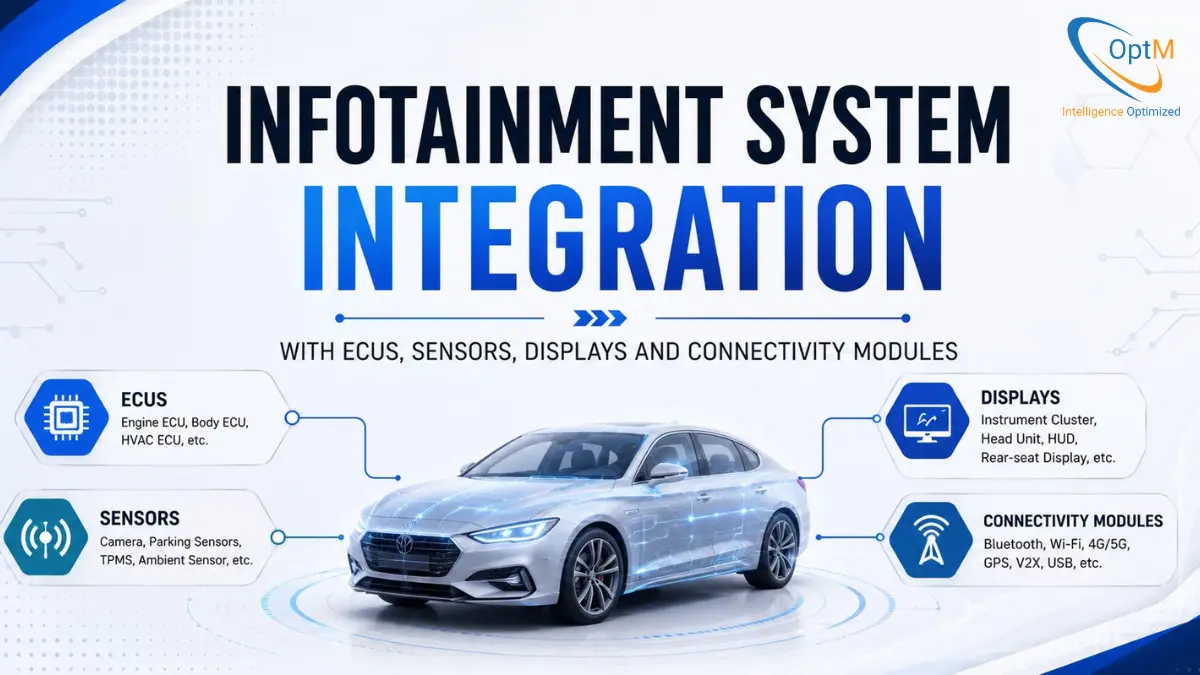
Integration with Electronic Control Units (ECUs)
The modern vehicle relies on dozens of peripheral Electronic Control Units (ECUs) to execute physical, mechanical actions—from engaging the anti-lock braking system (ABS) to rolling down a window. The infotainment system must integrate flawlessly with these legacy components to function as a true command center.
The Shift to Zonal and Domain Architectures
Historically, vehicles utilized a decentralized electrical/electronic (E/E) architecture where every new feature required a new ECU and dedicated copper wiring. The modern integration paradigm completely reverses this model.
-
Zonal Aggregation: The vehicle is divided into physical zones (e.g., front-left, rear-right). Localized Zonal Controllers aggregate the data from the basic ECUs in their physical quadrant.
-
Domain Centralization: These zonal controllers send a consolidated, high-speed data stream back to the central Cockpit Domain Controller (the infotainment system).
-
Command Execution: The central System-on-Chip (SoC) processes this aggregated data, executes complex logical decisions, and sends unified commands back down to the zones, drastically reducing wiring weight and centralizing software execution.
Managing Vehicle Telemetry via CAN FD
For the vast majority of vehicle control telemetry, the infotainment system integrates via Controller Area Network Flexible Data-Rate (CAN FD).
-
Physical Transceivers: A physical CAN transceiver on the infotainment system's printed circuit board (PCB) translates digital logic into differential voltage signals that travel across a twisted pair of copper wires.
-
The DBC File Translation: The system constantly listens to the network, parsing thousands of packets per second. It uses a predefined Database CAN (DBC) file as a translation dictionary. When a packet arrives, the Vehicle Hardware Abstraction Layer (VHAL) cross-references the DBC file to understand the exact payload (e.g., current steering wheel angle or battery coolant temperature).
-
Arbitration and Priority: If the infotainment system needs to command the HVAC ECU, it formats a CAN FD packet, assigns it a specific priority ID, and pushes it onto the bus. If the powertrain ECU simultaneously sends a higher-priority braking signal, the infotainment system's transceiver yields the bus to the braking signal and re-transmits the HVAC command microseconds later.
Local Interconnect Network (LIN) for Edge Actuators
For simple, non-safety-critical edge devices, CAN FD is overly expensive and complex.
LIN Master/Slave Topology: The infotainment system integrates with localized components (ambient cabin lighting, seat adjustment motors, steering wheel button clusters) via the LIN bus.
Systematic Polling: The infotainment unit acts as the "LIN Master," systematically polling the peripheral "LIN Slave" nodes. If a passenger adjusts a seat setting, the LIN slave reports the action during the next polling cycle, and the infotainment system routes the command to the appropriate power distribution module.
Integration with Sensors
Integrating with a temperature sensor over a LIN bus is a simple task. Integrating with a high-resolution LiDAR array or a multi-camera surround-view system is an entirely different engineering discipline.
High-Bandwidth ADAS Sensor Fusion
The massive data payloads generated by Advanced Driver Assistance Systems (ADAS) sensors completely overwhelm the bandwidth of traditional CAN FD networks.
-
Data Aggregation: The vehicle is surrounded by external sensors, including millimeter-wave radar, LiDAR scanners, and high-resolution optical cameras.
-
Centralized Processing: The infotainment system must ingest these massive sensory streams in real-time to overlay safety warnings on the navigation map or digital instrument cluster, requiring advanced networking architectures.
Automotive Ethernet and Time-Sensitive Networking (TSN)
To manage ADAS sensor integration, the system utilizes Automotive Ethernet, operating over a single unshielded twisted pair (UTP) of copper wires.
-
IEEE Standards: The integration relies on strict physical layer standards such as IEEE 802.3bw (100BASE-T1) or IEEE 802.3bp (1000BASE-T1) to meet automotive electromagnetic compatibility (EMC) requirements.
-
Precision Time Protocol (PTP): Utilizing IEEE 802.1AS, every node on the vehicle network synchronizes its internal clock to a master grandmaster clock with microsecond accuracy.
-
Credit-Based Shaping: To ensure a critical ADAS video frame is not delayed by a simultaneous software download, network switches use IEEE 802.1Qav to assign absolute priority to the sensor packets. The switch will pause the transmission of non-critical data mid-packet to guarantee the emergency sensor data arrives at the infotainment SoC within its strict, deterministic deadline.
Edge-AI and Driver Monitoring System (DMS) Integration
The infotainment system also directly integrates with internal sensors, most notably the Driver Monitoring System (DMS).
-
Hardware Interface: A near-infrared (NIR) camera streams live video of the driver's face directly into the infotainment SoC via a high-speed MIPI CSI-2 hardware interface.
-
Direct Memory Access (DMA): The integration bypasses the standard CPU. A dedicated DMA controller writes the incoming video frames directly into a localized RAM buffer.
-
Neural Processing Unit (NPU): The SoC's embedded NPU pulls the frames from the buffer and executes computer vision algorithms to calculate the driver's gaze vectors and blink frequency. By processing this data on the edge, the system achieves the near-zero latency required to trigger an immediate acoustic warning if the driver falls asleep.
Integration with Displays
An infotainment system is not a single screen; it is the computational engine driving multiple displays throughout the cabin. Integrating the central SoC with physical glass panels requires overcoming severe electrical and thermal boundaries.
Multi-Screen Orchestration and Video Serialization
To manage thermal output, OEMs frequently bury the powerful infotainment domain controller deep inside the dashboard or under a seat.
-
The Cable Dilemma: Standard video cables (like HDMI) cannot survive the electromagnetic noise of a running vehicle, nor do they feature the locking connectors required to survive constant physical vibration.
-
SerDes Technology: The integration layer utilizes Serializer/Deserializer (SerDes) technology, such as FPD-Link III or Gigabit Multimedia Serial Link (GMSL).
-
High-Speed Transmission: The GPU outputs a massive parallel video stream. A Serializer chip on the infotainment PCB converts this data into a high-speed serial stream that travels over a single, heavily shielded coaxial cable. At the back of the physical display panel, a Deserializer chip converts the stream back into parallel data for the LCD matrix to render, allowing flawless, uncompressed video transmission over distances up to 15 meters.
Hardware V-Sync and Memory Buffering
When the infotainment SoC is driving multiple screens simultaneously, the rendering pipelines must be perfectly integrated to prevent visual artifacts like "screen tearing."
-
Dual-Buffer Swapping: The system renders the upcoming UI frame into a hidden memory block (the Back Buffer) while the display reads from the active memory block (the Front Buffer).
-
Hardware Interrupts: The display controllers for the screens send a microscopic hardware Vertical Synchronization (V-Sync) interrupt pulse back to the SoC the moment they finish a physical refresh pass.
-
Zero-Latency Execution: The graphics framework waits for these simultaneous interrupts before executing the dual-buffer memory swap. This guarantees a perfectly synchronized, cohesive visual experience across entirely separate physical glass panels.
HMI Frameworks and Graphics APIs
The visual integration is orchestrated by sophisticated software layers.
-
The Scene Graph: Modern interfaces rely on frameworks like Qt/QML to build a highly optimized Scene Graph—a mathematical node tree representing every visual element on the screen.
-
Low-Level APIs: The Scene Graph engine batches these instructions and passes them to low-level graphics APIs (like OpenGL ES or Vulkan), which interact directly with the GPU's vertex and fragment shader pipelines to render complex vehicle telemetry and navigation data effortlessly.
Integration with Connectivity Modules
A modern vehicle is an internet-of-things (IoT) edge device. The infotainment system must integrate flawlessly with external cellular networks to facilitate cloud-native routing, streaming media, and enterprise fleet telemetry.
The Telematics Control Unit (TCU) Pipeline
Physical integration with the cellular network is handled by the Telematics Control Unit (TCU).
-
Hardware Composition: The TCU houses the 5G modems, the eSIM architecture, and the RF antenna arrays.
-
Network Bridging: The infotainment system typically communicates with the TCU over the Automotive Ethernet backbone. When a driver requests a new navigation route, the infotainment system packages the GPS coordinates into an encrypted TCP/IP payload and sends it to the TCU.
-
Edge-to-Cloud Sync: The TCU establishes a secure Transport Layer Security (TLS) tunnel to the OEM's cloud backend and transmits the request, establishing a bidirectional pipeline for continuous data exchange.
Over-the-Air (OTA) Updates and Cryptographic Handshakes
The most critical function of this connectivity integration is the management of Over-the-Air (OTA) software updates.
Payload Ingress: The TCU receives the binary firmware payload from the cloud and streams it to the infotainment system's Universal Flash Storage (UFS).
Hardware Security Module (HSM): The infotainment system's HSM verifies the cryptographic signatures of the payload (using ECDSA or RSA hash calculations) before allowing the system to proceed, ensuring the file has not been tampered with.
A/B Partitioning: The architecture utilizes an A/B partition scheme. The vehicle runs safely on Partition A, while the system silently unpacks and installs the new firmware onto Partition B in the background.
Network Distribution: the infotainment system acts as the OTA master node, broadcasting the specific, validated firmware patches across the CAN FD and Ethernet backbones to the peripheral ECUs.
Service-Oriented Middleware (SOME/IP)
The actual orchestration of this massive data flow is managed by complex Service-Oriented Architectures (SOA), heavily driven by standards like the AUTOSAR Adaptive framework.
Decoupling Services: Instead of hardcoding direct communication links, software components are abstracted into independent "Services".
Dynamic Binding: When the infotainment system needs battery data, it sends a request over the network using SOME/IP (Scalable service-Oriented MiddlewarE over IP). The system dynamically asks the network for the specific service, and the middleware dynamically binds the two components.
Infinite Scalability: This publish-subscribe model allows OEMs to integrate entirely new sensors or ECUs into the vehicle architecture years after production. The infotainment system can dynamically discover and bind to them without requiring a massive software rewrite.
##Real-World Workflow Example: A Comprehensive Integration Event
To synthesize how these localized networks, Ethernet backbones, and telematics modules function as a cohesive whole, let us map the microscopic workflow of an Infotainment System executing an automated EV charging intervention based on integrated telemetry and ADAS routing.
-
Mechanical Polling (CAN FD Integration): The infotainment system's Vehicle Hardware Abstraction Layer (VHAL) continuously parses CAN FD packets from the Battery Management System (BMS). It detects that due to a sudden drop in ambient temperature (reported by an external sensor via the LIN bus), the high-voltage battery's effective range has plummeted.
-
Cloud Sync (Connectivity Integration): The navigation application intercepts the alert. It formulates a secure HTTPS request and routes it over Automotive Ethernet to the 5G TCU. The TCU queries the OEM's cloud server, utilizing Open Charge Point Protocol (OCPP) APIs to locate a compatible, unoccupied DC fast charger within the newly restricted driving radius.
-
Visual Overrides (Display Integration): The cloud returns the coordinates of an emergency charger. The UI framework instantly pauses the current media display. The GPU calculates the new vector graphics, rendering a high-contrast emergency rerouting prompt on the central display. Simultaneously, a SOME/IP command is sent to the audio DSP to lower the media volume and play an acoustic alert.
-
Actuator Command (Bi-Directional Network Integration): The driver taps "Confirm" on the capacitive touch screen. The infotainment system instantly updates the ADAS routing module with the new GPS coordinates. Simultaneously, it constructs a high-priority CAN FD packet and transmits it back down the network to the thermal management ECU, commanding the vehicle to open coolant valves and begin pre-conditioning the battery pack to the optimal temperature required for maximum charging efficiency upon arrival.
Total elapsed execution time: Less than 1.5 seconds. Through the seamless integration of raw electrical pulses, service-oriented middleware, cellular telematics, and deterministic graphics rendering, the central domain controller transformed a potential roadside stranding into a minor, perfectly orchestrated detour.
Final Thoughts: Mastering the Integration Matrix
Infotainment system integration is the invisible connective tissue of the software-defined vehicle. It is the engineering discipline of forcing highly disparate technologies—from legacy analog sensors to cloud-native artificial intelligence—to speak a unified, deterministic language. As automakers aggressively pursue higher levels of autonomous driving and personalized digital ecosystems, the central domain controller will only be required to ingest and orchestrate greater volumes of critical data.
To succeed in this landscape, Tier-1 suppliers and OEMs cannot treat components as isolated silos. They must embrace system-level architectural thinking, mastering the nuances of Time-Sensitive Networking, hypervisor isolation, and Service-Oriented Architectures.
For original equipment manufacturers and procurement leaders aiming to deploy the next generation of safe, scalable, and fully integrated in-cabin computing environments, execution is paramount. Explore the comprehensive network engineering capabilities, proven middleware integrations, and end-to-end architectural expertise utilized within the Automotive Infotainment System engineered by OptM Solutions.
Frequently Asked Questions (FAQs)
How does the CAN FD DBC file translate binary payloads into telemetry data?
The DBC (Database CAN) file acts as a cryptographic dictionary. When the system receives a raw 64-byte payload attached to a specific Arbitration ID, the VHAL cross-references the DBC file to know exactly which bits represent the engine temperature versus the tire pressure.
What is the role of SerDes (Serializer/Deserializer) chips in display integration?
Standard HDMI cables fail in vehicles due to vibration and electromagnetic interference. SerDes chips convert massive parallel video data from the SoC into a high-speed serial stream, pushing it over a single heavily shielded coaxial cable to remote displays flawlessly.
Why is Time-Sensitive Networking (TSN) required for Automotive Ethernet?
Automotive Ethernet is a shared network. TSN utilizes Precision Time Protocol (PTP) and Credit-Based Shapers to ensure that critical ADAS sensor packets (like a collision warning) are given absolute priority, physically pausing background OTA downloads to guarantee microsecond delivery.
How does the LIN bus differ from CAN FD for actuator integration?
CAN FD is a fast, multi-master network for critical control. LIN (Local Interconnect Network) is a slower, cheaper master/slave network. The infotainment system uses LIN to systematically poll low-priority edge devices, like ambient cabin lighting or seat massagers.
What is the function of the Telematics Control Unit (TCU) in cloud integration?
The TCU houses the 5G modem, eSIM, and RF antennas. It establishes secure Transport Layer Security (TLS) tunnels to the OEM's enterprise cloud, acting as the bidirectional pipeline for MQTT diagnostic telemetry uploads and OTA firmware downloads.
How does the hypervisor manage security boundaries between integrated sensors?
The hypervisor assigns access to specific hardware interfaces (like the CAN transceiver or the Wi-Fi module) exclusively to specific virtual machines. If the media OS is hacked via Wi-Fi, the hypervisor's IOMMU physically blocks it from sending malicious packets down the CAN bus.
How does dynamic service binding work in an AUTOSAR Adaptive framework?
Instead of hardcoding ECU addresses, applications publish their capabilities as "Services." If the navigation app needs battery data, it queries the SOME/IP Service Broker. The broker dynamically binds the navigation app to the Battery Management System software, enabling infinite system scalability.