
Content Writer & SEO Specialist
Content Writer & SEO Specialist
Aditya Sharma is a content writer at OptM Solutions specializing in automotive electronics, embedded systems, telematics, electric vehicle technologies, connected mobility, and autonomous driving technologies.
LinkedIn ProfileThe automotive industry is currently navigating the most difficult transitional period in its history. The mandate from global executives is clear: transform the vehicle from a mechanical, depreciating asset into a connected, Software-Defined Vehicle (SDV) capable of generating recurring post-sale revenue. At the absolute center of this transformation sits the digital cockpit. However, executing this vision on the engineering floor is proving to be a logistical and computational nightmare.
The friction between software ambition and hardware reality is creating massive bottlenecks. According to a comprehensive industry report by McKinsey & Company, the complexity of mission-critical automotive software is currently growing at double to triple the speed of software-development productivity. This disproportionate scaling of complexity is directly responsible for hundreds of millions of dollars in delayed product launches across Tier-1 suppliers and original equipment manufacturers (OEMs).
For embedded systems engineers, software architects, and QA validation leads, the digital cockpit is no longer a simple multimedia project. It is a mixed-criticality edge-computing node. Before diagnosing the precise failure points of these systems, we strongly advise establishing a firm structural baseline by reviewing our definitive pillar guide on exactly What Is Infotainment System technology within the modern mobility ecosystem.
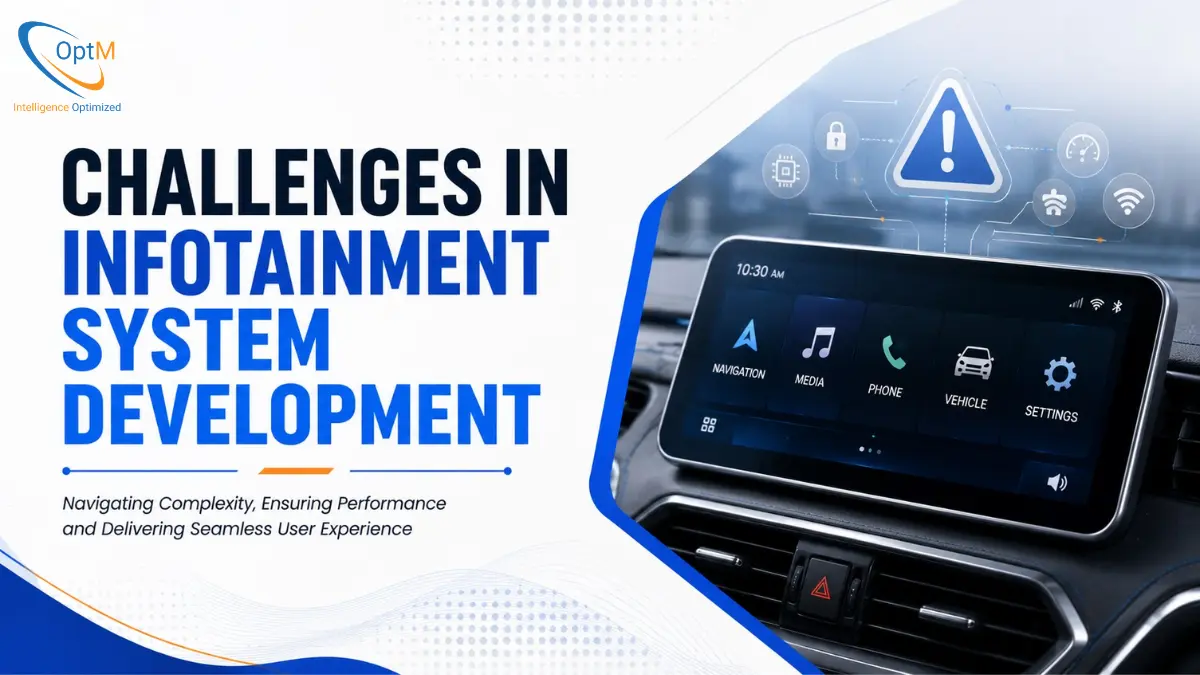
This technical guide abandons standard marketing overviews. We are deploying a rigorous, multi-formatted engineering autopsy to expose the exact Challenges in Infotainment System Development. From the microscopic realities of silicon thermal throttling to the macro-level nightmares of ISO 26262 compliance, this is the definitive breakdown of what stands between a prototype and a production-ready vehicle.
1. The Physical Constraint Matrix: Silicon, Thermals, and Bandwidth
Before a single line of C++ code is executed, the physical hardware establishes a rigid boundary of what is possible. The most profound challenges in early-stage development stem from the physical environment of the vehicle itself.
Root Cause Analysis: Passive Thermal Management
Consumer electronics—like a gaming laptop—manage high-performance processing by using massive copper heat pipes and high-RPM mechanical fans. An automotive domain controller cannot use mechanical fans. Over a 10-to-15-year lifecycle, mechanical fans fail due to microscopic dust ingress, severe road vibration, and varying humidity. Furthermore, the acoustic whine of a fan ruins the premium silence of a luxury cabin.
-
The Engineering Hurdle: The System-on-Chip (SoC) must rely entirely on passive cooling (aluminum heat sinks) while trapped inside a dark plastic dashboard that can reach 95°C (203°F) when parked in direct sunlight.
-
The Consequence of Failure: When the SoC temperature crosses its thermal junction limit (Tj), the silicon initiates "thermal throttling." It aggressively downclocks the CPU and GPU cores to prevent physical melting.
-
The UX Impact: When the GPU is downclocked by 40%, the system can no longer sustain 60 frames per second. The 3D navigation map begins to stutter, and voice-command processing lags, instantly destroying the user experience.
The Memory Bandwidth Bottleneck
A central computing hub requires precise selection of the Components of an Infotainment System. The most frequently miscalculated component is not the processor, but the volatile memory (RAM).
-
The Data Workload: A modern SoC might be tasked with simultaneously driving a 4K central display, a 1080p digital instrument cluster, and a 1080p passenger entertainment screen.
-
The Memory Starvation Effect: To render these pixels, the GPU must constantly read high-resolution textures from the LPDDR4x/LPDDR5 memory banks. If the memory bus width (e.g., 128-bit vs. 256-bit) is insufficient, the GPU cores are left waiting for data (memory starvation).
-
The Architectural Fix: Engineers must execute brutal memory profiling during the design phase, forcing UI designers to compress textures or eliminate unnecessary 3D assets to ensure the memory bandwidth ceiling is never breached during peak loads.
2. The Software Boundary: Hypervisor Contention and Mixed-Criticality
The defining characteristic of modern Infotainment System Architecture is the consolidation of multiple operating systems onto a single piece of silicon using a Type-1 Hypervisor. This creates a "mixed-criticality" environment, which is the source of the most devastating software bugs in automotive development.
The Friction of Temporal Partitioning
The hypervisor must run an ASIL-QM (unsecure) OS like Android Automotive (AAOS) for media, alongside an ASIL-B (secure) Real-Time Operating System (RTOS) like QNX for the speedometer and ADAS warnings.
-
The Challenge: AAOS is a massive, resource-hungry operating system. If a user opens a poorly optimized web browser within AAOS, it will attempt to consume 100% of the CPU cores.
-
The RTOS Requirement: The RTOS must execute its safety functions (like rendering a brake failure light) within a strict, deterministic 10-millisecond window.
-
The Engineering Solution: System architects must configure the hypervisor with "hard scheduling." They must mathematically guarantee that the RTOS receives a specific slice of CPU time, every single millisecond, effectively starving the AAOS domain if necessary to preserve functional safety. Tuning these scheduling algorithms without causing the Android system to freeze is a massive developmental hurdle.
Inter-Process Communication (IPC) Latency
Because the hypervisor completely isolates the memory of the two operating systems (using the IOMMU), they cannot easily share data. However, the media system (AAOS) needs to send song metadata to the instrument cluster (RTOS).
The IPC Execution Pipeline:
-
VirtIO Shared Memory: Engineers allocate a specific block of physical RAM as a zero-copy shared memory bridge.
-
The Mutex Problem: If AAOS tries to write new song data to the memory block at the exact microsecond the RTOS tries to read the old data, the system crashes (a race condition).
-
Spinlocks and Deadlocks: Software engineers use "spinlocks" to lock the memory block during a write. If the AAOS domain crashes while holding the lock, the RTOS will wait infinitely to read the data, causing the digital speedometer to freeze.
-
The Fix: The Role of Embedded Software in Infotainment System development requires implementing aggressive hardware watchdog timers that instantly reset the locks and reboot the unsecure OS if a deadlock is detected.
3. The Network Saturation Crisis: Bridging CAN FD and Automotive Ethernet
An isolated infotainment unit is useless. The system must act as the central routing hub for the entire vehicle, requiring complex Infotainment System Integration with ECUs, Sensors, Displays and Connectivity Modules.
Diagnosing the "Babbling Idiot" Syndrome
The vehicle's localized Controller Area Network (CAN FD) is a shared, multi-master bus. Any ECU can broadcast data at any time based on arbitration IDs.
-
The Threat: If a cheap, peripheral ECU (like a door lock module) suffers a hardware failure, it can enter a state known as a "Babbling Idiot." It begins rapidly broadcasting garbage data onto the CAN bus at maximum speed, ignoring all network rules.
-
The CPU Overload: The infotainment system's CAN transceiver receives this garbage data and sends a hardware interrupt to the CPU for every single packet. The CPU becomes so overwhelmed processing these useless interrupts (an IRQ storm) that it cannot process user inputs on the touchscreen.
-
The Mitigation: Integration engineers must develop intelligent, low-level hardware firewalls within the Vehicle Hardware Abstraction Layer (VHAL) to instantly detect anomalous packet frequencies and drop the data at the hardware level before it interrupts the CPU.
Time-Sensitive Networking (TSN) Configuration
To handle massive data payloads (like live video from ADAS cameras), the system utilizes Automotive Ethernet (IEEE 802.3bw).
-
The Conflict: The Ethernet network is shared. The system might be downloading a 2-gigabyte Over-the-Air (OTA) software update while simultaneously trying to stream uncompressed video from the rear backup camera to the central display.
-
The Challenge: Standard ethernet is "best effort," meaning packets arrive whenever there is free bandwidth. In automotive, if the backup camera video is delayed by 200 milliseconds, the driver hits an obstacle.
-
The TSN Solution: Engineers must meticulously configure Time-Sensitive Networking (TSN). They must utilize the Precision Time Protocol (PTP) to sync all hardware clocks to the microsecond. They must configure IEEE 802.1Qav Credit-Based Shapers on the network switches to aggressively pause the OTA download traffic, ensuring the video packets have an absolute, unobstructed pathway to the GPU. Configuring this network topology across multiple Tier-1 vendor components is one of the most frustrating challenges in modern vehicle architecture.
4. UI/UX Rendering Challenges: The Fight for 60 Frames Per Second
Consumers compare the responsiveness of their vehicle's dashboard to the responsiveness of an iPad. If the UI stutters, lags, or tears, the perception of vehicle quality is destroyed.
The Burden of the Scene Graph
Achieving flawless visual performance requires mastering Infotainment System UI/UX Design. Most premium interfaces are built using the Qt/QML framework.
-
The Node Tree Calculation: When a UI designer creates a beautiful menu with 3D rotating car avatars, translucent glass-morphism backgrounds, and dynamic drop shadows, the Qt Scene Graph must calculate the geometry and alpha-blending for millions of pixels.
-
Fragment Shader Overload: Blur effects and drop shadows are incredibly taxing on the GPU's fragment shaders. If the UI demands more shader calculations than the GPU can execute in 16.6 milliseconds, the system misses its 60fps target. The screen drops a frame, resulting in a visible stutter.
-
The Developer's Reality: UI designers and embedded software engineers are often at war. Designers want high-fidelity 3D assets; engineers want flat, compressed textures to preserve memory bandwidth. Finding the exact compromise between aesthetic luxury and mathematical reality requires brutal optimization phases.
V-Sync and Multi-Display Tearing
-
The Artifact: If the display panel reads pixel data from the memory buffer while the GPU is only halfway through drawing the new frame, the screen will display a jagged, tearing line across the center of the image.
-
The Synchronization Challenge: To prevent this, engineers utilize hardware Vertical Synchronization (V-Sync). However, when a single SoC is driving two separate screens (e.g., the cluster and the central display) via Serializer/Deserializer (SerDes) cables, the physical refresh rates of the two glass panels must be perfectly phase-locked. If they drift by even a few microseconds, the dual-buffer swapping logic breaks down, causing massive visual artifacts.
5. Security and Cryptographic Bottlenecks
As the infotainment unit becomes the secure gateway to the cloud, the cryptographic workload placed upon the SoC increases exponentially.
The Overhead of Over-The-Air (OTA) Validation
To monetize the SDV, OEMs must leverage the Benefits of Infotainment System architectures to push new features via OTA updates.
-
The Threat Vector: The OTA pipeline is the ultimate target for hackers. If they can intercept the download, they can flash malicious firmware into the vehicle.
-
The Cryptographic Defense: Every OTA payload must be mathematically signed by the OEM. The infotainment system's Hardware Security Module (HSM) must execute Elliptic Curve Digital Signature Algorithm (ECDSA) or RSA hash verifications to prove the payload is authentic.
-
The Boot-Time Challenge: Running these complex cryptographic hashes takes time. If the system must validate a 5-gigabyte OS image before it can boot, the driver might be sitting in a dark car for 30 seconds waiting for the screens to turn on.
-
The Engineering Compromise: Architects must implement A/B partitioning and background validation pipelines, ensuring the cryptography is executed silently while the vehicle is running on the stable "A" partition, completely masking the computational delay from the driver.
Fuzzing and the Attack Surface
Because the system features a 5G modem, Wi-Fi, and Bluetooth, its attack surface is massive.
-
The Vulnerability: Hackers use "fuzzing" to bombard the Bluetooth stack with malformed data packets. If the software lacks proper memory bounds checking, the malformed packet causes a buffer overflow, allowing the hacker to inject arbitrary code.
-
The Mitigation: Developers must utilize automated static code analysis and continuous fuzz-testing pipelines to identify and patch these vulnerabilities before launch, significantly increasing the time required in the QA cycle.
6. The Bureaucracy of Functional Safety (ISO 26262)
Perhaps the most significant, non-technical challenge in infotainment development is the sheer bureaucratic weight of proving that the software is safe.
Freedom From Interference (FFI)
Because the system executes Functions of Infotainment System that are safety-critical (like ADAS collision warnings on the instrument cluster), it must achieve Automotive Safety Integrity Level (ASIL) B compliance.
-
The Legal Burden: It is not enough for the software to work perfectly; the engineering team must legally prove that it cannot fail dangerously.
-
The Evidence: Engineers must generate thousands of pages of documentation proving "Freedom From Interference." They must deliberately inject faults into the Android media OS during testing to mathematically prove that the hypervisor's IOMMU physically blocked the memory corruption from reaching the RTOS.
The Cost of Traceability
Every single line of C++ code must be traceable back to a specific engineering requirement, and every requirement must have a corresponding automated test case. If an engineer optimizes a snippet of code to improve GPU performance, they must update the requirement, rewrite the test case, and re-execute the entire validation suite. This rigid traceability matrix is why Infotainment System Testing and Validation consumes over 50% of the entire development budget for a modern domain controller.
7. The Integration Nightmare: Software Supply Chain Fragmentation
In the past, an OEM bought a completely finished radio from a single Tier-1 supplier. Today, the SDV requires a Service-Oriented Architecture (SOA), where software components from dozens of different companies must coexist on the same silicon.
The Multi-Vendor Ecosystem:
-
The Silicon: Provided by Qualcomm or NXP.
-
The Hypervisor: Provided by QNX.
-
The Media OS: Provided by Google (AAOS).
-
The UI Framework: Provided by Qt Group.
-
The ADAS Algorithms: Provided by a specialized Tier-2 software startup.
-
The Integration Crisis: When the system crashes, who is at fault? If the navigation map stutters, the UI designer blames the graphics framework. The graphics framework vendor blames the hypervisor for stealing CPU cycles. The hypervisor vendor blames the silicon provider's GPU drivers.
Because automakers do not own the entire software stack, resolving a single bug requires coordinating debugging sessions across three different companies on three different continents. This supply chain fragmentation is the root cause of the "software-development productivity" crisis highlighted by McKinsey.
8. Real-World Autopsy: The Anatomy of a Launch Delay
To truly understand how these micro-challenges cascade into a macro-disaster, let us trace a hypothetical, yet highly realistic, development failure.
The Scenario: A Memory Leak Triggers an ASIL-B Compliance Failure
-
The Origin: A UI developer working for a Tier-2 supplier creates a new animation for the Spotify widget on the Android Automotive OS (AAOS) central display. They forget to release a memory pointer after the animation finishes (a memory leak).
-
The Accumulation: During standard 30-minute test drives, the leak goes unnoticed. However, during a 12-hour continuous HIL (Hardware-in-the-Loop) stress test, the Spotify widget slowly consumes all available RAM allocated to the unsecure AAOS virtual machine.
-
The Cascade: Out of memory, the AAOS kernel panics and locks up. The central display freezes.
-
The Hypervisor Flaw: Due to a misconfigured spinlock in the IPC (Inter-Process Communication) bridge, the secure RTOS (running the digital speedometer) attempts to read song data from the frozen AAOS domain. The RTOS gets stuck waiting for the lock to release.
-
The Fatal Failure: The digital speedometer freezes while the physical vehicle is accelerating to 70 MPH.
-
The Bureaucratic Fallout: The system fails ISO 26262 Freedom From Interference requirements. The launch is halted.
-
The Resolution: It takes three weeks of cross-company debugging to find the misconfigured spinlock in the hypervisor and the memory leak in the UI widget. The code is patched, but the entire ISO 26262 traceability matrix must be re-validated from scratch, costing the OEM millions in delayed vehicle shipments.
Final Thoughts: Engineering Through the Complexity
Developing a modern automotive infotainment system is not a project; it is an endurance event. Engineers are caught in a relentless crossfire between the physical limitations of silicon thermals, the mathematical constraints of network bandwidth, and the uncompromising legal demands of functional safety.
To successfully navigate this friction, Tier-1 suppliers and OEMs must abandon isolated, siloed development mentalities. They must embrace system-level architectural thinking, deploying automated CI/CD pipelines, ruthless memory profiling, and hyper-strict hardware abstraction layers from day one of the project.
For original equipment manufacturers and procurement leaders who cannot afford to lose hundreds of millions of dollars to software-driven launch delays, partnering with a deeply experienced engineering organization is the only viable path forward. Explore the proven hypervisor architectures, automated testing frameworks, and comprehensive integration expertise utilized within the Automotive Infotainment System engineered by OptM Solutions.
Frequently Asked Questions (FAQs)
Why is passive thermal management a major bottleneck for SoC performance?
Because mechanical fans fail in automotive environments, heat must be wicked away by aluminum blocks. If the GPU renders heavy 3D graphics in a hot dashboard, it hits its thermal junction limit. The silicon must downclock to prevent melting, causing the UI to stutter and drop frames.
How does memory bandwidth starvation cause UI stuttering?
When an SoC drives multiple screens, the GPU constantly reads high-resolution textures from RAM. If the LPDDR memory bus is too narrow, the GPU cores sit idle waiting for data (starvation). If the GPU misses the 16.6-millisecond render window, the screen drops a frame.
What causes an IRQ storm, and how does it crash the CPU?
If a broken network node rapidly blasts invalid CAN packets, the hardware transceiver sends an Interrupt Request (IRQ) to the CPU for every packet. The CPU spends 100% of its processing cycles acknowledging garbage interrupts, freezing all consumer applications and UI inputs.
Why is it difficult to synchronize V-Sync across multiple physical displays?
When one SoC drives a central display and an instrument cluster via SerDes cables, the physical refresh rates of the two LCD panels must be perfectly phase-locked. If they drift by a few microseconds, the hypervisor's dual-buffer swapping logic breaks, causing screen tearing artifacts.
How do cryptographic boot sequences impact system startup times?
Before the OS can load, the Hardware Security Module (HSM) must mathematically verify the ECDSA signatures of the firmware to prevent hacking. Calculating these complex hashes takes time. If unoptimized, the driver could be waiting 30 seconds for the screens to turn on after starting the car.
Why is software supply chain fragmentation delaying vehicle launches?
Modern domain controllers run silicon, hypervisors, OSs, and UI frameworks from five different companies. When a bug occurs (like a frozen map), determining which vendor's code caused the failure requires massive cross-company debugging, grinding CI/CD pipelines to a halt.
How do engineers resolve deadlocks in mixed-criticality IPC bridges?
If the unsecure OS crashes while holding a "spinlock" on a shared memory block, the secure OS waits infinitely to read it (a deadlock). Engineers must implement strict hardware watchdog timers that instantly detect the timeout, break the lock, and reboot the unsecure OS.