
Content Writer & SEO Specialist
Content Writer & SEO Specialist
Aditya Sharma is a content writer at OptM Solutions specializing in automotive electronics, embedded systems, telematics, electric vehicle technologies, connected mobility, and autonomous driving technologies.
LinkedIn ProfileIn the rapidly evolving landscape of software-defined vehicles (SDVs), the architectural definition of the dashboard has fundamentally shifted. For original equipment manufacturers (OEMs) and Tier-1 automotive electronics suppliers, the days of deploying isolated radio head units and static navigation displays are entirely obsolete. Today, the digital cockpit operates as a centralized, high-performance domain controller, consolidating dozens of previously decentralized electronic tasks into a single, highly virtualized computing environment.
According to a recent industry analysis published by Global Market Insights Inc. The global automotive infotainment market was valued at USD 30.9 billion in 2025 and is projected to surge to USD 60.9 billion by 2035, accelerating at a compound annual growth rate (CAGR) of 7.1%. This aggressive market expansion is not driven by consumer demand for better radios; it is driven by the absolute necessity of integrating connected telematics, edge artificial intelligence, and safety-critical advanced driver assistance systems (ADAS) into a singular, cohesive user interface.
To build reliable, scalable, and functionally safe in-cabin experiences, engineering leaders must move past superficial consumer feature lists and dissect the microscopic realities of what these systems actually do. Before exploring the granular execution pipelines, we highly recommend establishing a firm architectural baseline by reading our definitive pillar guide on exactly What Is Infotainment System technology within the modern SDV context.
In this deep-dive, we are mapping the exact computational and functional workloads of the modern digital cockpit. We will explore how the system prioritizes safety telemetry over multimedia, how it serves as the secure gateway to the cloud, and how it actively monitors driver states to prevent catastrophic collisions.
What Are the Core Functions of an Infotainment System?
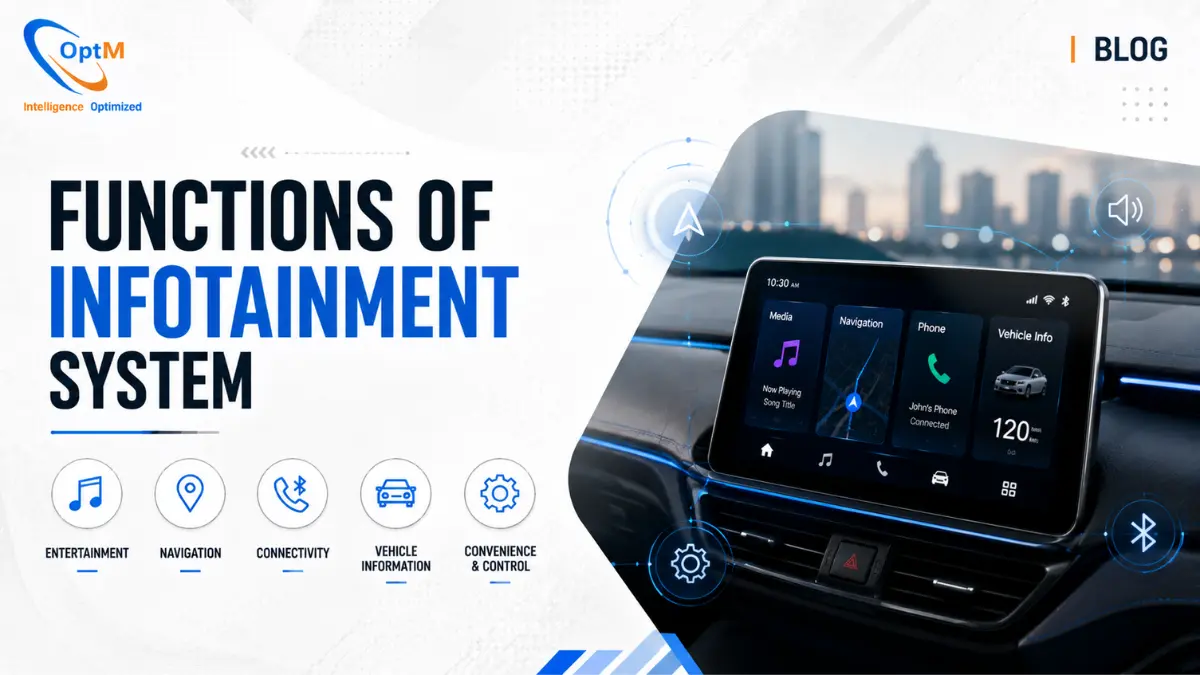
The primary functions of an infotainment system encompass real-time vehicle telemetry visualization, cloud-connected intelligent navigation, multimedia processing, and bidirectional telematics communication. By operating as a centralized domain controller, the system natively integrates with advanced driver assistance systems (ADAS) to render safety-critical alerts, manages over-the-air (OTA) firmware updates via secure cryptographic handshakes, and executes edge-AI computer vision algorithms for continuous driver monitoring and localized cabin personalization.
To achieve this vast array of tasks simultaneously without experiencing critical system failures, the underlying silicon must leverage Type-1 hypervisors and real-time operating systems. For a deeper look into the computational traffic management required to execute these features, explore our technical breakdown of How Does Infotainment System Work.
1. Telematics and Real-Time Vehicle Diagnostics
The most critical function of a modern infotainment system is serving as the primary diagnostic bridge between the vehicle's underlying mechanical realities and the human driver. The system must process thousands of data points per second from the vehicle's internal nervous system and translate them into a digestible, high-contrast visual format.
CAN FD Ingestion and Telemetry Parsing
To execute diagnostic functions, the infotainment System-on-Chip (SoC) connects to the vehicle's primary communication backbone via Controller Area Network Flexible Data-Rate (CAN FD) transceivers. The system continuously subscribes to specific arbitration IDs broadcasting from the Powertrain Control Module (PCM), the Body Control Module (BCM), and the Battery Management System (BMS).
When a CAN FD packet arrives at the domain controller, the Vehicle Hardware Abstraction Layer (VHAL) unpacks the 64-byte payload. It extracts raw hex values representing instantaneous tire pressure metrics, coolant thermal profiles, or high-voltage battery state-of-charge (SoC) percentages.
Visual Rendering and Cognitive Load Reduction
Translating these raw numbers into a safe, glanceable user interface requires masterful execution of Infotainment System UI/UX Design. In premium B2B applications, automotive UI architects strictly avoid cluttered, high-latency 3D gauges. Instead, using the Qt/QML framework, they construct clean, minimalist data matrices.
By relying on strict corporate identity palettes, normal operational data is rendered cleanly against a deep #001941 background. However, if the VHAL detects a critical fault code—such as a sudden drop in brake fluid pressure—the system bypasses all consumer media rendering. The GPU fragment shaders instantly override the display with a high-contrast colour primary warning banner, ensuring the driver processes the critical mechanical failure in less than 200 milliseconds.
2. Intelligent Navigation and EV Ecosystem Integration
Legacy automotive navigation systems relied on static map data stored on internal hard drives, rendering them obsolete the moment a new highway was constructed. Today, the navigation function of an infotainment system is a dynamic, cloud-native application that relies on continuous edge-to-cloud synchronization.
Multi-Constellation GNSS and Automotive Dead Reckoning (ADR)
To render precise vehicle location, the system ingests data from a Global Navigation Satellite System (GNSS) module capable of tracking GPS, GLONASS, Galileo, and BeiDou constellations simultaneously. However, satellite visibility is frequently obstructed in urban canyons or underground parking structures. To maintain flawless navigation continuity, the infotainment system executes Automotive Dead Reckoning (ADR) algorithms. It fuses the last known GNSS coordinate with raw telemetry from a 6-axis Inertial Measurement Unit (IMU) and individual wheel-speed sensors via the CAN bus, calculating the vehicle's exact trajectory through localized sensor fusion.
Cloud-Native Routing and OCPP Compliance
The true power of modern navigation lies in its integration with external cellular networks via the Telematics Control Unit (TCU). The system queries cloud-based mapping APIs via LTE/5G connections to retrieve real-time traffic density, dynamic routing alternatives, and high-definition topographical map tiles.
For electric vehicles, this function expands significantly. The infotainment system must execute "charge-aware routing." By actively monitoring the BMS for real-time energy consumption, battery temperature, and cabin HVAC load, the navigation algorithm calculates the vehicle's exact realistic range. It communicates with backend charging networks utilizing Open Charge Point Protocol (OCPP) standards to identify available, high-speed DC fast-charging stations along the route, reserving a charging stall automatically and initiating pre-conditioning of the battery thermal loops prior to arrival.
3. ADAS Interfacing and Safety-Critical Visualizations
As vehicles advance toward Level 2+ and Level 3 autonomy, the infotainment system functions as the primary visual output for the Advanced Driver Assistance Systems (ADAS). Because ADAS involves active collision avoidance, this function operates within strict functional safety parameters governed by ISO 26262.
Sensor Fusion and Automotive Ethernet
The vehicle is surrounded by external sensors, including millimeter-wave radar, LiDAR scanners, and high-resolution optical cameras. The massive data payloads generated by these sensors cannot travel over legacy CAN networks. Instead, the infotainment system receives this data via high-speed Automotive Ethernet (IEEE 802.3bw), utilizing Time-Sensitive Networking (TSN) protocols to ensure the video packets arrive with microsecond precision.
The Visualization Pipeline
When the ADAS domain controller detects an imminent threat—such as a pedestrian stepping into the vehicle's path—it sends a high-priority SOME/IP (Scalable service-Oriented MiddlewarE over IP) alert packet to the central infotainment SoC.
The infotainment system's Type-1 Hypervisor instantly allocates emergency CPU cycles to the secure Real-Time Operating System (RTOS) domain. The Qt Scene Graph halts its current media rendering batch, and the virtualized GPU draws an urgent visual overlay directly on top of the navigation map or digital instrument cluster. Simultaneously, the system commands the audio DSP to mute the cabin speakers and inject a high-decibel acoustic warning chime, ensuring the driver reacts before the automatic emergency braking (AEB) actuators engage.
4. Multimedia, Cabin Acoustics, and Active Noise Cancellation (ANC)
While diagnostic and safety functions dictate the structural architecture of the system, multimedia processing and acoustic management define the consumer's perception of luxury and quality.
High-Fidelity Audio Routing
Modern infotainment systems act as highly complex audio matrices. The central SoC decodes high-bitrate streaming audio files (such as FLAC or spatial audio formats) and passes the digital signals to an external, automotive-grade Digital Signal Processor (DSP). The DSP executes dynamic equalization, adjusting the audio frequencies in real-time based on the vehicle's current speed and ambient cabin noise.
Multi-Zone Audio and A2B Bus Integration
In a premium vehicle, audio is not localized to a single output. The infotainment system must manage multi-zone acoustic environments. If a phone call comes in, the DSP routes the cellular audio exclusively to the driver’s headrest speakers, while maintaining the multimedia audio output for the rear-seat passengers. This complex routing is achieved utilizing the Automotive Audio Bus (A2B), which daisy-chains microphones, amplifiers, and speakers across a single unshielded twisted pair (UTP) wire, drastically reducing wiring harness weight while delivering deterministic, low-latency digital audio.
Active Noise Cancellation (ANC)
Beyond entertainment, the system functions as a critical environmental control unit. By utilizing microphones distributed throughout the cabin to monitor low-frequency road noise and engine drone, the system's DSP generates inverted, phase-shifted acoustic waves. It broadcasts these anti-noise signals through the cabin speakers in real-time, effectively cancelling out the ambient interference and creating a silent, premium acoustic environment tailored for executive transit.
5. Connected Services and Over-the-Air (OTA) Firmware Updates
An infotainment system that cannot evolve is obsolete the moment it leaves the dealership. Serving as the secure gateway for Over-the-Air (OTA) firmware updates is one of the most commercially critical functions of the entire digital cockpit architecture.
The Telematics Control Unit (TCU) Pipeline
The system interfaces directly with the vehicle’s TCU, which houses the 5G modem and eSIM architectures. The TCU establishes a secure, encrypted Transport Layer Security (TLS) tunnel to the OEM's enterprise cloud servers via MQTT or WebSockets protocols.
Cryptographic Validation and A/B Partitioning
When the OEM pushes a critical software patch—for instance, an update to the ABS module algorithms—the infotainment system manages the entire download and validation workflow.
-
Ingress: The binary file is downloaded directly to the system's Universal Flash Storage (UFS) drive.
-
Hardware Security Validation: The system's embedded Hardware Security Module (HSM) intercepts the file headers. It executes a rapid ECDSA hash verification against the OEM's master certificate stored in immutable silicon, proving the update is authentic and free from malicious tampering.
-
Silent Installation: The architecture utilizes an A/B partition scheme. The vehicle runs safely on Partition A, while the system silently unpacks and installs the new firmware onto Partition B in the background.
-
Network Distribution: Upon driver confirmation and a safe ignition off-cycle, the infotainment system acts as the OTA master node. It broadcasts the specific, validated firmware patches across the CAN FD and Ethernet backbones to the peripheral zonal controllers and ECUs, completing the update seamlessly.
This capability is the bedrock of the software-defined vehicle, highlighting why understanding the Role of Embedded Software in Infotainment System design is paramount for long-term commercial success.
6. Edge AI and Driver Monitoring Systems (DMS)
As vehicles take over more driving responsibilities, the infotainment system must actively monitor the human driver to ensure they remain attentive and capable of reassuming control. This function relies heavily on edge-based artificial intelligence.
Computer Vision and Neural Processing Units (NPU)
A near-infrared (NIR) camera mounted inside the cabin continuously streams raw, uncompressed video of the driver's face directly into the infotainment SoC via a high-speed MIPI CSI-2 serial interface. Because sending live video to the cloud for processing introduces unacceptable latency and violates privacy regulations, the processing must happen locally "on the edge."
The SoC utilizes a dedicated Neural Processing Unit (NPU) to run complex computer vision inferencing models. The NPU tracks facial landmarks in real-time, calculating exact gaze-direction vectors and measuring the duration of eyelid closures (PERCLOS).
Safety Intervention Workflow
If the edge-AI model calculates that the driver's eyes have drifted away from the primary road vector for longer than a hardcoded safety threshold (e.g., 2.0 seconds), the NPU flags an immediate software exception. The infotainment system overrides all active processes, flashing a high-contrast visual alert on the screen and initiating a sharp acoustic warning to snap the driver's attention back to the road. This microsecond-perfect execution showcases the profound safety implications of the Components of an Infotainment System chosen during the initial engineering phase.
7. Real-World Workflow Example: Cross-Domain Functional Execution
To truly visualize how these independent functions merge into a singular, cohesive user experience, we must observe a real-world edge case. Let us map the exact workflow of an Infotainment System managing a critical EV battery depletion event during active navigation.
-
Telemetry Ingestion (Diagnostic Function): While driving on a remote highway, the CAN FD transceiver receives a high-priority packet from the Battery Management System (BMS). The packet indicates that due to extreme external cold temperatures, the high-voltage battery's effective range has plummeted by 15%, and the vehicle will no longer reach its programmed destination.
-
OS Abstraction (Middleware Function): The Vehicle Hardware Abstraction Layer (VHAL) unpacks the CAN packet and passes the critical state-of-charge alert across a zero-copy shared memory bridge into the Android Automotive OS domain.
-
Dynamic Re-Routing (Navigation Function): The navigation application intercepts the alert. It queries the cloud via the 5G TCU, accessing live OCPP data for charging stations within the newly reduced radius. It identifies an available DC fast charger 10 miles away.
-
UI/UX Rendering (Presentation Function): The Qt Scene Graph immediately suspends the active media display. The GPU renders an urgent, high-contrast overlay on the screen, asking the driver if they wish to reroute to the emergency charger.
-
Actuator Command (Telematics Function): The driver taps "Confirm." The infotainment system instantly routes the new GPS coordinates to the navigation display. Simultaneously, it sends a specific CAN bus command back to the BMS, instructing it to open the coolant valves and begin pre-conditioning the battery pack to the optimal thermal temperature for fast charging upon arrival.
This flawless, multi-domain choreography demonstrates that an infotainment unit is not a passive display; it is an active, intelligent orchestrator of the entire vehicle ecosystem.
8. Strategic Commercial Value and Future Trajectory
Understanding the depth and complexity of these functions is critical for OEMs attempting to monetize the software-defined vehicle lifecycle.
By centralizing these functions into a powerful domain controller, automakers can shift from selling static hardware to offering dynamic, subscription-based features (Features-on-Demand). If a customer wishes to upgrade their base navigation system to a premium, augmented-reality mapping suite, the OEM can simply execute an OTA update, unlocking the software capability without requiring a physical dealership visit. This creates a highly lucrative, recurring revenue stream that lasts for the operational lifetime of the vehicle.
Furthermore, by continuously aggregating anonymized driver behavior, telematics data, and hardware diagnostic logs via the infotainment cloud pipeline, OEMs can execute predictive maintenance models. They can detect failing brake calipers or degrading battery cells months before they result in a catastrophic failure, proactively scheduling service appointments and significantly reducing warranty claim costs.
Final Thoughts: Engineering the Nerve Center of Mobility
The functions of a modern automotive infotainment system represent the absolute pinnacle of embedded engineering. Orchestrating real-time telematics, edge-AI computer vision, cloud-native navigation, and functional safety visualizations simultaneously on a single piece of silicon requires a masterful understanding of hypervisors, service-oriented middlewares, and deterministic network topologies.
When these functions are architected cleanly and integrated securely, the result is a digital cockpit that disappears into the background, leaving the driver with an experience that feels perfectly intuitive, deeply personalized, and relentlessly safe.
For Tier-1 suppliers, procurement heads, and automotive OEMs aiming to integrate this level of high-performance, structurally secure computing into their next-generation fleets, execution is everything. Explore the comprehensive engineering capabilities, proven architectures, and end-to-end integration workflows of the Automotive Infotainment System engineered by OptM Solutions.
Frequently Asked Questions (FAQs)
How does charge-aware routing differ from standard GPS navigation?
Charge-aware routing dynamically factors in real-time EV battery state-of-charge, ambient temperature, and cabin HVAC load. It utilizes OCPP protocols to find available DC fast chargers along the route and commands the battery management system to pre-condition the battery prior to arrival.
What specific driver metrics does the NPU track for Driver Monitoring Systems (DMS)?
The Neural Processing Unit uses edge-AI computer vision to track facial landmarks, calculating head yaw/pitch (gaze deviation vectors) and the PERCLOS scale (the percentage of time the driver's eyelids are closed) to detect acute drowsiness or distraction.
How does Active Noise Cancellation (ANC) function through the infotainment DSP?
The system utilizes cabin microphones to record low-frequency engine drone and tire noise. The DSP instantly processes this audio and broadcasts phase-shifted, inverted acoustic waves through the cabin speakers, effectively cancelling the ambient noise.
How does the system handle sensor fusion from LiDAR and radar?
The infotainment unit receives pre-processed object data from the ADAS domain controller via Automotive Ethernet. It uses this data to render real-time, 360-degree environmental visualizations (like detecting adjacent vehicles) directly onto the digital instrument cluster.
How does the system validate an OTA firmware update before installation?
The system's Hardware Security Module (HSM) intercepts the downloaded binary payload. It executes ECDSA or RSA hash calculations against the OEM's public cryptographic keys stored in secure silicon to prove the update is authentic and untampered.
Can the infotainment system directly control the vehicle's powertrain?
No. The infotainment system acts as a command gateway. It sends highly prioritized requests (e.g., "activate eco mode") over the CAN bus to the Powertrain Control Module (PCM), which executes the actual mechanical logic based on its own safety parameters.
How does Automotive Dead Reckoning (ADR) maintain navigation in tunnels?
When GNSS satellite signals are lost, the system fuses the last known GPS coordinate with continuous data from the vehicle's 6-axis IMU and wheel-speed sensors (via CAN bus), mathematically calculating the vehicle's exact trajectory until satellite lock is re-established.