
Content Writer & SEO Specialist
Content Writer & SEO Specialist
Aditya Sharma is a content writer at OptM Solutions specializing in automotive electronics, embedded systems, telematics, electric vehicle technologies, connected mobility, and autonomous driving technologies.
LinkedIn ProfileTen years ago, vehicle telematics were essentially just tracking devices. They read a GPS satellite signal and put a dot on a fleet manager's digital map. Today, that simple tracking function is just a tiny fraction of what a Telematics Control Unit (TCU) actually does.
In the era of Software-Defined Vehicles (SDVs), the TCU is the operational command center of the car. It is an active, multi-tasking edge-computing terminal that simultaneously manages active safety protocols, downloads vehicle software updates, and executes remote commands. For anyone looking to understand the baseline concept, reading our guide on What is Telematics Control Unit is a great starting point. But to truly grasp why this technology is transforming the automotive industry, we have to look at what the hardware actually does on the road.
What are the Functions of a Telematics Control Unit?
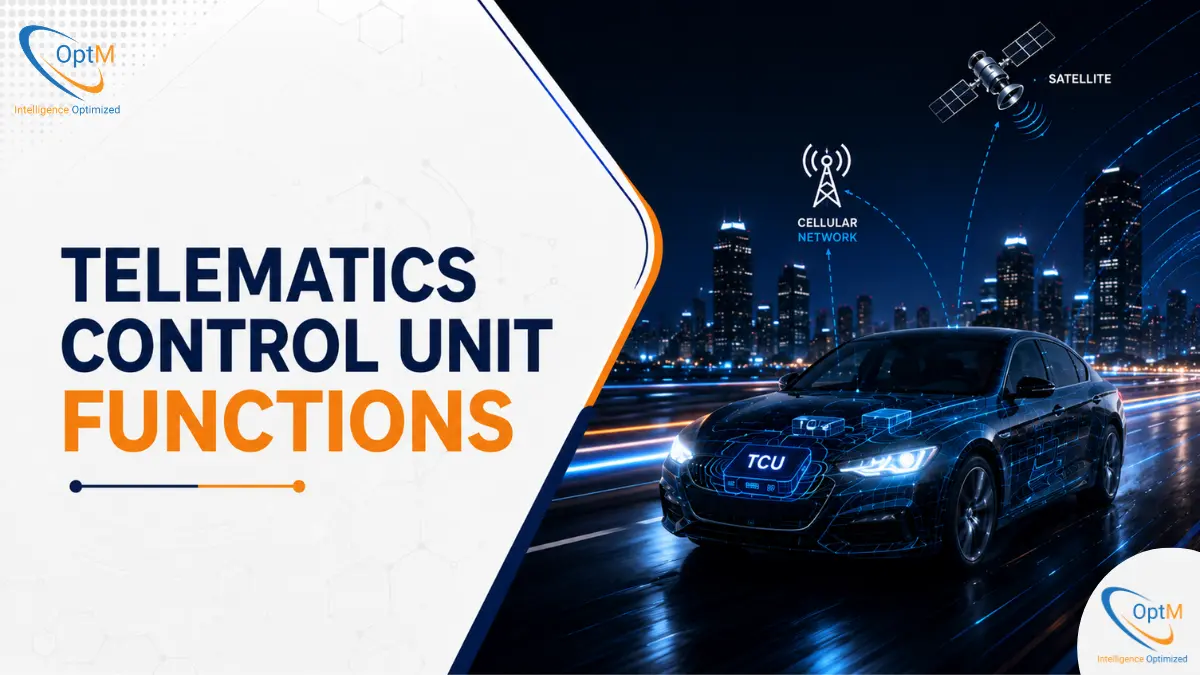
The core functions of a Telematics Control Unit (TCU) include executing remote vehicle diagnostics, orchestrating Over-The-Air (OTA) software updates, enabling Vehicle-to-Everything (V2X) communication, and providing automated emergency crash response (eCall). The unit acts as a bidirectional gateway, allowing fleet operators and OEMs to not only monitor the vehicle but actively control it.
The financial impact of these functions is massive. According to global technology intelligence firm ABI Research, the ability for automakers in the United States to remotely execute fixes via OTA updates will save the industry US$1.5 billion by 2028, completely eliminating the need for millions of physical dealership recalls. In this guide, we will break down exactly how these complex functions execute mechanically, explaining the engineering reality in a way that is clear and accessible.
1. Remote Vehicle Diagnostics (RVD) & Predictive Maintenance
The first major function of a TCU is acting as a continuous, remote mechanic that never sleeps.
The Old Way vs The TCU Way
Historically, if a sensor inside a car detected a problem, it would turn on the "Check Engine" light. To find out what was wrong, a mechanic had to physically plug a handheld OBD-II scanner into a port under the steering wheel.
A modern TCU eliminates this physical step. Instead of waiting for a car to break down, the TCU acts as an onboard, automated scanner.
How DTC Harvesting Works
Modern vehicles are made up of dozens of Electronic Control Units (ECUs)—tiny computers that control everything from the engine to the electric windows. The TCU connects to these computers using the vehicle's internal network (the CAN bus).
Using a standardized diagnostic language called Unified Diagnostic Services (UDS), the TCU actively "polls" (asks) these ECUs if they have any errors. It extracts pending and active Diagnostic Trouble Codes (DTCs). If an engine sensor detects that it is running too hot, it generates a code. The TCU captures this code immediately and sends it to the cloud. A fleet manager sitting 1,000 miles away knows the exact engine problem before the driver even sees a dashboard warning light.
Predictive Edge Analytics
To understand the deep computing behind this, check out our guide on [Telematics Control Unit Working]. But simply put, the TCU does more than just report broken parts—it predicts failures.
Imagine a commercial delivery truck's starter battery. Every time the driver turns the key, the TCU's embedded processor measures the exact voltage drop of the battery. Over three months, the TCU notices that the voltage drops a tiny bit lower every single week. The battery hasn't failed yet, but the TCU's "Edge Analytics" (local math) calculates a trend. It flags the anomaly and alerts the fleet manager: "Replace Battery in Truck 42 within the next 5 days to prevent a breakdown." This predictive maintenance saves thousands of dollars in towing fees and lost delivery time.
2. Over-The-Air (OTA) Campaign Management
If Remote Diagnostics is how the TCU reads the car, Over-The-Air (OTA) updates are how the TCU fixes the car.
FOTA vs SOTA
When your smartphone needs an update, you connect to Wi-Fi and click "Install." Vehicles work similarly, but the stakes are much higher because a bad update could disable the brakes or the engine. The TCU manages two distinct types of updates:
- Software Over-The-Air (SOTA): These are updates to the infotainment screen, navigation maps, or Bluetooth connectivity. They are relatively low-risk.
- Firmware Over-The-Air (FOTA): These are updates to the low-level logic controlling the engine, airbags, or steering. These are highly critical.
The Orchestration Sequence
The TCU functions as the secure download agent and installation manager. Here is the mechanical step-by-step of how it works:
- Secure Download: The TCU connects to the automaker's cloud server and downloads the new code. It checks the cryptographic signature of the file to ensure hackers haven't tampered with it.
- Safe State Verification: The TCU will never update a car while it is driving. It checks the CAN bus to verify the vehicle is in a "Safe State." (Is the engine off? Is the parking brake engaged? Is the battery charged above 70%?)
- The Flash: Once safety is confirmed, the TCU acts as the "Diagnostic Master Node." It sends the new code across the internal vehicle wires directly into the target ECU, erasing the old code and writing the new code.
For a deeper dive into the fail-safe recovery systems used if an update drops halfway through, review our guide on the Role of TCU in OTA Updates and Remote Vehicle Diagnostics.
3. High-Fidelity Spatial Tracking and Geo-Fencing
Tracking a vehicle's location is the oldest telematics function, but modern TCUs execute this with extreme precision.
Multi-Constellation GNSS
A basic smartphone GPS uses American satellites. If tall buildings block those satellites, your location drifts. An industrial TCU uses a multi-constellation Global Navigation Satellite System (GNSS) receiver. It talks to the American GPS, the European Galileo, the Russian GLONASS, and the Chinese BeiDou satellites simultaneously. By locking onto 20+ satellites instead of just 4, the TCU maintains sub-meter accuracy even in dense city streets.
Dynamic Geo-Fencing at the Edge
A geo-fence is an invisible digital boundary drawn on a map. When a vehicle crosses the boundary, a rule is triggered.
In older systems, the TCU sent its GPS coordinates to the cloud, and the cloud computer calculated if the truck crossed the line. This caused a delay. Today, the TCU downloads the geo-fence map directly into its own memory. As the car drives, the TCU calculates its position against the boundary locally (at the "edge").
This allows for instant, automated functions. For example, some European cities have "Zero Emission Zones." When a hybrid delivery van's TCU calculates that it has crossed the invisible geo-fence into the city center, the TCU instantly sends a command to the engine ECU, forcing the van to switch from gasoline to 100% electric battery power.
4. Automated Emergency Response (eCall) & Crash Telemetry
Perhaps the most critical function of a TCU is saving lives during a catastrophic accident. In the European Union, a system called "eCall" is legally mandated for all new vehicles.
The Interrupt Trigger
Imagine a car is driving down a highway. The TCU is busy sending fuel data to the cloud. Suddenly, a collision occurs. The crash sensors trigger the airbags. The moment the airbag ECU fires, it sends a high-priority "Crash Event" message across the CAN bus.
The TCU is programmed to treat this message as an absolute priority. It immediately interrupts and drops whatever it was doing (like sending fuel data) and initiates its emergency protocol.
The Minimum Set of Data (MSD)
Within milliseconds of the crash, the TCU builds a tiny, highly compressed digital file called the Minimum Set of Data (MSD). This file contains:
- The exact GPS coordinates.
- The vehicle's heading (which direction it was traveling, so ambulances know which side of the highway to enter).
- The Vehicle Identification Number (VIN).
- The type of fuel the vehicle uses (crucial so firefighters know if they are dealing with gasoline or a high-voltage EV battery).
The TCU's cellular modem automatically dials the local emergency number (like 911 or 112) and transmits this data package directly to the dispatchers, while simultaneously opening a voice line so the operator can speak to the cabin.
The impact is staggering. According to crash deployment evaluations monitored by the National Highway Traffic Safety Administration (NHTSA) and the European Commission, Automated Collision Notification systems reduce emergency response times by up to 50% in rural areas and 40% in urban areas, helping save up to 1,500 lives per year in the EU alone.
5. Remote Command Execution & Bi-Directional Control
TCUs do not just listen to the car; they can tell the car what to do. This is known as bidirectional control.
Secure Cloud-to-Vehicle Commands
Using secure web protocols (like MQTT or HTTP/2), a fleet manager can click a button on a web dashboard, sending a signal through the cellular network down to the TCU. The TCU authenticates the command and translates it into a physical action on the car.
Real-World Use Cases
- Stolen Asset Recovery (Immobilization): If a rental car is stolen, the company cannot safely turn off the engine while the thief is driving 80 mph down a highway. However, they can send a "Starter Disable" command to the TCU. The TCU tells the engine computer, "The next time this car is turned off, do not allow the engine to restart." The thief parks the car, and it becomes securely immobilized.
- EV Pre-Conditioning: Electric vehicle batteries perform poorly in freezing weather. While an EV is still plugged into the charger at home, the owner uses an app to send a command to the TCU. The TCU commands the vehicle's thermal management system to warm up the battery and the cabin using electricity from the house, rather than draining the battery on the road.
6. Advanced Driver Behavior & Eco-Scoring
Fleet operators need to know if their drivers are operating vehicles safely and efficiently. The TCU functions as an impartial digital co-pilot that translates vehicle physics into human risk profiles.
Inertial Measurement Unit (IMU) Integration
The TCU is equipped with an internal Inertial Measurement Unit (IMU)—a chip containing a 3-axis accelerometer and a gyroscope. This chip measures gravity and movement.
The TCU blends the IMU data with data from the vehicle's steering wheel and brake pedal. If a driver slams on the brakes, the accelerometer detects a massive G-force spike, and the CAN bus confirms the brake pedal was pressed 100%. The TCU logs this as a "Harsh Braking Event." Over a month, the TCU builds a comprehensive Eco-Score or Safety Score for that specific driver.
Real-Time Coaching Loops
Advanced TCUs don't just report bad driving to the boss; they try to fix it in real-time. If the TCU detects aggressive cornering or speeding, it can instantly trigger a haptic vibration in the driver's seat or play an auditory warning chime through the radio speakers. This real-time coaching loop corrects the behavior before an accident happens.
To see how these coaching metrics translate into actual insurance savings and fuel reduction, read our business breakdown on Telematics Control Unit Benefits.
7. V2X (Vehicle-to-Everything) Communication Enablement
The most futuristic function of the TCU is acting as the vehicle's voice in a smart city. This technology is called V2X, or Vehicle-to-Everything.
V2V and V2I Operations
Instead of just communicating with the cloud, the TCU uses special, ultra-fast 5G networks (URLLC) or Dedicated Short-Range Communications (DSRC) to talk directly to the world around it.
- Vehicle-to-Vehicle (V2V): Imagine you are driving on a foggy highway. A car a quarter-mile ahead of you slams on its brakes. You cannot see it. However, that car's TCU instantly broadcasts a "Hard Braking Alert" outward. Your TCU receives the signal and flashes a warning on your dashboard seconds before you even see the brake lights.
- Vehicle-to-Infrastructure (V2I): A TCU can talk to smart traffic lights. As a car approaches an intersection, the traffic light broadcasts that it will turn red in 3 seconds. The TCU calculates the car's speed and distance. If the TCU realizes the driver is not slowing down and will run the red light, it can interface with the car's Advanced Driver Assistance Systems (ADAS) to automatically apply the brakes.
This is the foundation of self-driving cars. You can understand how these networks are being built by first understanding the role of TCU in connected vehicle ecosystems.
8. Security Functions: Acting as the Vehicle Firewall
Because the TCU physically connects the internal computers of a car to the public internet, its most important silent function is defense. The TCU must act as a firewall against cyberattacks.
Network Segmentation
If a hacker manages to breach the cellular connection of the TCU, they must not be allowed to access the steering or braking computers. Automotive engineers use "Network Segmentation." The TCU isolates the public-facing internet connection from the safety-critical CAN bus. It acts as a strict bouncer, only allowing specifically authorized messages to pass through to the engine.
Intrusion Detection Systems (IDS)
The TCU also functions as a security guard monitoring the internal wires. It runs an Intrusion Detection System (IDS). If the radio or the infotainment screen suddenly starts sending thousands of commands trying to control the brakes (which it should never do), the TCU recognizes this as abnormal behavior. It flags the potential cyberattack, blocks the messages, and alerts the OEM's security center.
To understand the encryption keys and hardware security modules used to execute these defenses, check out our guide on Cybersecurity Challenges in Telematics Control Unit Development.
The OptM Advantage: Engineering High-Performance TCU Functions
Running all of these complex functions simultaneously—processing crash data, updating software, tracking satellites, and fighting off cyberattacks—requires immense processing power. A cheap, generic tracker will crash or overheat under this workload.
This is where professional B2B engineering makes the difference. At OptM Solutions, we design the software and hardware environments required to execute these heavy tasks flawlessly. By developing customized, production-ready embedded Linux operating systems, OptM ensures that a TCU can run predictive analytics and V2X communications concurrently without processor throttling, frame drops, or dangerous latency.
We build the architecture that allows automakers to trust that when a critical emergency command is sent, the TCU will execute it in milliseconds.
Conclusion
The Telematics Control Unit has evolved from a simple map-dot generator into the central nervous system of the modern commercial fleet and passenger vehicle. Its functions—ranging from remote predictive maintenance and OTA orchestration to high-fidelity spatial tracking and automated emergency response—directly dictate a vehicle's commercial viability, safety profile, and operational efficiency.
As the automotive industry transitions fully into software-defined architectures, the ability to control and update a vehicle remotely is no longer a luxury; it is a fundamental requirement.
To unlock advanced diagnostics, real-time edge processing, and secure OTA orchestration for your automotive platforms, engineering teams must build upon robust, automotive-grade hardware. Explore the technical specifications and integration capabilities of our production-ready gateway on the OptM Telematics Control Unit product page.
Frequently Asked Questions
Can remote diagnostics actually fix a broken mechanical part?
While it cannot fix snapped metal, remote diagnostics allow fleets to identify the exact failing component (via UDS polling) in real-time. This allows dispatchers to order the specific replacement part before the truck even reaches the repair depot.
How does the TCU execute geo-fencing without cloud latency?
Advanced TCUs download the digital polygon maps directly into their local memory. The processor calculates boundary crossings at the network edge, triggering instant vehicle reactions (like speed limiting) without waiting for a cloud server response.
What exactly is an eCall Minimum Set of Data (MSD)?
During a crash, the TCU builds a highly compressed MSD file containing the vehicle's exact GPS coordinates, heading (direction of travel), VIN, and fuel type. This is instantly transmitted to emergency responders to cut rescue times.
How does the TCU generate an impartial driver behavior score?
It fuses physical inertia data from its internal accelerometer (detecting G-force spikes from harsh braking) with direct CAN bus inputs (throttle position and steering angle) to create a physics-based safety profile, completely free of human bias.
Can a TCU safely immobilize a stolen vehicle?
Yes, through secure bidirectional control, authorized users can send a "Starter Disable" command. The TCU instructs the engine ECU to prevent the vehicle from restarting the next time it is turned off, ensuring it isn't disabled dangerously on a highway.
What is the practical difference between V2V and V2I functions?
Vehicle-to-Vehicle (V2V) involves cars sharing direct trajectory data to prevent blind-spot collisions. Vehicle-to-Infrastructure (V2I) involves the car communicating with smart traffic lights or toll booths to optimize urban traffic flow.
How does the TCU manage EV pre-conditioning?
While an EV is plugged into the grid, a user can send a command to the TCU. The TCU commands the vehicle's thermal management ECU to warm up the battery using grid electricity, preserving the vehicle's actual driving range for the road.