
Content Writer & SEO Specialist
Content Writer & SEO Specialist
Aditya Sharma is a content writer at OptM Solutions specializing in automotive electronics, embedded systems, telematics, electric vehicle technologies, connected mobility, and autonomous driving technologies.
LinkedIn ProfileModern vehicles are no longer dependent only on mechanical braking force. They rely on sensors, electronic control units, hydraulic modulation, embedded software, and real-time decision-making to maintain stability during critical braking situations.
One of the most important safety systems in this ecosystem is the Anti Lock Braking System, commonly known as ABS.
ABS helps prevent wheel lockup during sudden braking, allowing the driver to maintain steering control and reduce the risk of skidding. In modern automotive platforms, ABS is not just a braking feature. It is a safety-critical embedded system that works with vehicle sensors, ECU logic, hydraulic control, and other stability technologies.
For OEMs, Tier 1 suppliers, EV manufacturers, and automotive engineering teams, understanding ABS is important not only from a safety perspective but also from a system integration, software, validation, and production-readiness perspective.
What Is Anti Lock Braking System?
An Anti Lock Braking System (ABS) is an automotive safety system that prevents vehicle wheels from locking during sudden or hard braking. It continuously monitors wheel speed and adjusts brake pressure when it detects that a wheel is about to stop rotating, helping the driver maintain steering control and vehicle stability.
In simple terms, ABS helps the wheels keep rotating instead of sliding on the road surface.
When a driver applies brakes suddenly, especially on wet, loose, or slippery roads, the wheels may lock. Once the wheels lock, the vehicle can skid, and the driver may lose directional control. ABS reduces this risk by rapidly adjusting brake pressure at individual wheels.
A conventional braking system applies braking force based on pedal input. ABS adds intelligence to this process by using sensors and electronic control to decide when braking pressure should be reduced, held, or reapplied.
In modern vehicles, ABS acts as a foundation for several advanced safety systems, including traction control, electronic stability control, and ADAS-related vehicle stability functions.
How Anti Lock Braking System Works
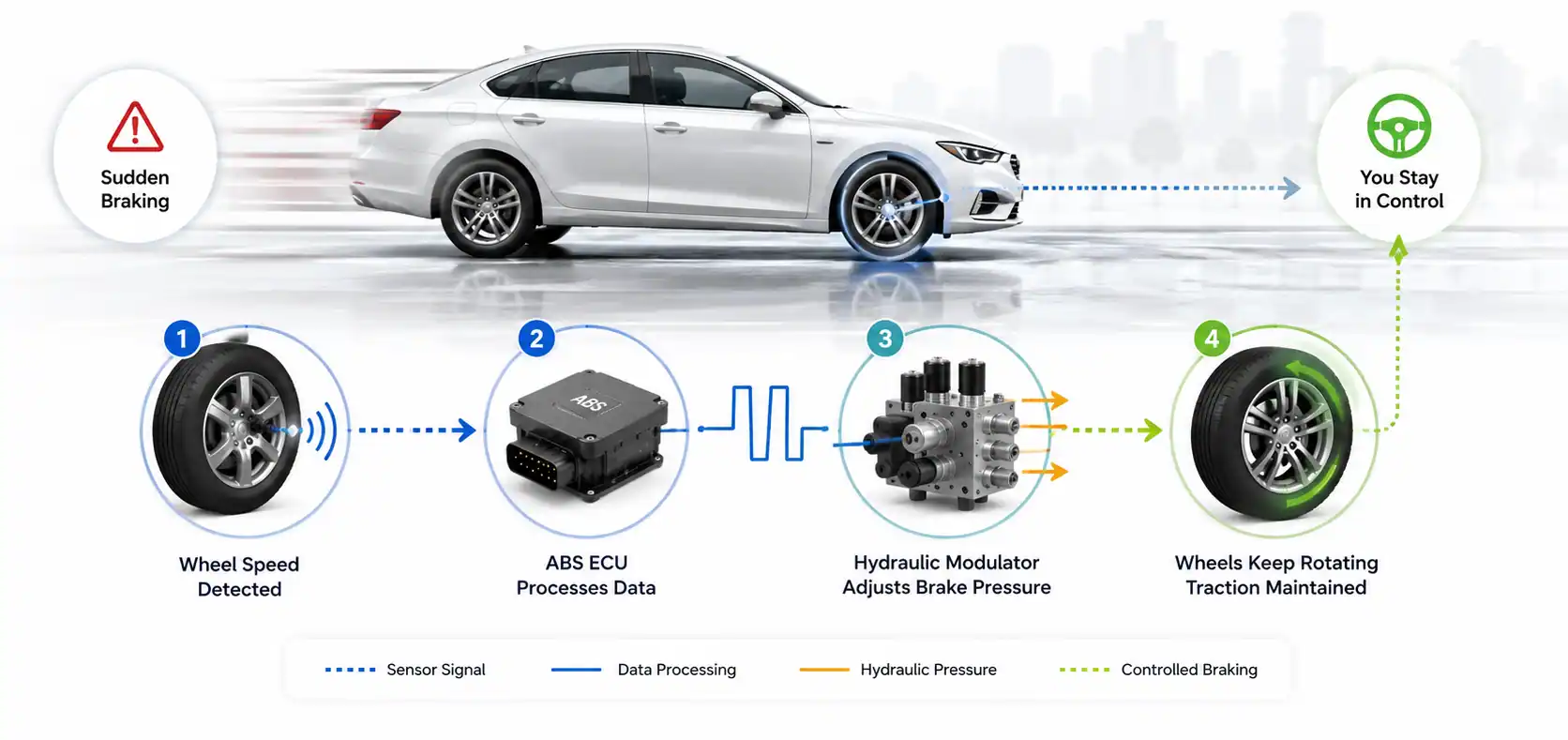
An Anti Lock Braking System works by monitoring wheel speed, detecting possible wheel lockup, and adjusting brake pressure through an electronic control unit and hydraulic modulator. When the ABS ECU identifies that a wheel is slowing too quickly, it reduces brake pressure momentarily and reapplies it rapidly to maintain traction.
The working of ABS can be understood in four stages:
1. Wheel Speed Monitoring
Wheel speed sensors are placed near the wheels to continuously measure how fast each wheel is rotating. These sensors send real-time signals to the ABS control unit. If one wheel suddenly slows down faster than the others, it may indicate that the wheel is about to lock.
2. ABS ECU Decision Making
The ABS control unit receives wheel speed data and processes it in real time. It compares wheel behavior and identifies whether braking pressure needs to be adjusted. This decision-making happens within milliseconds because braking safety depends on fast response.
3. Hydraulic Pressure Modulation
Once the ECU detects possible wheel lockup, it commands the hydraulic modulator to adjust brake pressure. The system may:
- Reduce brake pressure to release the lockup
- Hold brake pressure to maintain constant force
- Reapply brake pressure to maximize braking force
This cycle happens rapidly (often dozens of times per second), allowing the wheel to regain traction.
4. Maintaining Steering Control
Because ABS prevents complete wheel lockup, the tires maintain better contact with the road. This allows the driver to steer the vehicle even during emergency braking.
This is the key safety value of ABS: it does not simply help the vehicle stop; it helps the driver remain in control while braking.
Every second counts during an emergency braking situation. According to the World Health Organization, approximately 1.19 million people die each year due to road traffic crashes worldwide, highlighting the critical importance of vehicle safety technologies.
Components of Anti Lock Braking System
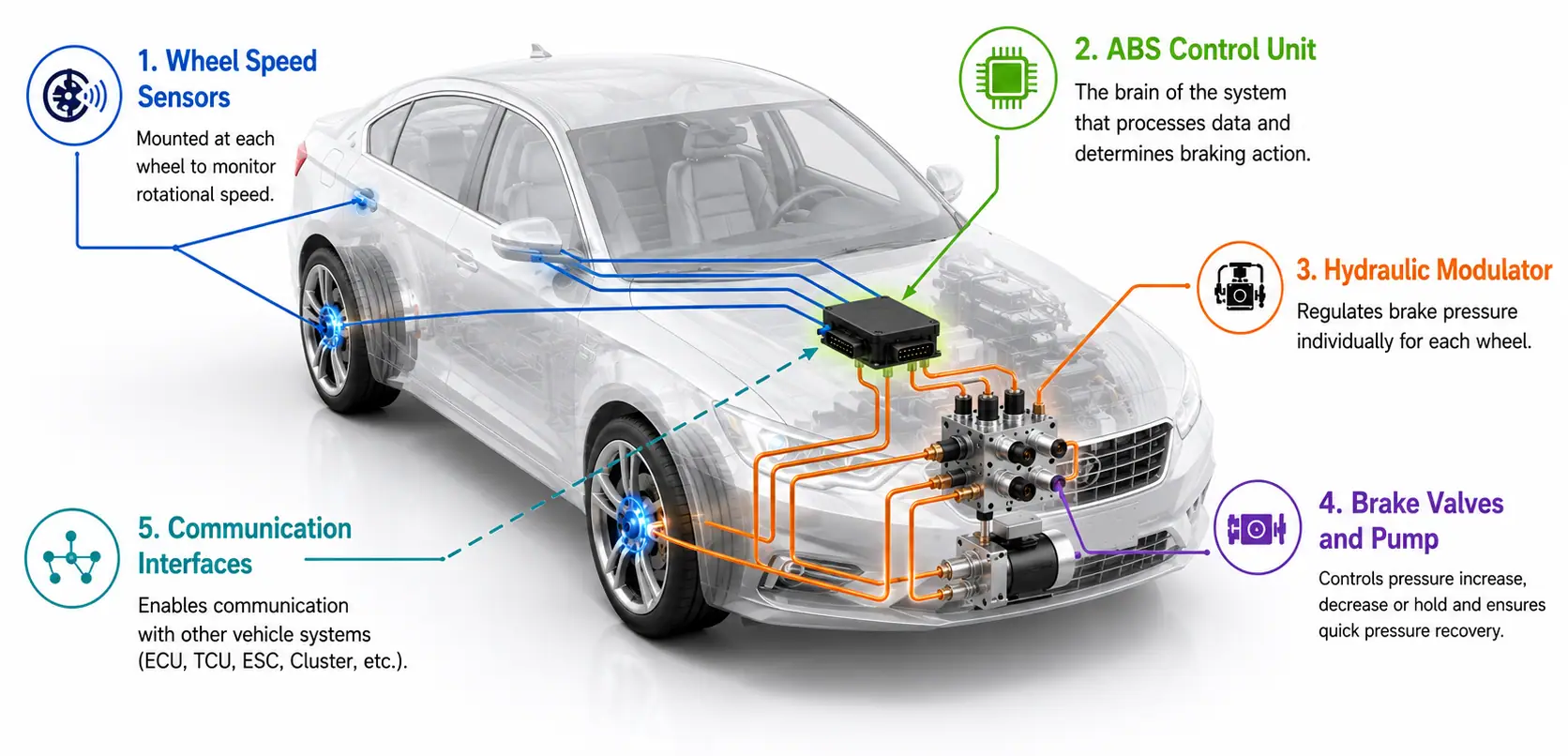
An Anti Lock Braking System is made up of sensors, an electronic control unit, hydraulic control elements, valves, pumps, and communication interfaces. Each component plays a specific role in detecting wheel behavior, processing braking data, and controlling brake pressure.
- Wheel Speed Sensors: Wheel speed sensors monitor the rotational speed of each wheel. They are essential because ABS depends on accurate wheel speed data to detect lockup conditions. If sensor data is inaccurate or delayed, ABS performance can be affected.
- ABS Control Unit: The ABS control unit, also known as the ABS ECU or ABS Module, is the brain of the system. It receives sensor signals, processes wheel speed data, detects lockup risk, and sends commands to the hydraulic modulator. In modern vehicles, this unit is supported by embedded software and real-time control logic.
- Hydraulic Modulator: The hydraulic modulator adjusts brake pressure based on ECU commands. It controls how much pressure is applied, released, or maintained at the braking circuit. This is the component that physically executes the pressure modulation required to prevent wheel lockup.
- Brake Valves and Pump: Valves regulate brake fluid pressure during ABS operation. The pump helps restore pressure when required. Together, these components enable rapid braking pressure adjustment.
- Communication Interfaces: Modern ABS systems often interact with other vehicle systems through automotive communication networks such as CAN. This allows ABS to exchange data with other ECUs and vehicle safety systems.
The components of an Anti Lock Braking System work together as a closed-loop safety system, where sensors detect wheel behavior and the ECU controls braking pressure response.
Types of Anti Lock Braking System
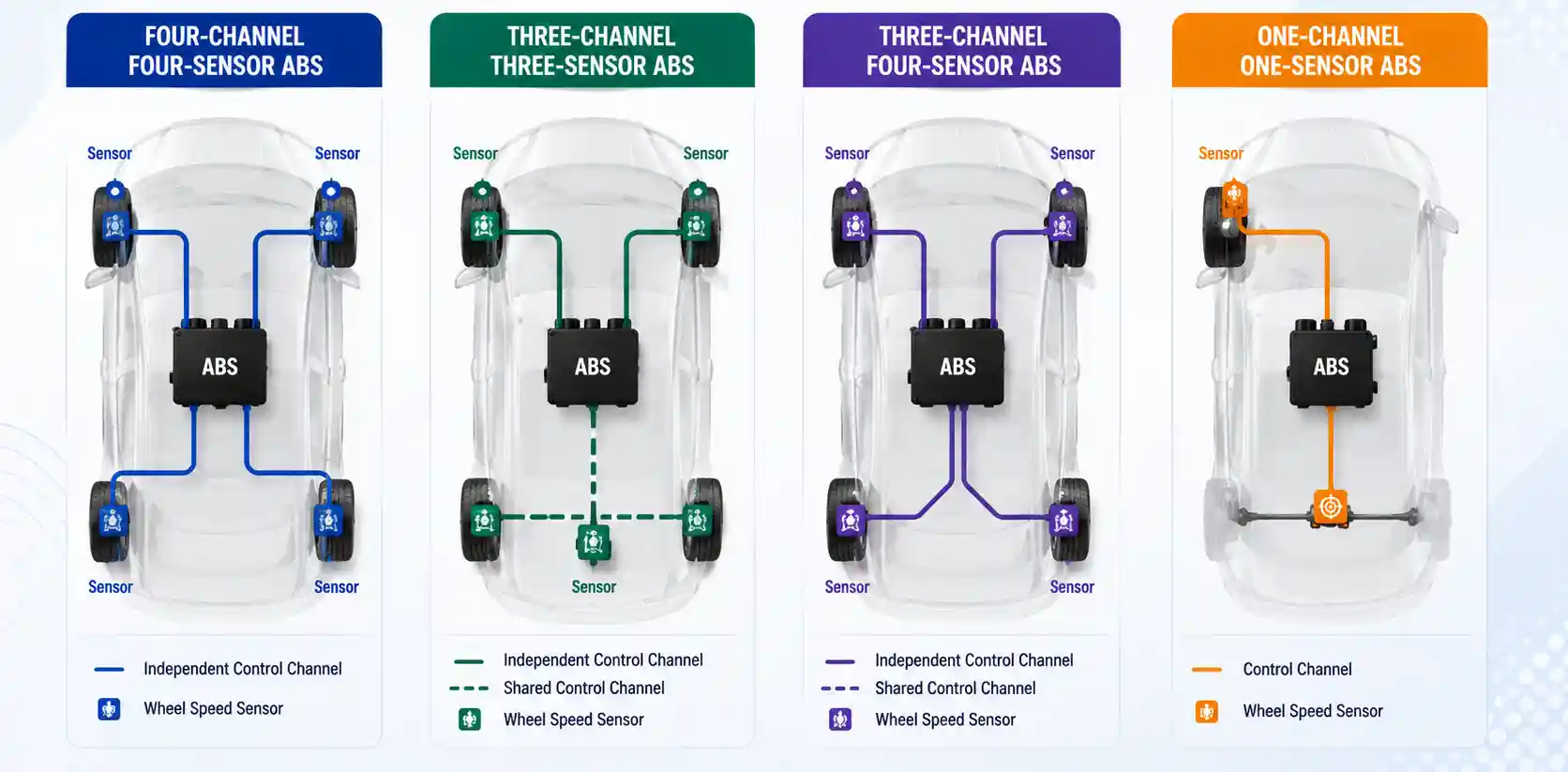
Anti Lock Braking Systems or ABS Brake System can be classified based on the number of sensors and control channels used to regulate wheel braking. The type of ABS used depends on vehicle category, cost, braking performance requirements, and safety architecture.
The Anti Lock Braking System in cars & passenger vehicles is commonly available in four-channel four-sensor configurations that provide independent control of each wheel. In contrast, the Anti Lock Braking System in bikes is often designed with simpler architectures optimized for two-wheel braking dynamics while still delivering improved safety and stability.
| ABS Type | Basic Configuration | Common Use Case |
|---|---|---|
| Four-channel four-sensor ABS | Individual sensor and control for each wheel | Modern passenger cars, premium vehicles, EVs |
| Three-channel ABS | Separate front wheel control and combined rear control | Some trucks and older vehicle platforms |
| Two-channel ABS | Limited wheel-pair control | Select commercial or older systems |
| One-channel ABS | Usually rear-wheel control only | Some basic or older vehicle applications |
Four-Channel Four-Sensor ABS
This is the most advanced and commonly preferred configuration in modern vehicles. Each wheel has its own sensor and independent control channel. It provides better braking stability because the system can manage each wheel separately.
Three-Channel ABS
Three-channel ABS usually controls the front wheels independently while managing the rear wheels together. It is commonly found in certain commercial vehicle configurations.
One-Channel and Two-Channel ABS
These systems offer limited control compared to four-channel ABS. They are generally used in simpler or cost-sensitive applications.
For modern automotive safety expectations, four-channel ABS provides stronger control and better stability.
Function of Anti Lock Braking System
The primary function of an Anti Lock Braking System is to prevent wheel lockup during braking so that the driver can maintain steering control and vehicle stability.
ABS performs several important functions:
- Prevents wheels from locking
- Maintains tire-road traction
- Reduces skidding risk
- Supports steering control during emergency braking
- Improves braking stability on slippery surfaces
- Supports wider vehicle safety systems
The most important point is that ABS does not guarantee a shorter stopping distance in every road condition. Its main function is to help maintain control during braking.
In modern vehicles, ABS also works as a base layer for other safety systems such as Electronic Stability Control (ESC) and Traction Control. These systems use braking intervention and sensor data to improve vehicle stability in different driving conditions.
Whether it is an Anti Lock Braking System in a car or a bike, the primary objective remains the same: preventing wheel lockup and helping the driver or rider maintain control during emergency braking situations.
Advantages of Anti Lock Braking System
The main advantage of an Anti Lock Braking System is improved vehicle control during sudden braking. By preventing wheel lockup, ABS helps reduce skidding and allows the driver to steer the vehicle while braking.
Key advantages include:
- Better Steering Control: ABS allows the driver to maintain directional control during emergency braking. This is especially useful when the driver needs to brake and steer at the same time.
- Reduced Skidding: When wheels lock, the vehicle may slide uncontrollably. ABS reduces this risk by keeping the wheels rotating.
- Improved Stability on Slippery Roads: ABS is useful on wet, icy, gravel, or low-traction surfaces where wheel lockup can happen quickly.
- Support for Modern Safety Systems: ABS provides a foundation for systems like ESC, traction control, and advanced braking assistance.
- Better Fleet and Commercial Vehicle Safety: For commercial vehicles and fleets, ABS can improve braking consistency and reduce safety risks in real-world driving conditions.
For OEMs and Tier 1 suppliers, ABS also contributes to safety compliance, vehicle reliability, and customer trust.
ABS Control Unit Architecture Explained
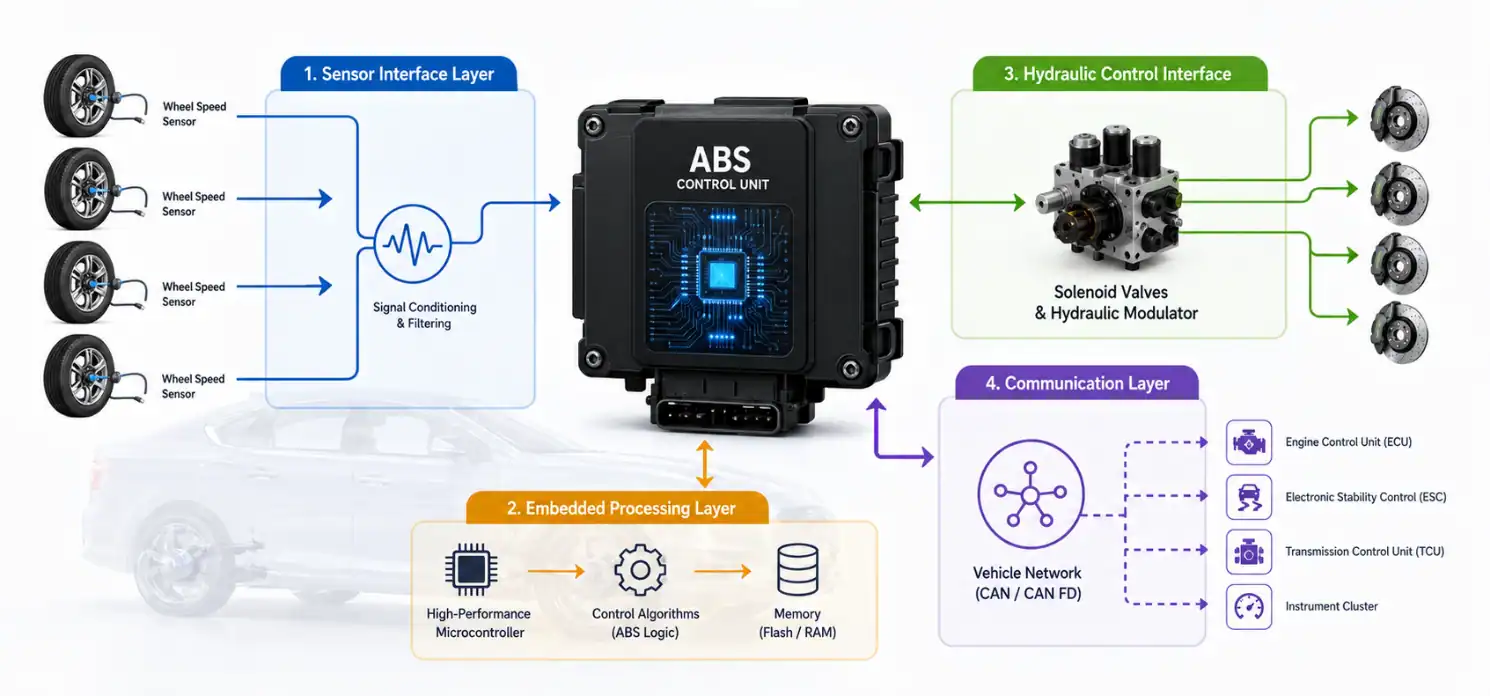
The ABS control unit architecture includes sensor input handling, embedded processing, hydraulic control output, diagnostics, and communication with other vehicle systems. It acts as the electronic decision-making layer that connects wheel speed data with real-time brake pressure control.
A typical ABS control unit architecture includes four major layers:
1. Sensor Interface Layer
This layer receives signals from wheel speed sensors. The quality of this input is critical because the ECU depends on accurate data to detect wheel lockup.
2. Embedded Processing Layer
This is where the ABS ECU processes sensor data and applies control logic. It determines whether brake pressure should be reduced, held, or reapplied. In production-grade automotive environments, this layer must be fast, reliable, and deterministic.
3. Hydraulic Control Interface
This layer sends commands to the hydraulic modulator, valves, and pump. It converts electronic decisions into braking pressure adjustments.
4. Communication Layer
Modern ABS control units may communicate with other vehicle systems through CAN or similar automotive networks. This allows integration with ESC, traction control, diagnostics, and other safety systems. This is where ABS becomes more than a standalone braking system—it becomes part of the larger vehicle safety architecture.
OptM’s automotive engineering capabilities include ABS modules, embedded control systems, CAN communication, real-time response systems, and vehicle sensor integration, which align closely with this type of automotive safety architecture.
Role of Embedded Software in ABS Control Unit Operation
Embedded software plays a critical role in ABS operation because it controls how sensor data is interpreted, how braking decisions are made, and how the hydraulic modulator responds during emergency braking.
In earlier vehicle systems, braking was largely mechanical and hydraulic. In modern vehicles, braking safety depends heavily on embedded software and ECU intelligence.
Embedded software in ABS supports:
- Wheel speed data interpretation
- Lockup detection logic
- Brake pressure control algorithms
- Diagnostic fault detection
- Communication with other ECUs
- Fail-safe behavior
- Real-time system response
For safety-critical systems like ABS, software must respond predictably under different road, speed, and braking conditions.
That is why embedded software expertise matters in ABS development. OptM’s work across embedded firmware, RTOS integration, CAN communication, vehicle diagnostics, automotive-grade embedded systems, and safety-focused firmware aligns with the software foundation required for modern ABS control units.
ABS Control Unit Integration with Wheel Speed Sensors, Hydraulic Modulator and ECU
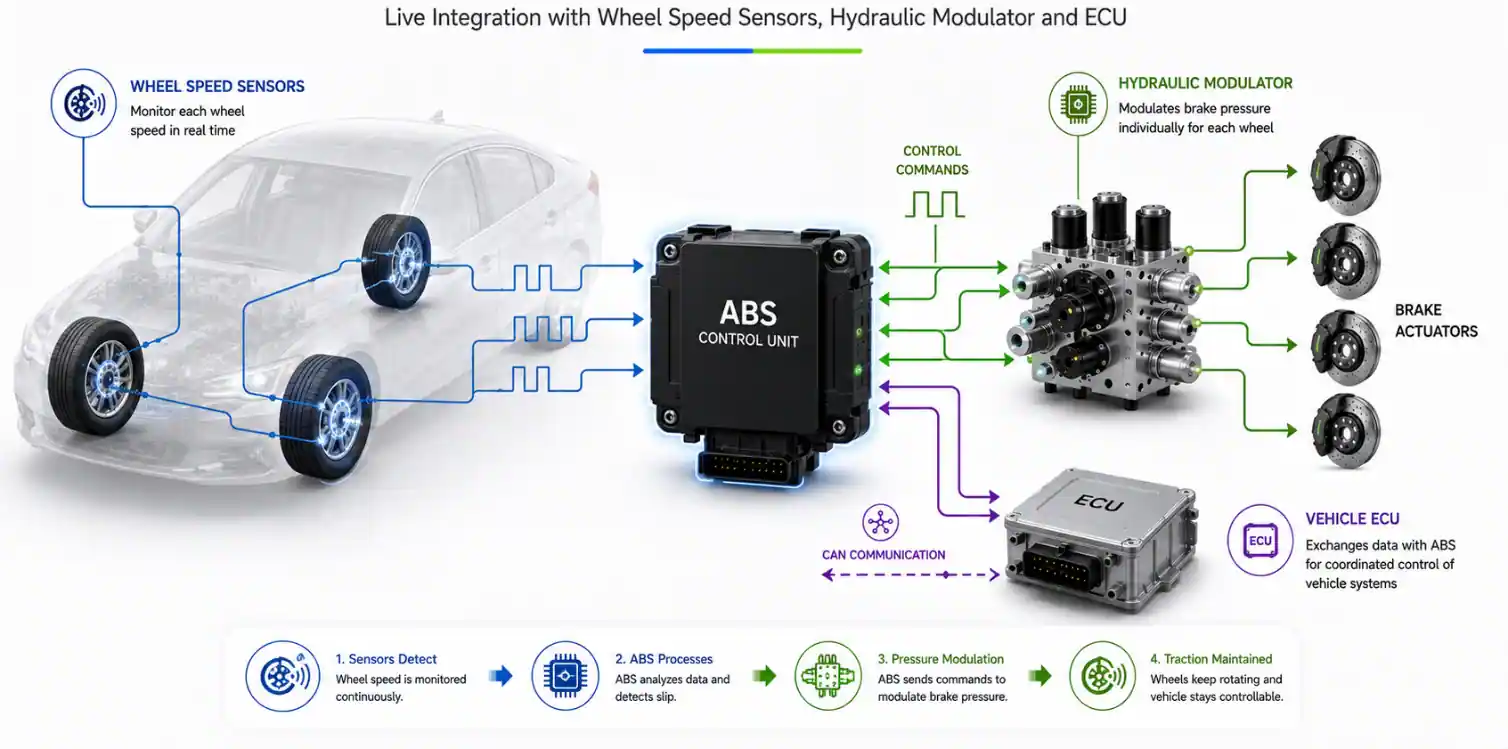
ABS performance depends on how well the control unit integrates with wheel speed sensors, the hydraulic modulator, and other vehicle ECUs. Even if each component works individually, poor integration can affect braking response, diagnostics, and system reliability.
Integration involves three major areas:
1. Sensor Integration
Wheel speed sensors must provide accurate and timely signals. The ABS ECU depends on this data to identify wheel slip or lockup conditions. Sensor noise, wiring issues, or calibration errors can affect system behavior.
2. Hydraulic Modulator Integration
The hydraulic modulator must respond quickly to ECU commands. If response timing is delayed, braking pressure control may become less effective. This is especially important during emergency braking.
3. ECU and Vehicle Network Integration
Modern ABS systems may interact with other ECUs through vehicle communication networks. This allows ABS to support broader safety functions such as ESC, traction control, and diagnostics. Reliable ABS control unit integration ensures that wheel speed sensors, hydraulic modulators, ECU logic, and vehicle networks respond as one coordinated braking system.
For OEMs and Tier 1 suppliers, integration quality is one of the most important factors in ABS development because the system must perform reliably across different vehicle platforms, environments, and braking conditions.
ABS Control Unit Testing and Validation
ABS control unit testing and validation ensure that the system performs reliably under real-world braking conditions. Since ABS is a safety-critical automotive system, it must be tested for sensor accuracy, ECU response, hydraulic control, diagnostics, and environmental durability.
Testing usually includes:
- Functional Testing: This verifies whether the ABS performs its core functions correctly, such as detecting wheel lockup and adjusting brake pressure.
- Sensor Validation: Wheel speed sensor signals must be tested for accuracy, stability, and response under different driving conditions.
- ECU Response Testing: The ABS ECU must process inputs and generate outputs within strict timing limits.
- Hydraulic Response Testing: The hydraulic modulator, valves, and pump must respond correctly to ECU commands.
- Environmental Testing: ABS components may face heat, vibration, moisture, dust, and road conditions. Testing ensures the system remains reliable in production environments.
- Vehicle-Level Validation: The complete ABS system must be tested under different braking scenarios, road surfaces, speeds, and vehicle loads.
For automotive teams, ABS validation is not only about confirming that the system works. Production-ready ABS control unit testing and validation verifies whether the system performs consistently across road surfaces, vehicle loads, braking intensity, and environmental conditions.
Common Challenges in ABS Control Unit Development
ABS control unit development involves several engineering challenges because the system must respond in real time, operate safely, and integrate with multiple vehicle systems.
Common challenges include:
- Sensor Noise and Signal Accuracy: Wheel speed sensors must provide clean and reliable data. Any noise or delay can affect ECU decision-making.
- Real-Time Latency: ABS decisions must happen within milliseconds. Delayed processing can reduce system effectiveness during emergency braking.
- Hydraulic Response Consistency: The hydraulic modulator must respond accurately to ECU commands. Any mismatch between software command and hydraulic response can affect braking stability.
- ECU Integration Complexity: Modern vehicles use multiple ECUs. ABS must integrate properly with stability control, traction control, diagnostics, and sometimes ADAS-related systems.
- Software Validation: ABS software must be tested across multiple braking conditions, vehicle speeds, road surfaces, and failure scenarios.
- EV and Connected Vehicle Complexity: In EVs and software-defined vehicles, braking systems may interact with regenerative braking, vehicle control units, and connected diagnostics. This increases integration complexity.Common ABS control unit development challenges usually appear around sensor noise, latency, hydraulic response timing, ECU synchronization, and validation complexity.
These challenges make ABS development a multidisciplinary task involving embedded software, hardware integration, vehicle dynamics, diagnostics, and validation engineering.
ABS Control Unit vs Electronic Stability Control
ABS and Electronic Stability Control (ESC) are both vehicle safety systems, but they solve different problems. ABS prevents wheel lockup during braking, while ESC helps prevent loss of vehicle stability during cornering, sudden maneuvers, or skidding situations.
| Feature | ABS | Electronic Stability Control |
|---|---|---|
| Primary Purpose | Prevents wheel lockup during braking | Helps maintain vehicle stability |
| Main Trigger | Hard braking or wheel lock tendency | Loss of directional control or skidding |
| Key Function | Modulates brake pressure | Applies braking to specific wheels and may reduce engine torque |
| Driver Benefit | Maintains steering control during braking | Helps prevent oversteer or understeer |
| System Relationship | Foundational braking safety system | Builds on ABS and other vehicle sensors |
ABS is mainly active during braking. ESC is broader because it monitors vehicle direction, steering input, yaw behavior, and stability.
In simple terms:
- ABS helps you steer while braking.
- ESC helps the vehicle stay stable when it starts losing control.
Modern vehicles often use both systems together as part of a larger safety architecture.
How to Choose the Right ABS Provider or Manufacturer
Choosing the right ABS provider is not only about sourcing a braking module. For OEMs and Tier 1 suppliers, the decision usually depends on how well the provider can support embedded control, ECU integration, sensor compatibility, hydraulic modulation, diagnostics, validation, and production scalability.
A strong ABS provider should be evaluated across these factors:
1. Functional Safety and Compliance Readiness
ABS is a safety-critical system, so development should align with automotive functional safety expectations. Standards such as ISO 26262 define the functional safety framework for electrical and electronic systems in road vehicles, while ASIL classification helps determine the required level of safety rigor for automotive systems.
2. ECU and Embedded Software Capability
Modern ABS depends heavily on ECU software, real-time control logic, fault diagnostics, and communication reliability. The provider should understand embedded firmware, RTOS-based control, CAN communication, and safety-focused software behavior.
3. Sensor and Hydraulic Modulator Integration
ABS performance depends on accurate wheel speed sensor input and fast hydraulic pressure modulation. A capable provider should understand sensor signal quality, actuator response timing, valve control, pump behavior, and braking pressure coordination.
4. Vehicle Network and System Integration
ABS does not work in isolation anymore. It often interacts with ESC, traction control, ADAS functions, vehicle diagnostics, and other ECUs. NHTSA’s FMVSS No. 126 documentation also highlights how Electronic Stability Control builds on anti-lock braking technologies for vehicle stability functions.
5. Testing and Validation Depth
OEMs should evaluate whether the provider can support functional testing, sensor validation, ECU response testing, environmental checks, braking simulations, and vehicle-level validation. In safety-critical braking systems, validation quality is as important as product design.
6. Platform Customization and Scalability
The ABS system should be adaptable for passenger vehicles, EVs, commercial vehicles, and industrial mobility platforms. For EVs, the provider should also understand interaction points between ABS, regenerative braking, vehicle control units, and connected diagnostics.
7. Long-Term Engineering Support
ABS programs require support beyond initial development. OEMs and Tier 1 suppliers often need calibration support, diagnostics updates, integration assistance, documentation, and future platform adaptation.
A practical way to evaluate an ABS partner is to use a simple OptM’s S.A.F.E. Evaluation Framework:
| Framework Area | What It Means |
|---|---|
| S — Safety Readiness | Functional safety approach, fail-safe behavior, diagnostics |
| A — Architecture Fit | ECU, sensor, hydraulic, and network integration |
| F — Field Reliability | Environmental durability, validation, real-world braking consistency |
| E — Engineering Support | Customization, testing, documentation, lifecycle support |
This framework helps OEMs and Tier 1 suppliers evaluate an ABS solution beyond basic braking functionality. Instead of checking only whether the system prevents wheel lockup, it encourages teams to assess safety readiness, architecture compatibility, field durability, and long-term engineering support. This makes the selection process more practical for production-grade vehicle programs.
Conclusion
Anti Lock Braking System has evolved from a basic braking support feature into a critical part of modern vehicle safety architecture. It helps prevent wheel lockup, supports steering control during emergency braking, and works with sensors, ECU logic, hydraulic modulation, and embedded software to improve vehicle stability.
For OEMs, Tier 1 suppliers, and automotive engineering teams, ABS development is not only about braking performance. It also requires reliable ECU integration, real-time embedded control, sensor coordination, software validation, and production-ready system engineering.
If you are exploring advanced ABS solutions for modern vehicle platforms or in search of a reliable Manufacturer/Supplier, visit OptM’s ABS Module Product Page to understand how OptM supports automotive teams with embedded control, ABS module development, ECU integration, and vehicle safety system engineering.
Frequently Asked Questions (FAQs)
1. What happens if an ABS module fails?
If an ABS module fails, the Anti Lock Braking System may stop functioning correctly, and the ABS warning light will typically appear on the dashboard. In most cases, conventional braking remains available, but features such as anti-lock braking, traction control, and electronic stability functions may be limited or disabled. The vehicle may also experience reduced braking stability on slippery roads.
2. How do I know if ABS is not working?
Common signs of a malfunctioning ABS include an illuminated ABS warning light, unresponsive traction control, unusual brake pedal behavior, or wheel lockup during hard braking. Diagnostic scanning is usually required to identify whether the issue originates from the ABS module, wheel speed sensors, wiring, or hydraulic components.
3. Does an ABS module affect the transmission?
The ABS module does not directly control the transmission. However, modern vehicles share data between multiple electronic control units (ECUs). In some cases, faulty ABS signals may affect systems that rely on wheel speed information, such as transmission control, cruise control, traction control, or vehicle stability systems.
4. How is an ABS module programmed?
An ABS module is typically programmed using manufacturer-specific diagnostic tools through vehicle communication networks such as CAN. Programming may include firmware installation, calibration, vehicle configuration, sensor adaptation, and diagnostic setup. Modern ABS control units may also support software updates and calibration through UDS (Unified Diagnostic Services) protocols.
5. What is ABS module replacement?
ABS module replacement is the process of removing a faulty ABS control unit and installing a new or refurbished unit. Depending on the vehicle, the replacement may require software programming, calibration, sensor verification, and diagnostic testing to ensure proper communication with the braking and vehicle control systems.
6. Where is the Anti Lock Braking System located?
The Anti Lock Braking System consists of multiple components located throughout the vehicle. The ABS control module and hydraulic modulator are usually installed in the engine compartment near the brake master cylinder, while wheel speed sensors are mounted near each wheel hub.
7. Why does an ABS module fail?
ABS modules can fail due to electrical faults, moisture ingress, vibration, overheating, corrosion, damaged wiring, sensor issues, or internal electronic component failure. In commercial and heavy-duty vehicle applications, harsh environmental conditions can accelerate wear and affect long-term reliability.
8. How long should an ABS module last?
An ABS module is generally designed to last the lifetime of the vehicle and can often operate reliably for 10 years or more. However, operating conditions, environmental exposure, maintenance quality, and electrical system health can influence its service life.
9. Does the ABS module control the speedometer?
In many modern vehicles, wheel speed data collected by ABS sensors is shared with other vehicle systems. While the ABS module does not directly control the speedometer, it may provide wheel speed information that contributes to vehicle speed calculations used by the instrument cluster.
10. Does the ABS module control traction control?
Yes, in many modern vehicles the ABS module works closely with the traction control system. Both systems use wheel speed sensor data to monitor tire behavior. Traction control can use the ABS hydraulic system to selectively apply braking force and help reduce wheel spin during acceleration.
11. Are anti-lock brakes different from conventional brakes?
Yes. Conventional brakes apply braking force based solely on driver input, whereas anti-lock brakes use sensors, an ABS control unit, and hydraulic modulation to prevent wheel lockup during hard braking. This allows drivers to maintain better steering control and vehicle stability in emergency braking situations.
12. What Is Anti Lock Braking System in a Bike?
An Anti Lock Braking System in a bike prevents wheel lockup during sudden braking by monitoring wheel speed and automatically adjusting brake pressure. This helps riders maintain balance, steering control, and stability, particularly on wet or slippery roads.
13. What Is Anti Lock Braking System in a Car?
An Anti Lock Braking System in a car uses wheel speed sensors, an ABS control unit, and a hydraulic modulator to prevent wheel lockup. By regulating brake pressure at individual wheels, ABS helps drivers maintain steering control and reduces the risk of skidding during emergency braking.