
Content Writer & SEO Specialist
Content Writer & SEO Specialist
Aditya Sharma is a content writer at OptM Solutions specializing in automotive electronics, embedded systems, telematics, electric vehicle technologies, connected mobility, and autonomous driving technologies.
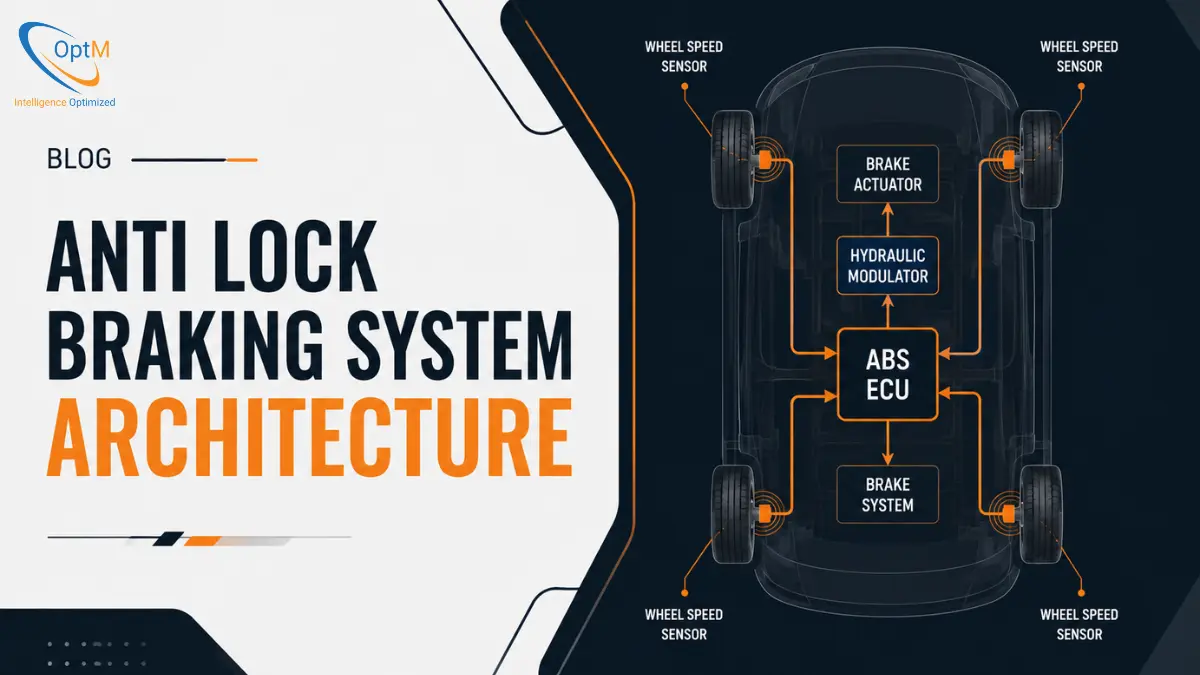
LinkedIn ProfileModern Anti-lock Braking Systems (ABS) are no longer standalone braking components. In today's software-defined vehicles, ABS performance depends on seamless integration between wheel speed sensors, hydraulic actuators, embedded control software, and vehicle electronic control units (ECUs).
When a driver performs emergency braking, the ABS Control Unit must receive wheel speed data, calculate wheel slip, communicate with the hydraulic modulator, and coordinate with the vehicle ECU--all within milliseconds. This integrated architecture is what enables modern vehicles to maintain stability and steering control under challenging braking conditions.
If you're new to ABS technology, understanding the fundamentals through our What is Anti Lock Braking System guide can provide useful context before exploring the integration architecture.
Why ABS Component Integration Matters
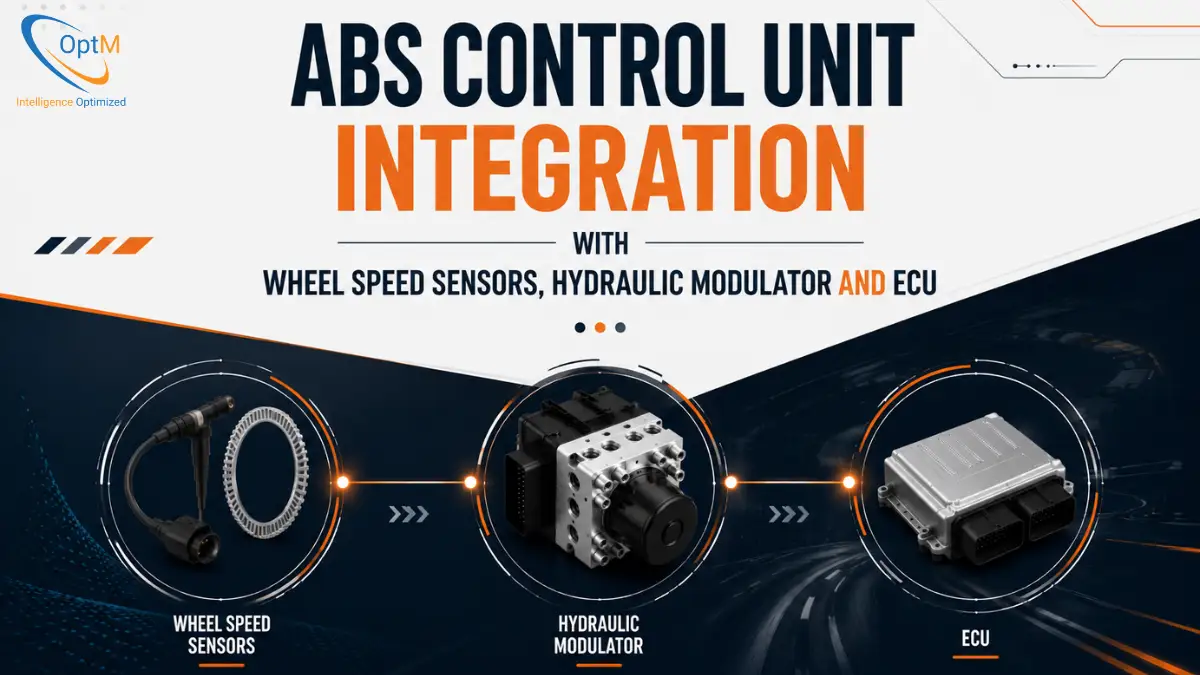
ABS integration refers to the coordinated communication between wheel speed sensors, the ABS Control Unit, hydraulic modulator, and vehicle ECU. The control unit continuously processes wheel behavior, determines slip conditions, and commands braking adjustments in real time to prevent wheel lock-up and maintain vehicle stability.
An ABS system is only as effective as the communication between its components.
The wheel speed sensors generate data, the ABS Control Unit makes decisions, the hydraulic modulator executes braking adjustments, and the ECU shares vehicle-wide information. If any part of this communication chain experiences delays or inaccuracies, braking performance can be affected.
In safety-critical automotive environments, this entire workflow must operate continuously while the vehicle is in motion.
How the ABS Control Unit Integrates with Wheel Speed Sensors
Wheel speed sensors serve as the primary data source for the ABS Control Unit. They continuously monitor wheel rotation and transmit speed information that allows the control unit to detect wheel slip and potential lock-up conditions during braking.
The integration process begins at the wheel speed sensors.
Each sensor continuously measures wheel rotational speed and sends this information to the ABS Control Unit. The control unit compares wheel speeds across the vehicle and looks for abnormal deceleration patterns.
ABS Sensor Integration Workflow
Wheel Speed Sensor → ABS Control Unit → Slip Detection Algorithm → Braking Decision
When one or more wheels begin slowing significantly faster than expected, the ABS Control Unit identifies a potential lock-up event and initiates corrective action.
This sensor-driven decision-making process forms the foundation of the entire ABS architecture.
For a deeper understanding of individual sensor functionality, readers often explore the role of wheel speed sensors within the Components of Anti Lock Braking System architecture.
How the ABS Control Unit Communicates with the Hydraulic Modulator
The hydraulic modulator acts as the execution layer of the ABS system. Based on commands received from the ABS Control Unit , it adjusts brake pressure at individual wheels to prevent wheel lock-up while maintaining braking effectiveness.
Once wheel slip is detected, the ABS Control Unit sends commands to the hydraulic modulator.
The hydraulic modulator uses electronically controlled solenoid valves to regulate brake pressure through three key phases:
- Pressure Reduction
- Pressure Hold
- Pressure Reapplication
This cycle can occur multiple times per second during emergency braking.
| ABS Decision | Hydraulic Modulator Action | Result |
|---|---|---|
| Wheel Lock Predicted | Reduce Brake Pressure | Wheel Regains Rotation |
| Wheel Stable | Maintain Pressure | Controlled Braking |
| Traction Restored | Reapply Pressure | Maximum Safe Braking |
The rapid interaction between the ABS Control Unit and hydraulic modulator allows the vehicle to continue steering while braking aggressively.
ABS Control Unit and ECU Integration Workflow
The ABS Control Unit exchanges operational data with the vehicle ECU through automotive communication networks such as CAN. This communication enables coordinated vehicle behavior across braking, traction control, diagnostics, and stability management systems.
Modern vehicles contain multiple ECUs responsible for different vehicle functions.
The ABS Control Unit does not operate in isolation. It shares data with the vehicle ECU through Controller Area Network (CAN) communication, allowing other safety systems to respond appropriately.
Common information exchanged includes:
- Vehicle speed data
- Wheel speed information
- Brake system status
- Diagnostic fault codes
- Stability control requests
This communication becomes particularly important in vehicles equipped with traction control and electronic stability systems, where multiple safety functions depend on shared braking information.
Real-Time ABS Integration Workflow
The complete integration process follows a continuous feedback loop:
Step 1: Driver Applies Brakes
The braking event begins when the driver presses the brake pedal.
Step 2: Wheel Speed Sensors Capture Data
Sensors continuously monitor wheel rotation and transmit speed signals.
Step 3: ABS Control Unit Detects Slip
Embedded control algorithms identify potential wheel lock conditions.
Step 4: Hydraulic Modulator Adjusts Pressure
Brake pressure is increased, reduced, or maintained based on control decisions.
Step 5: ECU Receives System Status
Vehicle control systems receive braking information through CAN communication.
Step 6: Vehicle Maintains Stability
The driver retains steering control while achieving effective braking performance.
This workflow forms the operational foundation described in our guide on How Anti Lock Braking System Works.
Engineering Challenges in ABS Integration
Developing a reliable ABS architecture involves much more than connecting components together.
Engineering teams must address several integration challenges:
- Sensor signal accuracy under harsh operating conditions
- Millisecond-level real-time processing requirements
- CAN communication reliability
- Electromagnetic interference management
- Functional safety compliance
- Long-term durability validation
The Automotive Safety Council highlights that modern braking safety systems depend on accurate sensor inputs, rapid electronic control decisions, and precise hydraulic actuation, emphasizing the importance of tightly integrated ABS architectures in maintaining vehicle stability.
From an engineering standpoint, the challenge is not simply developing individual components--it is ensuring that every component responds as a synchronized safety system under real-world driving conditions.
How OptM Supports ABS Control Unit Development
From a product engineering perspective, ABS development extends far beyond braking algorithms.
Engineering teams must validate:
- Wheel sensor integration
- Real-time embedded control software
- ECU communication workflows
- CAN network performance
- Hydraulic response behavior
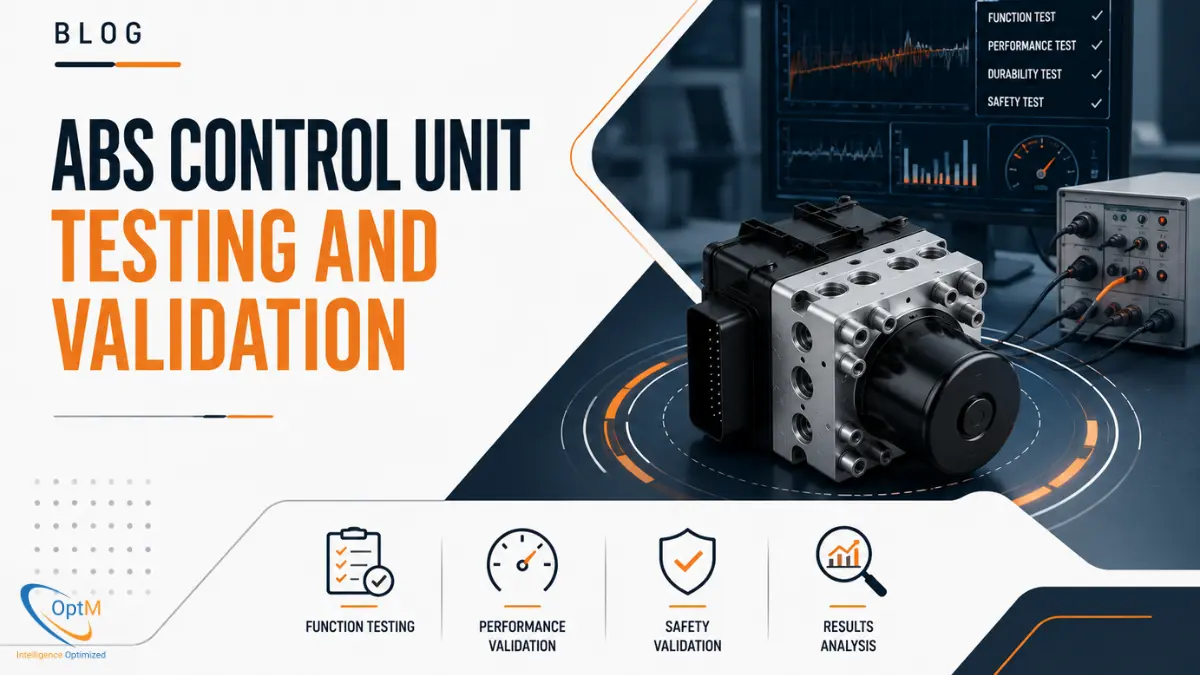
- System-level safety validation
OptM's automotive engineering expertise includes ABS modules, automotive-grade ECU architectures, CAN communication systems, embedded control software, vehicle sensor integration, and safety-focused firmware development that support modern braking system architectures.
Based on implementation observations across automotive embedded ecosystems, successful ABS deployment depends on achieving reliable interaction between hardware, software, communication networks, and vehicle control systems--not simply optimizing individual components.
Explore OptM's ABS Module capabilities to understand how automotive-grade ECU design, embedded control systems, CAN communication, and sensor integration contribute to next-generation braking solutions.
Frequently Asked Questions (FAQs)
How does the ABS Control Unit receive wheel speed data?
Wheel speed sensors continuously transmit wheel rotation information to the ABS Control Unit, enabling real-time slip detection and braking decisions.
Can the hydraulic modulator work without the ABS Control Unit?
No. The hydraulic modulator relies on commands from the ABS Control Unit to adjust brake pressure appropriately.
How does the ECU interact with the ABS system?
The ECU exchanges vehicle status, diagnostic, and braking-related information with the ABS Control Unit through CAN communication networks.
Why is real-time processing important in [ABS systems](/blog/what-is-anti-lock-braking-system/)?
ABS decisions must occur within milliseconds to prevent wheel lock-up and maintain vehicle control during braking events.
What communication protocol is commonly used in ABS integration?
Most modern automotive ABS architectures use CAN communication for reliable data exchange between vehicle control modules.