
Content Writer & SEO Specialist
Content Writer & SEO Specialist
Aditya Sharma is a content writer at OptM Solutions specializing in automotive electronics, embedded systems, telematics, electric vehicle technologies, connected mobility, and autonomous driving technologies.
LinkedIn ProfileHow Anti Lock Braking System Works is one of the most common questions drivers have after experiencing brake pedal vibration during emergency braking. While many assume something is wrong with the vehicle, that vibration is usually a sign that one of the most important automotive safety systems is working exactly as intended.
An Anti-Lock Braking System (ABS) prevents wheel lock-up during hard braking, helping drivers maintain steering control and vehicle stability when it matters most. Today, ABS is a standard safety feature in most modern vehicles and serves as the foundation for technologies such as Electronic Stability Control (ESC) and Traction Control Systems (TCS).
In this guide, we'll explain exactly how ABS works, what happens inside the system during emergency braking, the components involved, and why it remains one of the most important safety innovations in automotive engineering.
What Is an Anti Lock Braking System (ABS)?
An Anti-Lock Braking System (ABS) is an electronic safety system that prevents a vehicle's wheels from locking during sudden or heavy braking.
Instead of allowing the wheels to stop rotating completely, ABS continuously adjusts brake pressure to keep the tires gripping the road surface. This helps the driver maintain steering control while slowing the vehicle.
The primary objectives of ABS are:
- Prevent wheel lock-up
- Reduce skidding risk
- Maintain steering control
- Improve vehicle stability
- Enhance braking safety
Before ABS became common, drivers often had to manually "pump" the brakes during emergency situations to avoid wheel lock. Modern ABS performs this process automatically and significantly faster than any human driver can.
Why Do Wheels Lock During Hard Braking?
To understand ABS, you first need to understand why wheel lock happens.
When you press the brake pedal, the braking system applies force to slow down the wheels. Under normal conditions, the tires maintain grip with the road while decelerating.
However, during sudden or aggressive braking, the braking force can exceed the available traction between the tire and road surface.
When this happens:
- The wheel stops rotating
- The vehicle continues moving forward
- Tire grip decreases
- Steering control is reduced
- Skidding becomes more likely
Think of it this way:
A rotating tire can both brake and steer.
A locked tire can only slide.
And once a tire starts sliding, controlling the vehicle becomes significantly more difficult.
This is exactly the situation ABS is designed to prevent.
How Does an Anti Lock Braking System Work?
An Anti-Lock Braking System works by monitoring wheel speed through sensors and detecting when a wheel is about to lock during braking. The ABS control unit then rapidly adjusts brake pressure using hydraulic valves, allowing the wheel to continue rotating while maintaining traction, steering control, and vehicle stability.
Now let's look at the complete process step by step.
What Happens The Moment You Slam The Brakes?
Imagine you're driving at 90 km/h on a rainy highway.
A truck ahead suddenly brakes.
You immediately press the brake pedal as hard as possible.
This is where ABS starts doing its job.
Stage 1: Brake Pressure Increases
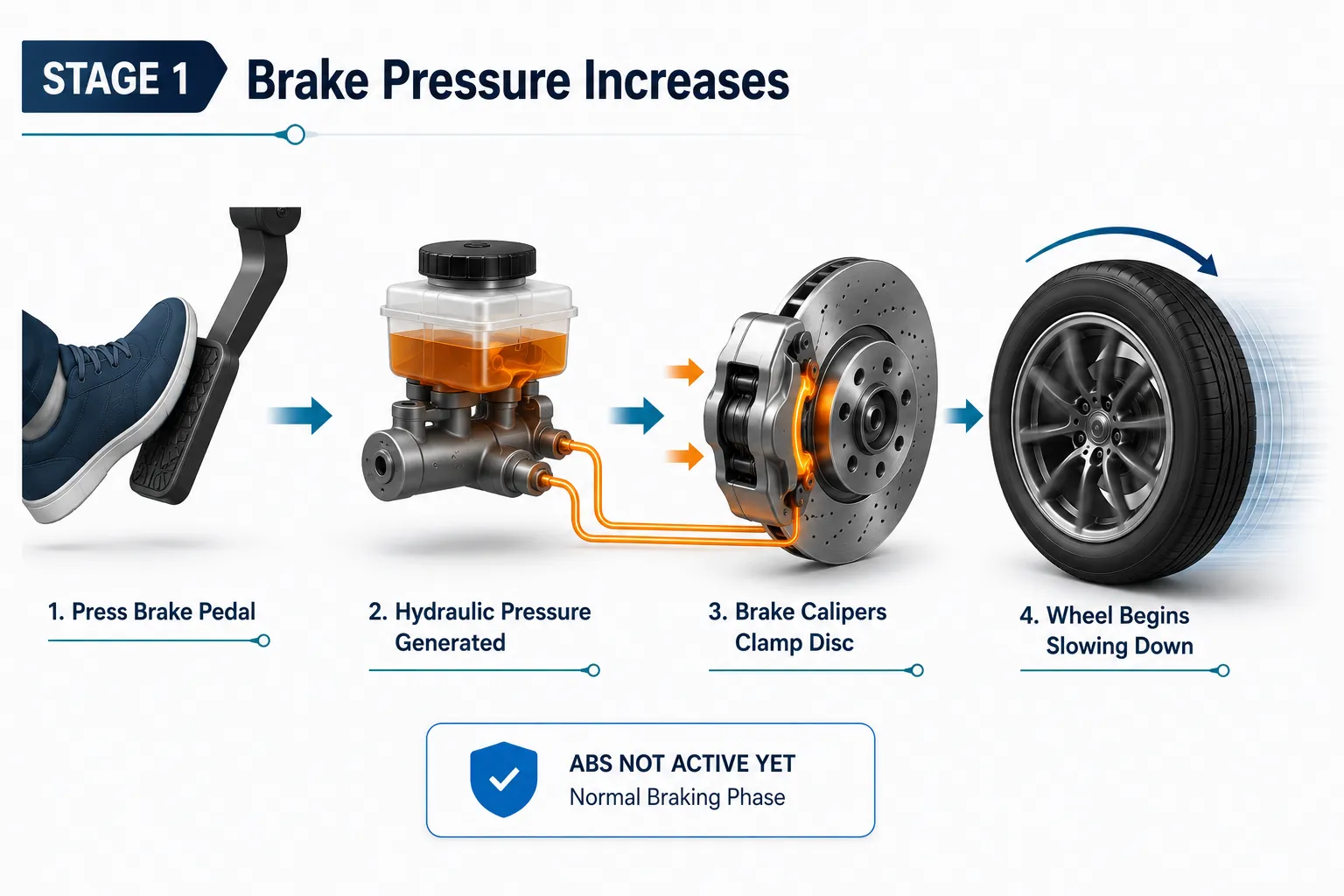
The moment you press the brake pedal:
- Hydraulic pressure is generated
- Brake calipers clamp the brake discs
- The wheels begin slowing down rapidly
At this stage, ABS hasn't intervened yet.
The braking system is functioning normally.
Stage 2: Wheel Speed Sensors Continuously Monitor Rotation
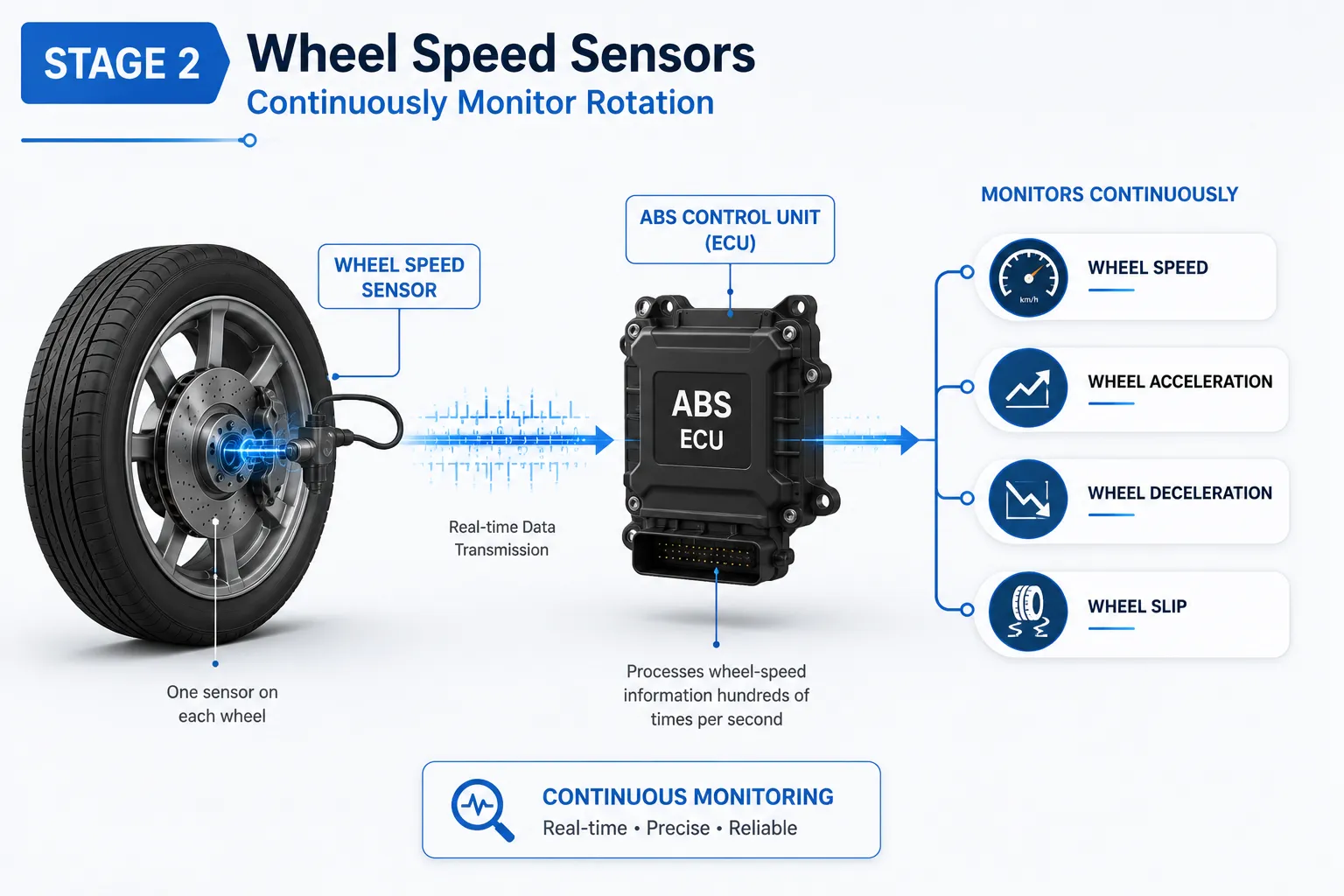
Each wheel is equipped with a wheel speed sensor.
These sensors continuously track:
- Wheel speed
- Wheel acceleration
- Wheel deceleration
- Wheel slip
The data is sent to the ABS Control Unit (ECU) in real time.
Modern ABS systems can process wheel-speed information hundreds of times every second.
Stage 3: ABS Predicts Wheel Lock Before It Happens
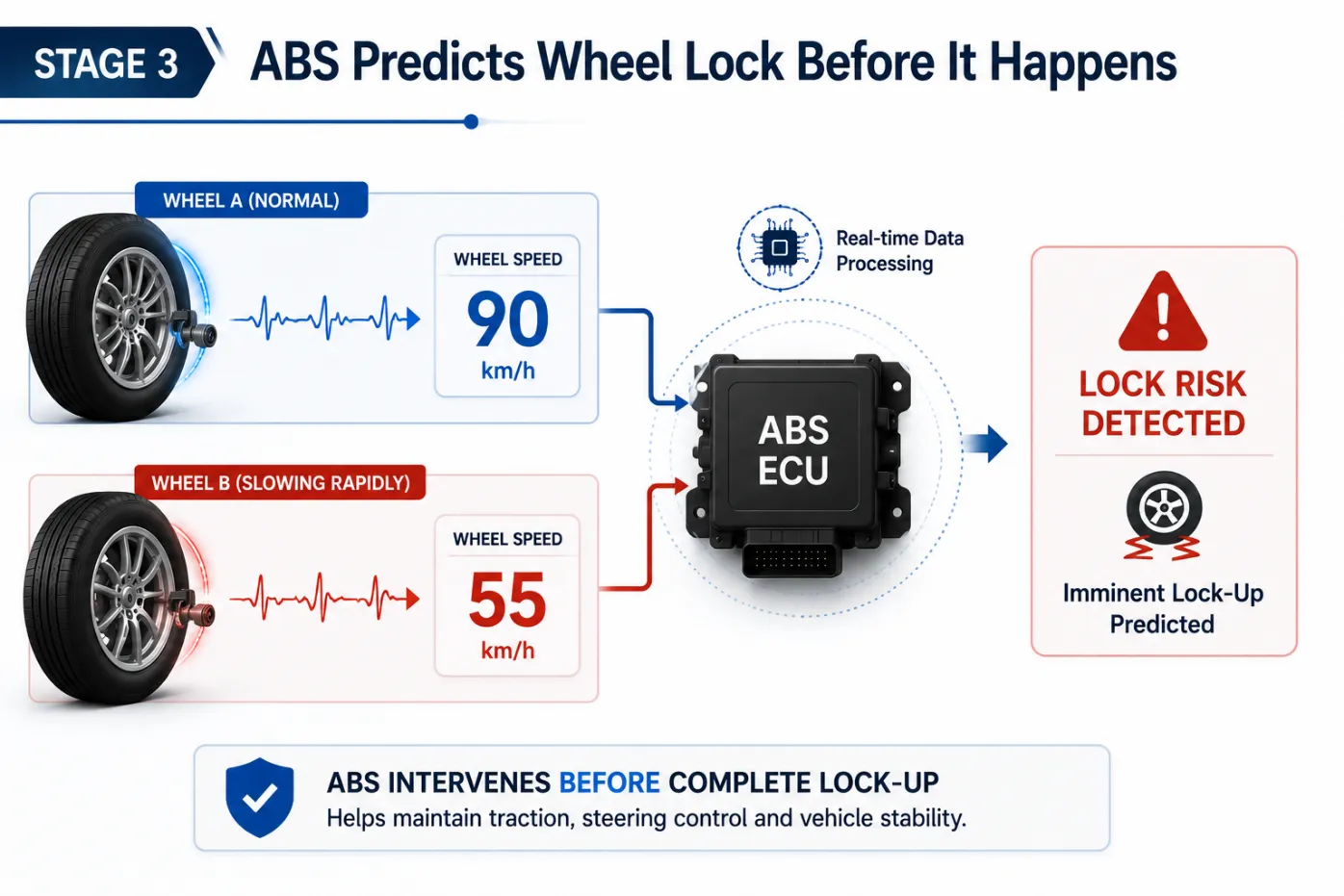
One of the biggest misconceptions about ABS is that it reacts after a wheel locks.
In reality, ABS intervenes before complete lock-up occurs.
Let's say:
- The vehicle is still moving at 90 km/h
- One wheel suddenly slows much faster than the others
The ABS ECU recognizes this as an impending lock-up condition.
Instead of waiting for the wheel to stop rotating, the system predicts the loss of traction and prepares to intervene.
This predictive capability is one of the main reasons ABS is so effective.
Stage 4: Hydraulic Valves Reduce Brake Pressure
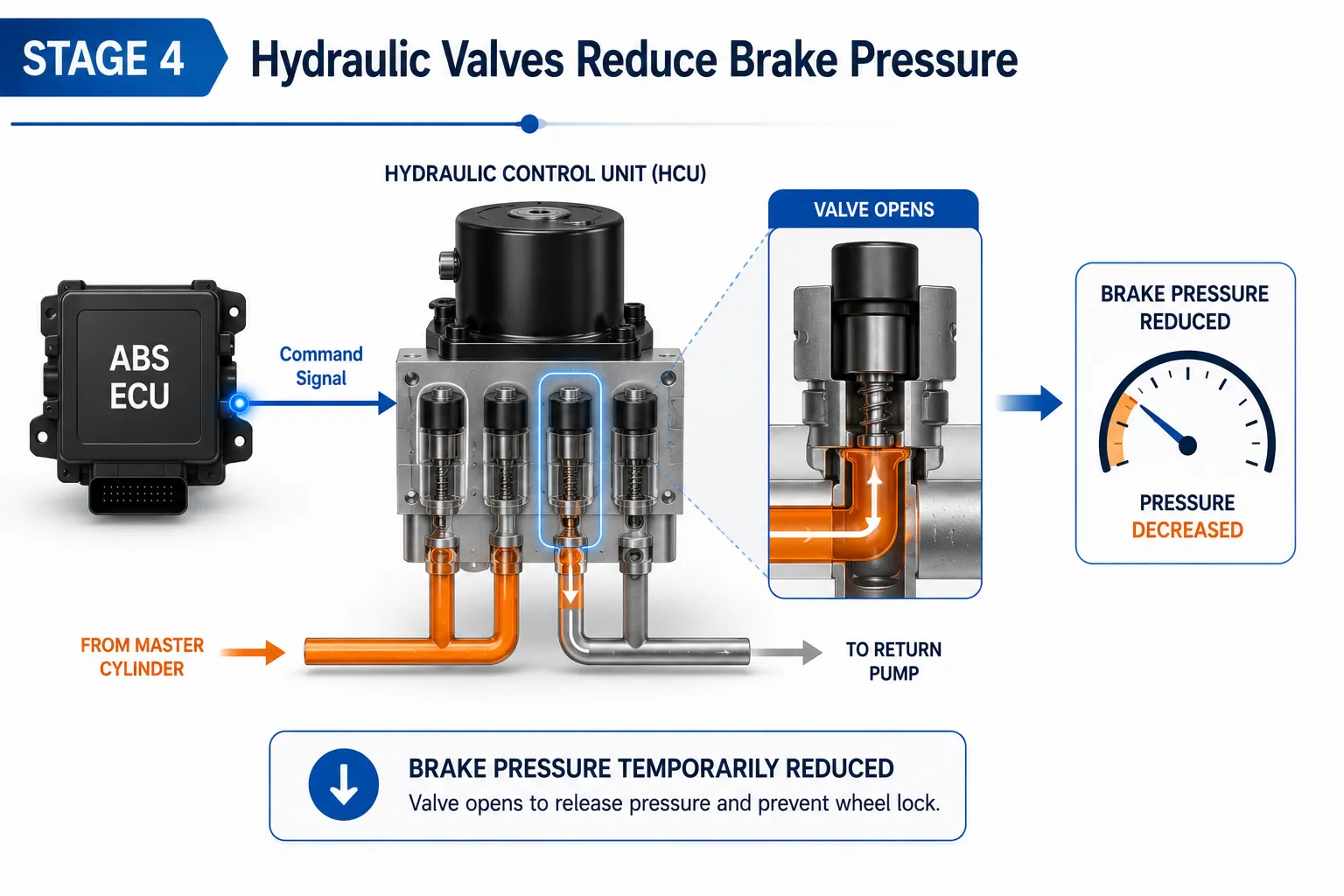
Once the ABS ECU identifies a wheel approaching lock-up, it sends a command to the Hydraulic Control Unit (HCU).
The HCU contains electronically controlled solenoid valves.
These valves temporarily reduce brake pressure to the affected wheel.
This brief pressure release allows the wheel to regain rotational movement and restore traction with the road surface.
Stage 5: The Wheel Starts Rotating Again
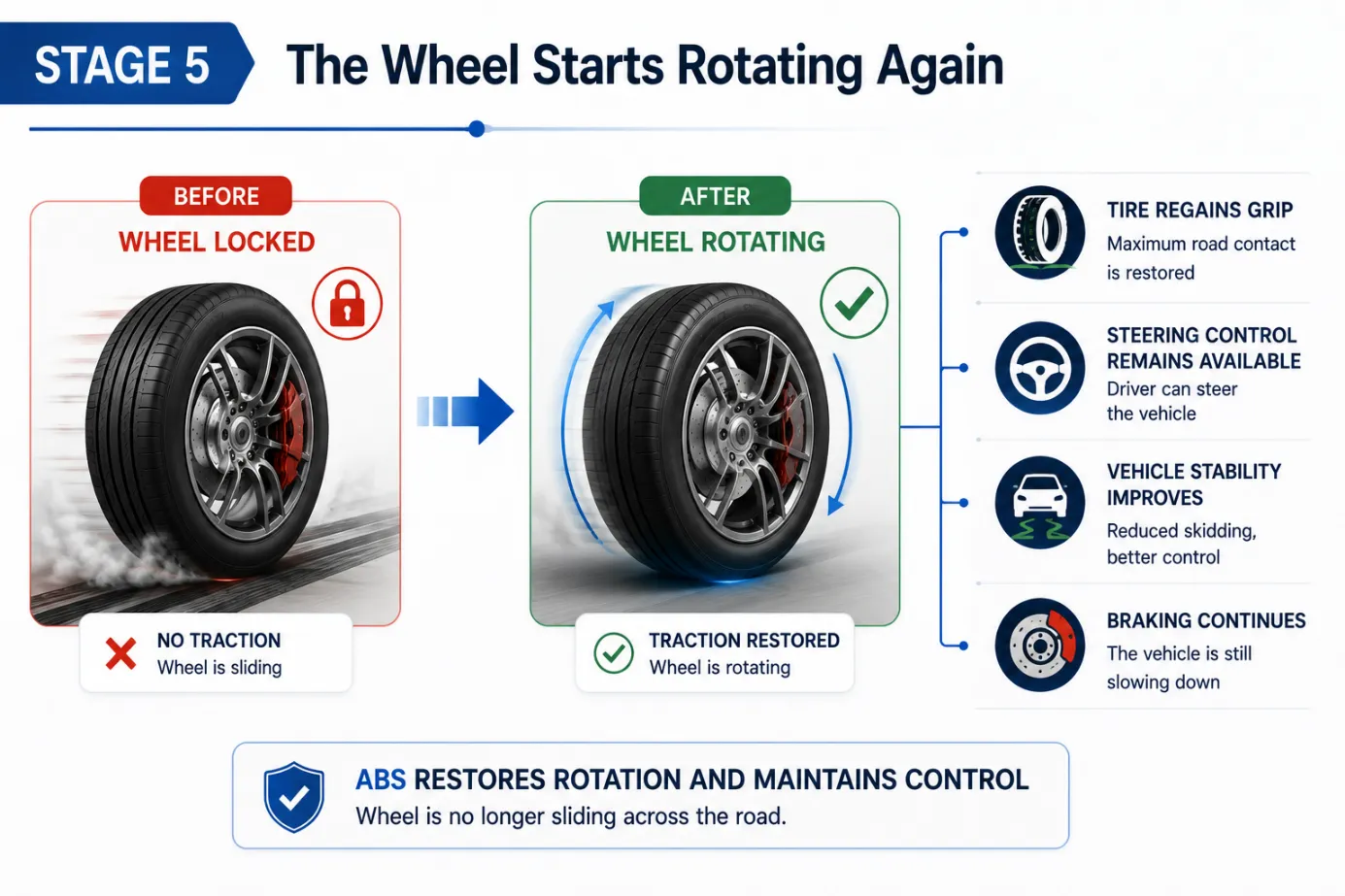
As brake pressure decreases:
- The tire regains grip
- The wheel resumes rotation
- Steering control remains available
- Vehicle stability improves
At this point, the vehicle is still braking, but the wheel is no longer sliding across the road.
Stage 6: Brake Pressure Is Reapplied
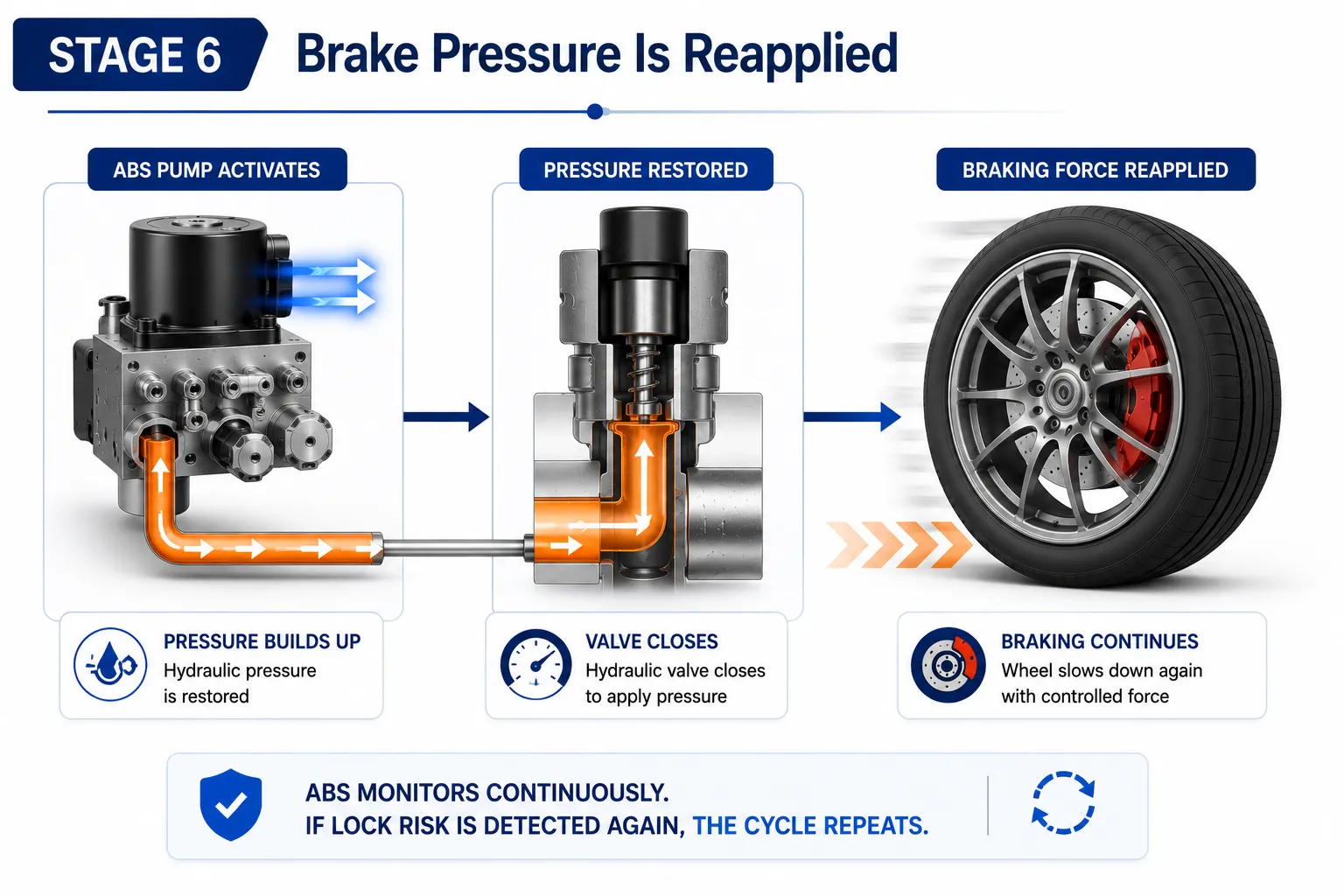
The ABS pump restores hydraulic pressure.
Braking force is applied again.
The wheel begins slowing once more.
If another lock-up condition is detected, ABS repeats the process.
Stage 7: The Entire Cycle Repeats Multiple Times Per Second
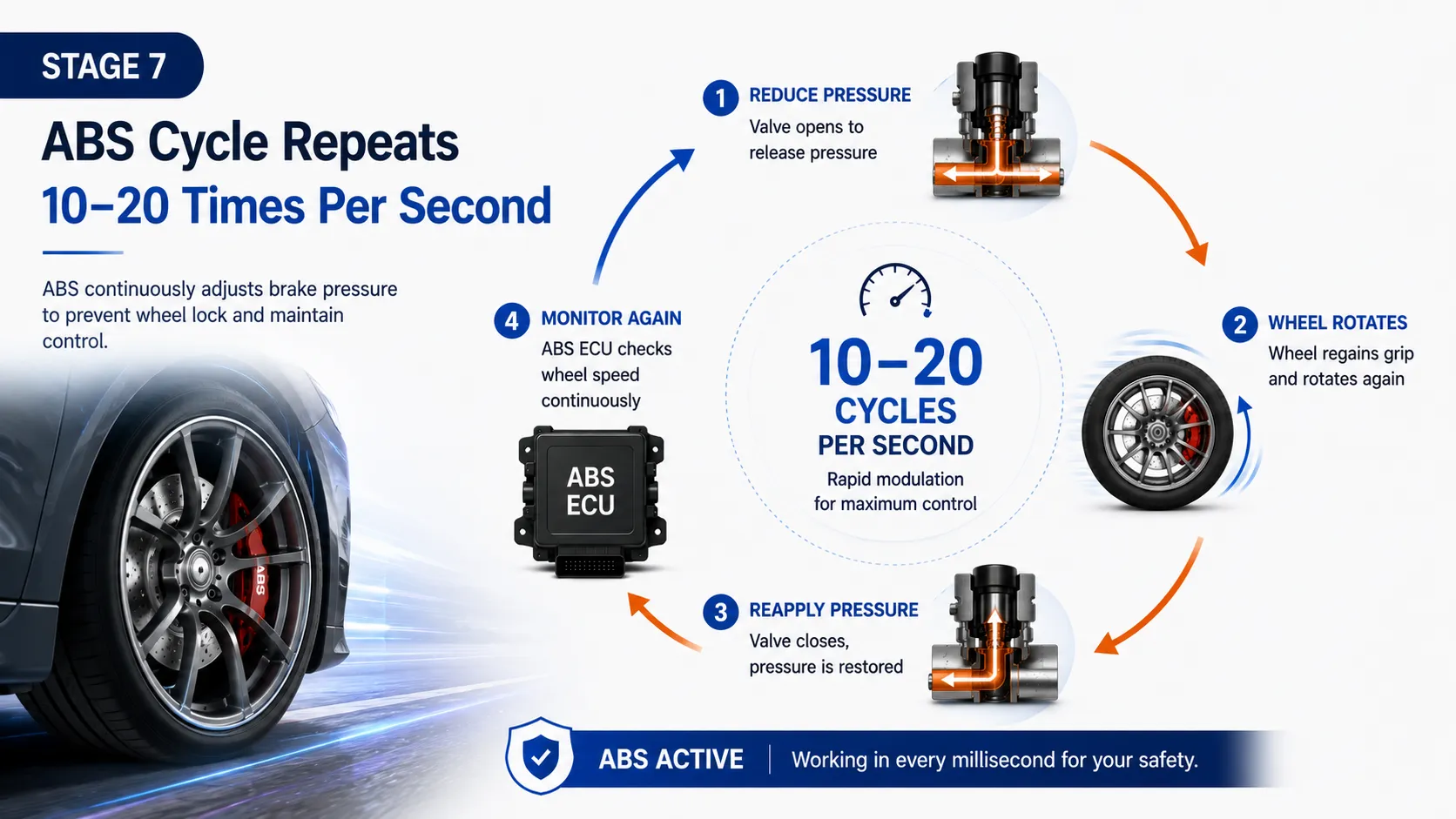
This pressure modulation cycle can occur 10 to 20 times per second depending on the vehicle, road surface, and driving conditions.
That rapid cycle of:
- Pressure reduction
- Pressure holding
- Pressure reapplication
is what creates the vibration many drivers feel in the brake pedal.
If you've ever felt the brake pedal pulsating during emergency braking, that's usually ABS working exactly as intended.According to the National Highway Traffic Safety Administration , ABS-equipped vehicles have demonstrated safety benefits in preventing loss-of-control situations, particularly on wet and slippery surfaces.
Main Components of an ABS System
ABS relies on several integrated components that work together in real time.
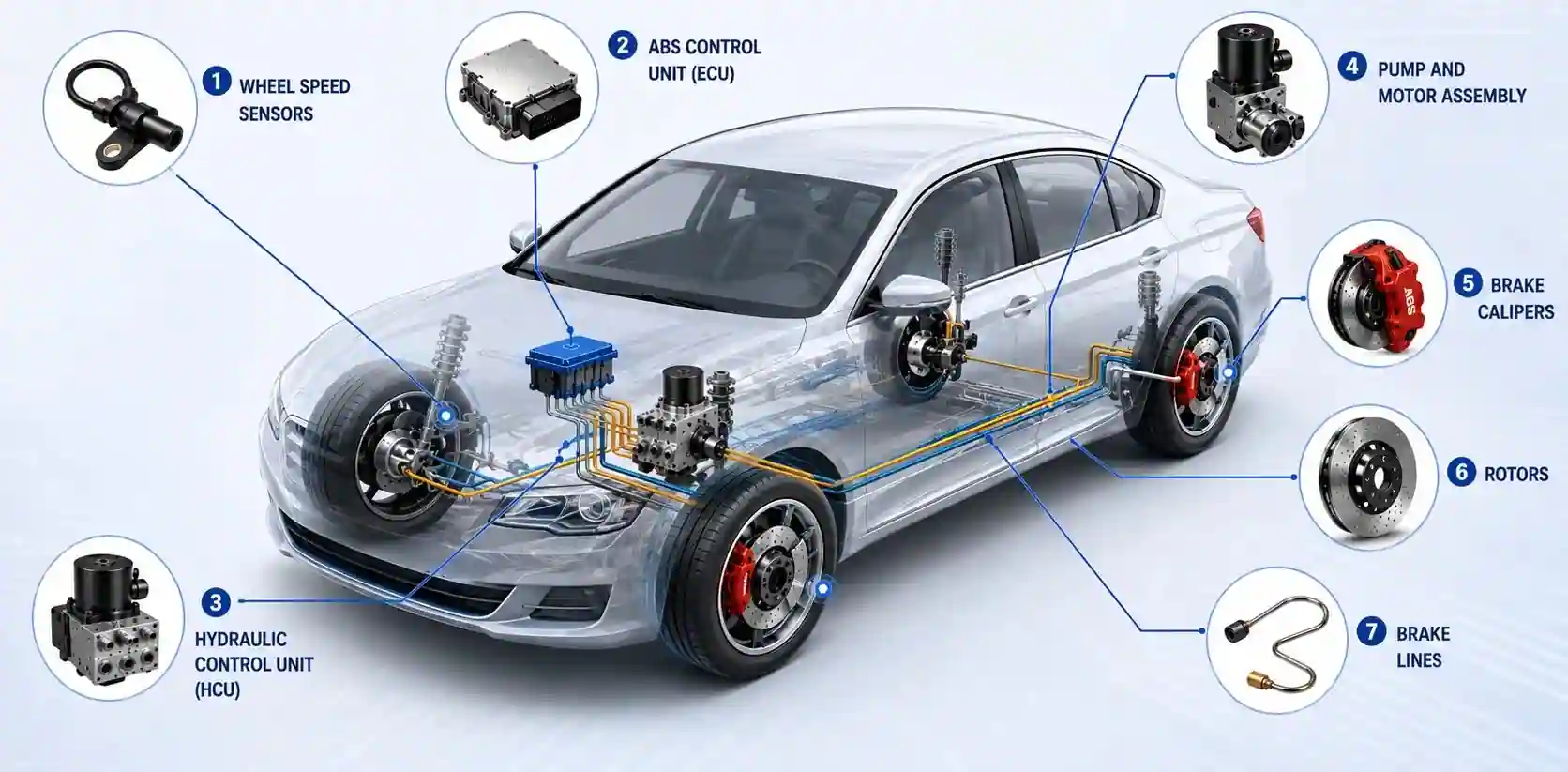
Wheel Speed Sensors
Wheel speed sensors continuously monitor wheel rotation and detect changes in wheel behavior.
Their primary role is to identify potential lock-up conditions before traction is lost.
ABS Control Unit (ECU)
The ABS ECU acts as the brain of the system.
It analyzes wheel-speed data and determines:
- When intervention is required
- Which wheel needs adjustment
- How much brake pressure should be modified
Modern ABS ECUs use automotive-grade embedded control software capable of making decisions within milliseconds.
Hydraulic Control Unit (HCU)
The Hydraulic Control Unit physically regulates brake pressure during ABS operation.
It contains:
- Solenoid valves
- Hydraulic channels
- Pressure control mechanisms
The HCU executes the commands issued by the ABS ECU.
Pump and Motor Assembly
When pressure is released during ABS intervention, the pump restores hydraulic pressure back into the braking circuit.
This enables repeated braking adjustments without sacrificing stopping performance.
Brake Calipers, Rotors, and Brake Lines
These are the physical braking components responsible for generating stopping force.
ABS doesn't replace them--it intelligently controls how brake pressure is delivered to them.
ABS Working Example: Rainy Highway Emergency Braking Scenario
Let's put everything together in a real-world scenario.
Imagine you're driving at 90 km/h during heavy rain.
The road is wet.
Visibility is reduced.
A vehicle several meters ahead suddenly brakes.
You react immediately and press the brake pedal with maximum force.
Without ABS
The wheels lock.
The tires lose rotational movement and begin sliding across the wet road.
You attempt to steer around the obstacle.
However, because the wheels are no longer rotating, steering response is severely reduced.
The vehicle starts skidding instead of turning.
With ABS
Wheel speed sensors detect the rapid deceleration.
The ABS ECU predicts wheel lock-up.
Brake pressure is automatically adjusted.
The wheels continue rotating.
You maintain braking force while retaining steering control.
This gives you a much better chance of maneuvering around the obstacle safely.
Research from the Insurance Institute for Highway Safety found that motorcycles equipped with ABS experienced approximately 31% fewer fatal crashes compared with similar models without ABS.
| Scenario | Without ABS | With ABS |
|---|---|---|
| Wheel Rotation | Stops | Continues |
| Steering Control | Severely Reduced | Maintained |
| Vehicle Stability | Reduced | Improved |
| Skid Risk | High | Lower |
| Obstacle Avoidance | Difficult | More Likely |
How Fast Does ABS Operate?
ABS works significantly faster than human reaction capability.
Modern systems can monitor wheel behavior and adjust brake pressure multiple times every second.
The process involves:
- Sensor data collection
- ECU analysis
- Hydraulic actuation
- Pressure modulation
All occurring within milliseconds.
In safety-critical automotive environments, this rapid response capability is essential for maintaining vehicle control during emergency situations.
Types of ABS Systems Used in Vehicles
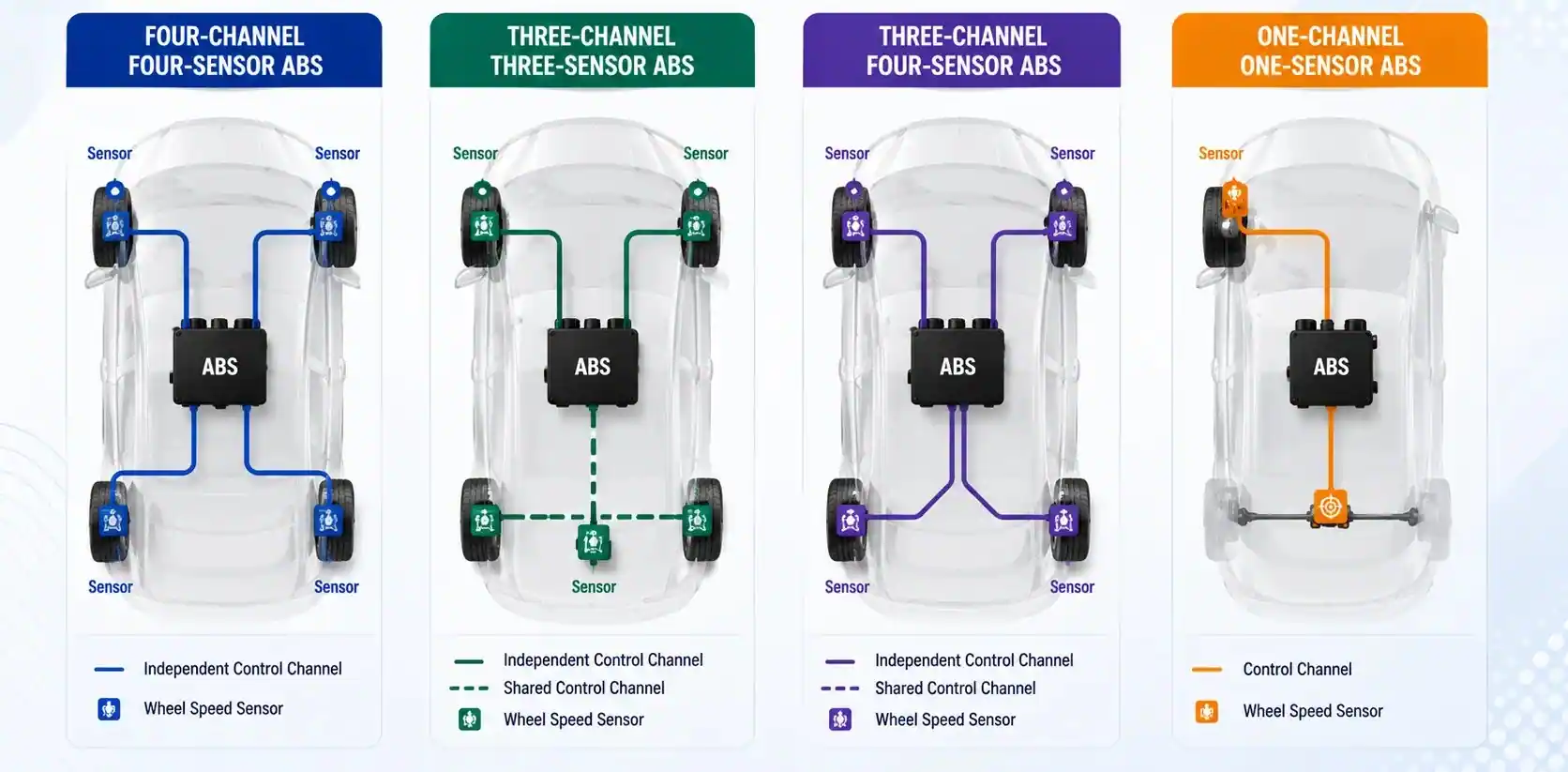
Four-Channel Four-Sensor ABS
The most advanced and widely used ABS configuration. Each wheel has its own sensor and control channel, allowing independent braking control and maximum stability.
Three-Channel Three-Sensor ABS
Common in some commercial vehicles and pickup trucks. The front wheels are controlled independently while the rear wheels share a common braking channel.
Three-Channel Four-Sensor ABS
Uses four sensors but shares braking control for the rear wheels. This provides improved wheel monitoring while maintaining a simpler braking architecture.
One-Channel One-Sensor ABS
A basic ABS design found primarily in older vehicles and certain utility applications. A single sensor monitors wheel behavior and controls braking intervention.
Advantages and Disadvantages of ABS
ABS is one of the most effective vehicle safety technologies ever developed, but like any system, it comes with both strengths and limitations.
Its biggest advantage is helping drivers maintain control during emergency braking. However, it should always be viewed as a safety aid--not a substitute for responsible driving.
| Advantages | Disadvantages |
|---|---|
| Prevents wheel lock-up during hard braking | May increase stopping distance on loose gravel or sand |
| Helps maintain steering control | More complex than conventional braking systems |
| Reduces skidding risk | Repairs can be more expensive |
| Improves vehicle stability | Sensor failures can affect performance |
| Supports ESC, TCS, and ADAS systems | Requires proper diagnostics and maintenance |
| Enhances emergency braking safety | Some drivers may become overconfident |
How ABS Works with Modern Vehicle Safety Systems
Modern vehicles use ABS as the foundation for several advanced safety technologies.
Electronic Stability Control (ESC)
ESC uses wheel speed data and selective braking intervention to help maintain vehicle stability during cornering and sudden maneuvers.
Traction Control System (TCS)
TCS leverages ABS hardware to reduce wheel spin during acceleration and improve traction.
Advanced Driver Assistance Systems (ADAS)
Many ADAS features rely on ABS-supported braking control for collision mitigation and emergency braking functions.
ABS Control Unit Architecture in Modern Vehicles
Modern ABS architectures combine:
- Wheel speed sensors
- Embedded control software
- ABS ECU
- Hydraulic Control Unit
- CAN communication networks
- Vehicle diagnostics systems
As vehicles become increasingly software-defined, ABS modules are evolving into more intelligent braking platforms capable of interacting with broader vehicle safety ecosystems.
In connected mobility environments, ABS systems frequently communicate with multiple ECUs through CAN-based architectures to support coordinated vehicle dynamics management.
Final Thoughts
ABS has become one of the most important vehicle safety technologies ever developed. By preventing wheel lock-up during hard braking, it helps drivers maintain steering control, improve vehicle stability, and reduce the risk of skidding in critical situations.
While most drivers only notice ABS when the brake pedal vibrates, the system is continuously making split-second decisions using sensors, embedded control software, and hydraulic pressure management.
As modern vehicles evolve toward connected, software-defined, and intelligent mobility platforms, ABS continues to serve as the foundation for advanced safety systems such as ESC, TCS, and ADAS.
If you're interested in how modern automotive-grade ABS modules combine real-time processing, CAN communication, and embedded control architectures to deliver reliable braking performance, explore OptM's ABS Module solutions and automotive engineering expertise.