
Content Writer & SEO Specialist
Content Writer & SEO Specialist
Aditya Sharma is a content writer at OptM Solutions specializing in automotive electronics, embedded systems, telematics, electric vehicle technologies, connected mobility, and autonomous driving technologies.
LinkedIn ProfileAn ABS Control Unit and Electronic Stability Control (ESC) are both critical vehicle safety technologies, but they solve different problems. The ABS Control Unit prevents wheel lock-up during braking, while ESC helps maintain vehicle stability when a vehicle begins to skid or lose directional control. Modern vehicles rely on both systems working together to improve safety, control, and driving confidence across varying road conditions.
Vehicle safety systems have evolved significantly over the past two decades. Features that were once considered premium are now standard requirements in many markets due to increasing safety regulations and consumer expectations.
Among these technologies, the ABS Control Unit and Electronic Stability Control are often discussed together because they share components and operate within the same vehicle dynamics ecosystem. However, many people mistakenly assume they perform the same function.
Understanding the difference between ABS and ESC is important for OEMs, automotive engineers, fleet operators, and anyone involved in modern vehicle development. While both systems contribute to safer driving, their objectives, operating logic, and intervention methods are fundamentally different.
What Is an ABS Control Unit?
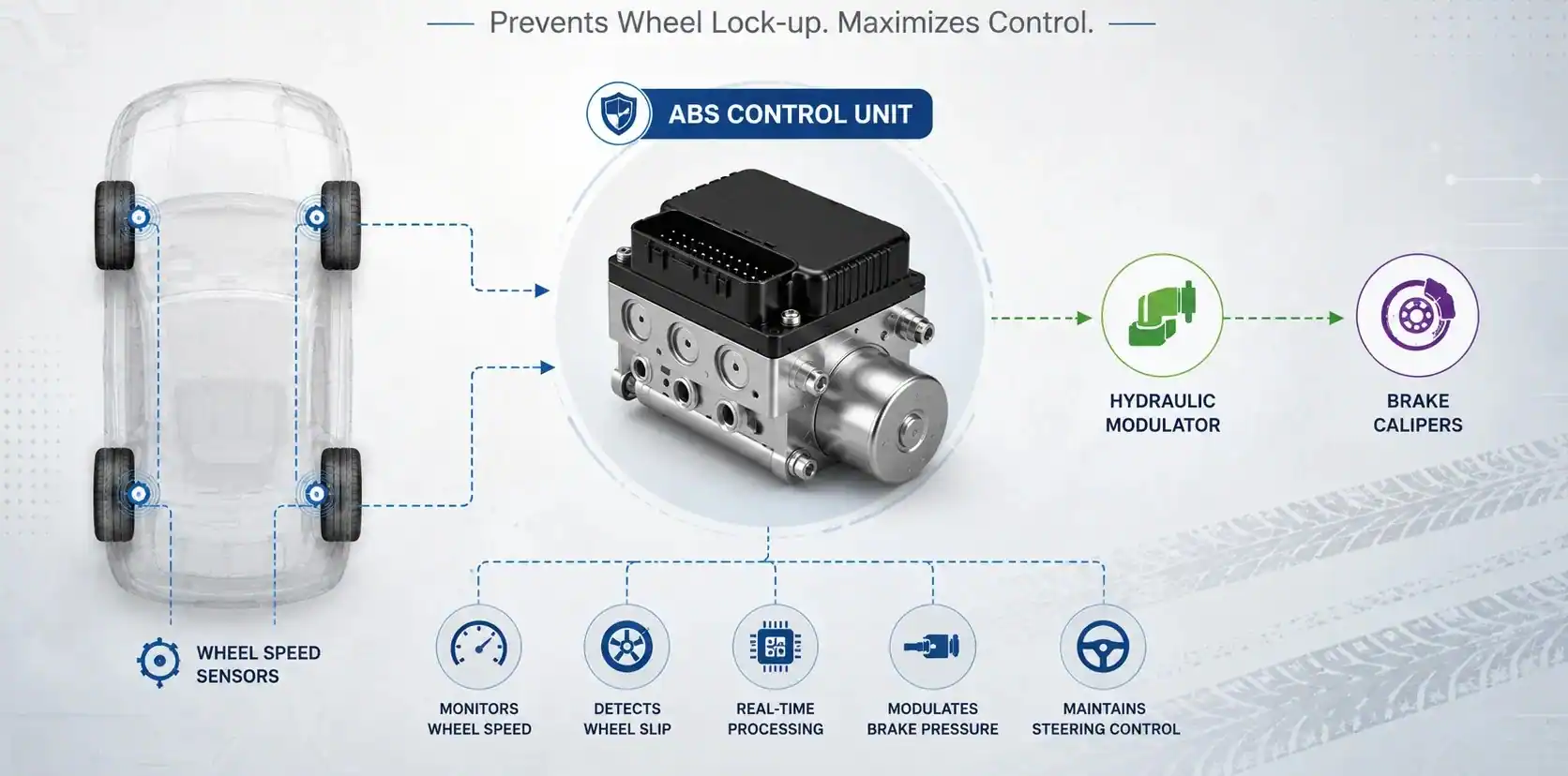
An ABS Control Unit is an automotive-grade electronic control unit responsible for preventing wheel lock-up during braking events. It continuously receives wheel speed data, calculates wheel slip conditions, and commands the hydraulic braking system to adjust brake pressure whenever lock-up is detected.
The primary objective of ABS is simple: maintain steering control during braking.
Without ABS, aggressive braking can cause wheels to stop rotating completely, resulting in loss of steering capability and increased risk of skidding.
The ABS Control Unit typically performs several critical functions:
- Monitoring wheel speed sensor inputs
- Detecting wheel slip conditions
- Controlling hydraulic brake pressure
- Coordinating with vehicle braking systems
- Executing real-time braking decisions
If you are new to the topic, it may be helpful to first explore What is Anti Lock Braking System , Functions of Anti Lock Braking System , and How Anti Lock Braking System Works before diving deeper into advanced vehicle stability systems.
What Is Electronic Stability Control (ESC)?
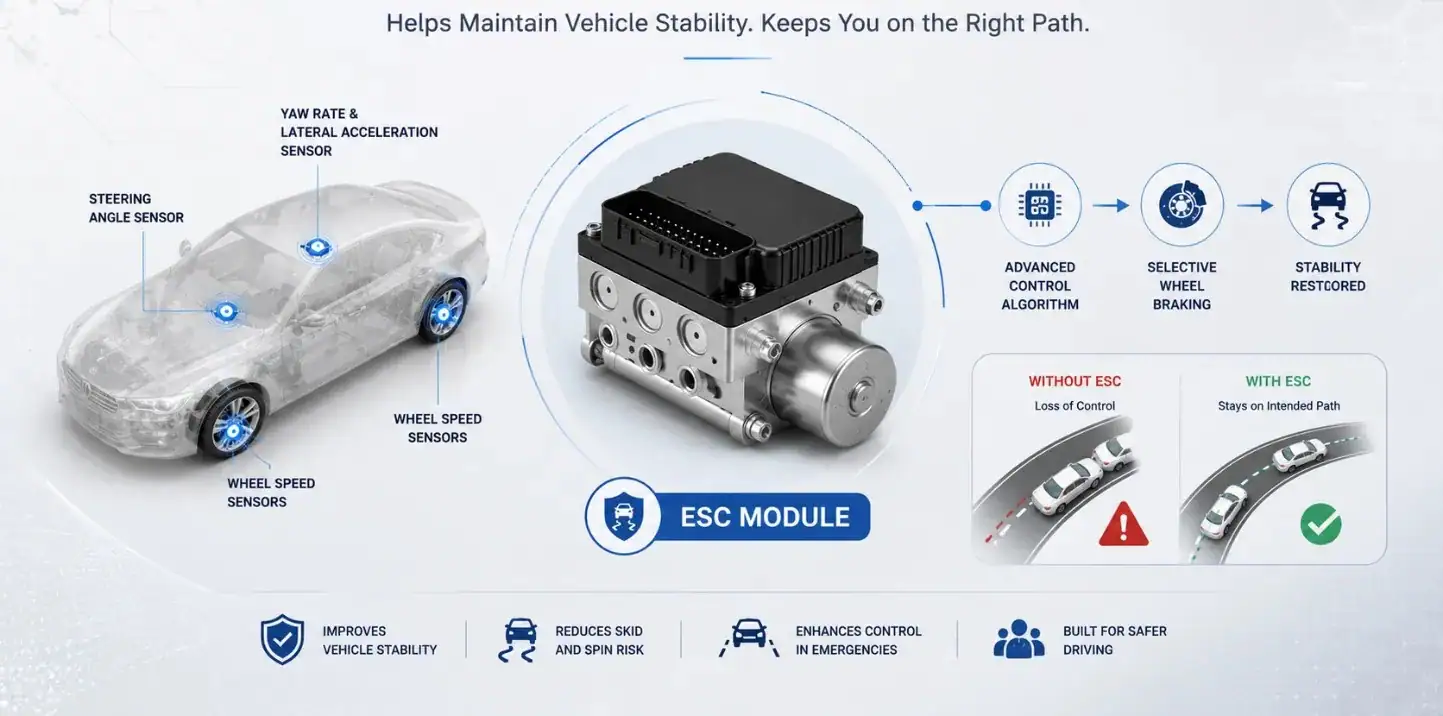
Electronic Stability Control is an advanced vehicle dynamics control system designed to help drivers maintain directional stability during challenging driving situations.
Rather than focusing only on braking events, ESC continuously evaluates how the vehicle is moving compared to how the driver intends it to move.
The system monitors:
- Steering angle
- Vehicle yaw rate
- Wheel speed
- Lateral acceleration
- Vehicle direction
When ESC detects that the vehicle is beginning to understeer or oversteer, it automatically intervenes by selectively applying braking force to specific wheels. In some implementations, it may also coordinate with engine torque management systems.
The goal is to keep the vehicle traveling in the driver's intended direction.
According to the European Commission , Electronic Stability Control is one of the most effective vehicle safety technologies for reducing loss-of-control accidents and improving vehicle stability in emergency situations.
ABS Control Unit vs Electronic Stability Control: The Core Difference
The easiest way to understand the distinction is to focus on their primary objectives.
| Parameter | ABS Control Unit | Electronic Stability Control |
|---|---|---|
| Main Objective | Prevent wheel lock-up | Maintain vehicle stability |
| Activation Trigger | Hard braking | Vehicle instability or skidding |
| Primary Focus | Braking performance | Directional control |
| Sensors Used | Wheel speed sensors | Multiple vehicle dynamics sensors |
| Intervention Method | Brake pressure modulation | Selective wheel braking |
| Driver Input Considered | Brake pedal application | Steering, braking, and vehicle behavior |
| Safety Outcome | Improved steering control during braking | Reduced risk of spin-outs and skids |
A common question is:
Is ESC the Same as ABS?
No, ABS and ESC are different systems with different objectives.
ABS prevents wheels from locking during braking, while ESC helps maintain vehicle stability when a vehicle begins to lose directional control. ESC often relies on ABS hardware and braking infrastructure to perform stability corrections.
How ABS and ESC Work Together
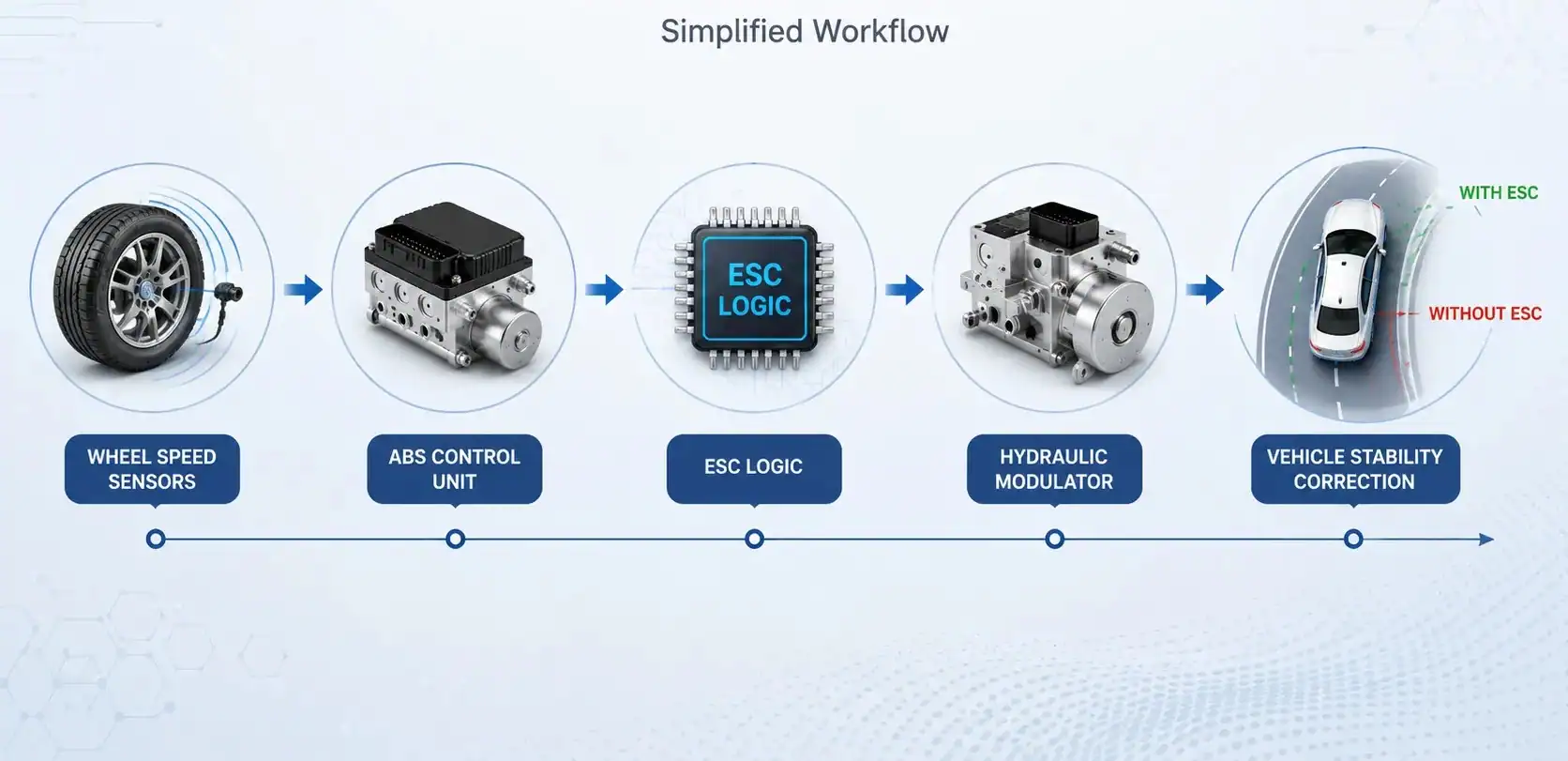
Although they serve different purposes, ABS and ESC are deeply interconnected.
In modern vehicles, ESC is typically built on top of the existing ABS architecture.
The ABS system already provides several essential components:
- Wheel speed sensors
- Hydraulic modulator
- Brake control electronics
- Real-time braking control logic
ESC uses these components while adding additional sensor inputs and stability algorithms.
A simplified workflow looks like this:
Wheel Speed Sensors → ABS Control Unit → ESC Logic → Hydraulic Modulator → Vehicle Stability Correction
Because ESC uses braking interventions to correct vehicle behavior, the responsiveness and reliability of the ABS Control Unit directly influence overall stability system performance.
This is why ABS architecture remains a foundational component of modern active safety systems.
For a deeper understanding of system architecture you should first understand about Components of Anti Lock Braking System and ABS Control Unit Integration with Wheel Speed Sensors, Hydraulic Modulator and ECU to get more better insight on this.
Sensors Used by ABS and ESC
One of the biggest differences between ABS and ESC lies in the sensor ecosystem.
Sensors Typically Used by ABS
- Wheel speed sensors
- Brake pressure monitoring inputs
Sensors Typically Used by ESC
- Wheel speed sensors
- Steering angle sensor
- Yaw rate sensor
- Lateral acceleration sensor
- Vehicle dynamics sensors
From an engineering standpoint, ESC requires a significantly broader understanding of vehicle behavior.
The system must continuously compare the driver's steering intentions against the vehicle's actual movement. Any discrepancy can trigger corrective action.
In safety-critical automotive environments, accurate sensor fusion becomes essential because even small timing inconsistencies can impact stability intervention effectiveness.
Real-World Example: Emergency Lane Change
Consider a vehicle traveling on a highway when the driver suddenly encounters debris on the road.
The driver immediately brakes and steers to avoid the obstacle.
How ABS Responds
The ABS Control Unit detects rapid wheel deceleration and prevents wheel lock-up by modulating brake pressure.
This allows the driver to continue steering while braking aggressively.
How ESC Responds
During the sudden lane change, the vehicle begins to drift beyond the driver's intended trajectory.
ESC detects abnormal yaw movement and selectively applies braking force to specific wheels.
This corrective action helps bring the vehicle back onto the intended path.
This example highlights a crucial point:
ABS helps the driver maintain steering control during braking.
ESC helps the vehicle maintain stability during steering maneuvers.
Together, they create a much safer driving experience than either system could provide independently.
From an Automotive Engineering Perspective
In production-grade automotive environments, ABS and ESC are rarely evaluated as isolated technologies.
Vehicle manufacturers increasingly view braking control, stability management, sensor integration, and communication architectures as a unified safety ecosystem.
At OptM , engineering teams working with automotive-grade embedded systems understand that vehicle safety performance depends on far more than braking algorithms alone. Sensor synchronization, ECU responsiveness, CAN communication reliability, and real-time software execution all influence how effectively safety systems perform under real-world conditions.
OptM's automotive engineering expertise spans:
- Automotive-grade ECU architectures
- ABS module development
- Embedded automotive software
- CAN and J1939 communication systems
- Vehicle sensor integration
- Real-time control systems
- Intelligent mobility platforms
These capabilities help support the development of connected and safety-focused automotive systems across passenger vehicles, commercial vehicles, EV platforms, and intelligent mobility ecosystems.
Challenges in Integrating ABS and ESC Systems
As vehicle architectures become increasingly software-defined, integrating ABS and ESC systems presents several engineering challenges.
Real-Time Data Processing
Both systems require rapid decision-making based on constantly changing sensor inputs.
Sensor Synchronization
Vehicle dynamics calculations depend on highly accurate and synchronized sensor data.
Communication Reliability
Safety-critical information must travel reliably across vehicle communication networks such as CAN.
Functional Safety Compliance
Automotive safety systems must comply with standards such as:
System Validation Complexity
Extensive testing and validation are required to ensure predictable behavior across diverse driving scenarios, weather conditions, and vehicle configurations.
The Future of Vehicle Stability Systems
Vehicle stability technologies continue to evolve alongside advances in software-defined vehicles, ADAS platforms, and intelligent mobility systems.
Several trends are shaping the future of ABS and ESC development:
- AI-assisted vehicle dynamics control
- Centralized vehicle computing architectures
- Predictive stability algorithms
- Integration with ADAS platforms
- Software-defined braking systems
- Enhanced sensor fusion frameworks
Future vehicle platforms will increasingly rely on centralized safety domains where ABS, ESC, ADAS, and vehicle dynamics functions operate as part of a coordinated software ecosystem rather than isolated modules.
For automotive manufacturers, this shift will create new opportunities to improve safety, performance, and vehicle intelligence through tighter system integration.
Conclusion
The discussion around ABS Control Unit vs Electronic Stability Control is not about choosing one system over the other. Both technologies address different safety challenges and work together to improve overall vehicle control.
ABS ensures drivers retain steering control during heavy braking by preventing wheel lock-up. ESC extends that protection by helping maintain vehicle stability during sudden maneuvers, slippery conditions, and loss-of-control situations.
As modern vehicles become increasingly connected, software-driven, and safety-focused, the integration between ABS, ESC, sensors, ECUs, and vehicle communication networks will become even more important.
For organizations developing next-generation braking and vehicle safety platforms, understanding these interactions is essential for building safer, smarter, and more reliable mobility solutions.
Looking Deeper into ABS Development?
Modern ABS modules are no longer simple braking controllers. They are sophisticated embedded systems that combine real-time processing, sensor integration, ECU communication, and advanced control algorithms to support vehicle safety and stability.
Explore OptM's ABS Solutions to understand how automotive-grade ABS Systems & Module are designed, integrated, tested, and optimized for today's connected vehicle platforms.