
Content Writer & SEO Specialist
Content Writer & SEO Specialist
Aditya Sharma is a content writer at OptM Solutions specializing in automotive electronics, embedded systems, telematics, electric vehicle technologies, connected mobility, and autonomous driving technologies.
LinkedIn ProfileModern vehicles rely heavily on electronic control systems to deliver safety, stability, and driving confidence. Among these systems, the ABS Control Unit plays a critical role by preventing wheel lock-up during sudden braking and helping drivers maintain steering control.
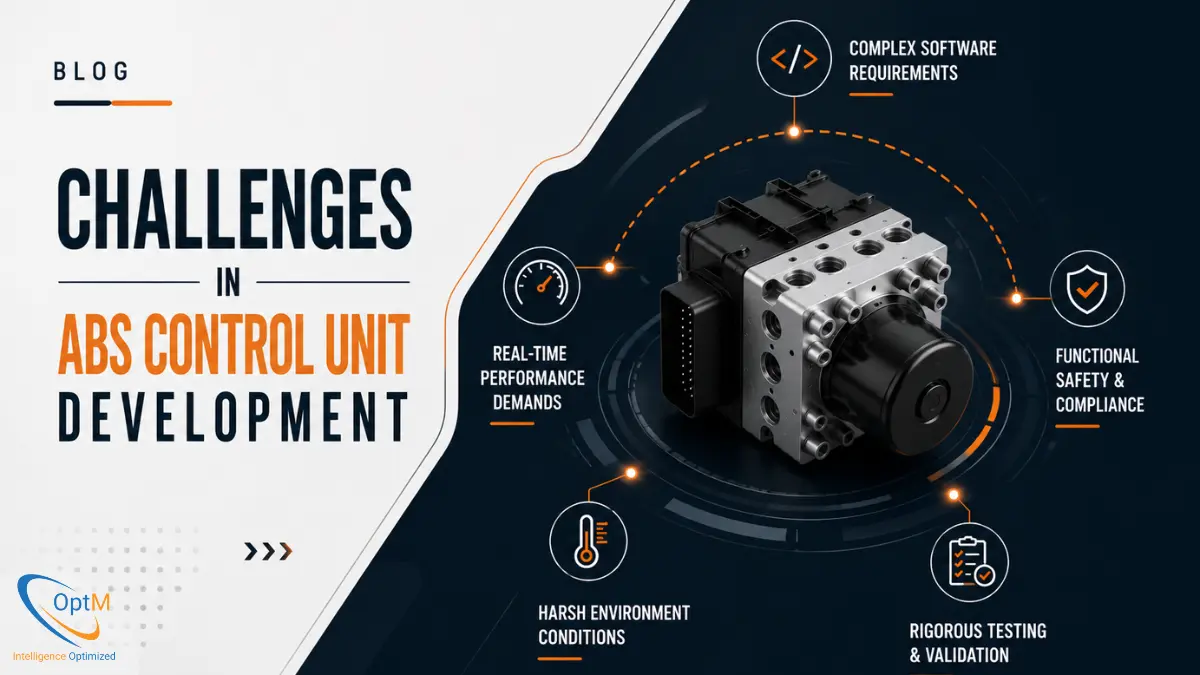
While ABS functionality may appear straightforward from a driver's perspective, developing an automotive-grade ABS Control Unit is one of the more demanding engineering tasks within vehicle electronics. The system must process sensor inputs within milliseconds, make accurate braking decisions, operate reliably in harsh environments, and comply with stringent automotive safety requirements.
As vehicle architectures evolve toward software-defined and connected platforms, the complexity of ABS development continues to increase.
For readers looking to understand the broader braking ecosystem, it is useful to first explore our guide on What is Anti Lock Braking System , which explains the foundational concepts behind modern ABS technology.
Why ABS Control Unit Development Is More Complex Than Ever
An ABS Control Unit is no longer a standalone braking controller. Modern implementations operate within a highly connected vehicle ecosystem where multiple ECUs, sensors, communication networks, and safety systems must work together seamlessly.
Several industry trends are driving this complexity:
- Electrification and EV adoption
- Software-defined vehicle architectures
- Increasing functional safety requirements
- Advanced Driver Assistance Systems (ADAS)
- Connected mobility platforms
- Real-time vehicle communication networks
As a result, engineering teams must balance performance, safety, reliability, and integration requirements throughout the development lifecycle.
Challenge #1: Achieving Real-Time Response During Emergency Braking
An ABS Control Unit must continuously monitor wheel speed information and determine whether a wheel is approaching a lock condition. These calculations must occur within milliseconds because braking events evolve extremely quickly.
A delayed response can reduce braking effectiveness and compromise vehicle stability.
Key engineering considerations include:
- High-speed wheel slip calculations
- Deterministic software execution
- Low-latency sensor processing
- Fast hydraulic modulation control
- Real-time operating constraints
In safety-critical automotive environments, engineering teams often prioritize predictable execution behavior over raw processing power. Consistent response timing is often more valuable than peak computational performance when vehicle safety is involved.
Challenge #2: Ensuring Reliable Wheel Speed Sensor Integration
The ABS Control Unit depends entirely on accurate wheel speed information. If sensor data becomes unreliable, braking decisions can also become unreliable.
Wheel speed sensors operate in challenging conditions, including:
- Water exposure
- Dust and debris
- Extreme temperatures
- Road vibration
- Electromagnetic interference
Engineering teams must design robust signal processing mechanisms capable of filtering noise while preserving critical braking information.
From a development perspective, obtaining clean and consistent sensor data is often more difficult than designing the braking algorithm itself.
This challenge becomes even more apparent when examining how ABS modules interact with wheel speed sensors, hydraulic modulators, and vehicle ECUs throughout the braking architecture.
Challenge #3: Meeting Functional Safety Requirements
Unlike many vehicle electronics systems, ABS directly influences braking performance and passenger safety. This makes functional safety one of the most important development considerations.
Automotive manufacturers typically follow the principles defined by the Functional Safety Standard developed by the International Organization for Standardization (ISO) to reduce the risk of hazardous system failures.
Development teams must implement:
- Fault detection mechanisms
- Diagnostic monitoring
- Safe-state operation strategies
- Failure recovery procedures
- System redundancy where required
These requirements add significant complexity to both hardware and software development processes.
Challenge #4: Developing Reliable Embedded Software
Modern ABS performance depends heavily on software quality.
Embedded software is responsible for:
- Processing wheel speed inputs
- Executing braking control algorithms
- Managing diagnostic functions
- Communicating with vehicle networks
- Supporting safety mechanisms
As vehicle software grows more sophisticated, developers face several challenges:
- Managing real-time execution requirements
- Handling edge-case braking scenarios
- Ensuring long-term software reliability
- Preventing memory-related failures
- Supporting future updates and maintenance
At OptM Solutions , automotive software development frequently involves balancing computational efficiency with safety-critical reliability requirements. Even minor software defects can create significant validation challenges during vehicle integration.
Challenge #5: Testing and Validation Across Thousands of Scenarios
Developing an ABS Control Unit does not end with hardware and software implementation. Validation is often one of the most resource-intensive phases of the entire project.
The system must perform consistently across countless real-world conditions, including:
- Dry asphalt
- Wet roads
- Gravel surfaces
- Snow-covered roads
- Different vehicle loads
- Varying tire conditions
Testing typically includes:
- Hardware-in-the-loop (HIL) validation
- Software-in-the-loop (SIL) testing
- Vehicle-level testing
- Fault injection testing
- Environmental stress testing
In practice, engineering teams often discover integration-related issues during validation that were not visible during simulation stages. This is why ABS validation frequently consumes a significant portion of overall development timelines.
Readers interested in this process can also explore our article on ABS Control Unit Testing and Validation.
Challenge #6: Integrating ABS with Modern Vehicle Systems
Today's ABS Control Unit rarely operates in isolation.
Modern vehicles require ABS to communicate with:
- Vehicle ECUs
- Traction control systems
- Electronic Stability Control (ESC)
- ADAS platforms
- Telematics systems
- EV control architectures
This communication typically occurs through automotive protocols such as CAN and other vehicle network architectures.
As integration complexity increases, engineering teams must ensure reliable data exchange without introducing latency or communication conflicts.
At OptM , automotive engineering projects often involve designing systems that operate within broader connected mobility ecosystems, where ECU coordination and communication reliability become equally important as the core braking logic itself.
This growing overlap between braking and stability functions is also why understanding ABS Control Unit vs Electronic Stability Control has become increasingly important for vehicle developers.
Real-World Engineering Insight: The Challenge Is Usually System Integration
One common misconception is that ABS development is primarily about braking algorithms.
In reality, many engineering challenges emerge during integration.
An ABS algorithm may perform flawlessly in a laboratory environment, yet require substantial refinement once connected to real sensors, hydraulic systems, communication networks, and vehicle-specific architectures.
During ECU and system integration stages, teams often encounter:
- Sensor calibration differences
- CAN communication inconsistencies
- Hardware timing mismatches
- Vehicle-specific tuning requirements
- Safety validation findings
These practical realities are often what determine the success of an ABS deployment in production-grade vehicle programs.
Key Challenges at a Glance
| Challenge | Engineering Impact |
|---|---|
| Real-time processing | Delayed braking decisions |
| Sensor integration | Inaccurate wheel speed data |
| Functional safety compliance | Increased development complexity |
| Embedded software reliability | System instability risks |
| Extensive validation | Longer development cycles |
| Vehicle-level integration | Communication and interoperability issues |
Conclusion
ABS Control Unit development extends far beyond designing a braking controller. It requires a combination of embedded software expertise, functional safety engineering, real-time system design, rigorous validation, and seamless vehicle integration.
As vehicles become increasingly connected, software-defined, and safety-focused, ABS Control Units must evolve accordingly. Engineering teams that successfully address these challenges can deliver braking systems that not only meet regulatory expectations but also improve vehicle stability, driver confidence, and overall road safety.Explore how OptM's automotive engineering team develops advanced ABS Modules designed for modern passenger vehicles, commercial fleets, and next-generation mobility platforms.
Frequently Asked Questions (FAQs)
What is the biggest challenge in ABS Control Unit development?
Real-time decision-making while maintaining functional safety compliance and reliable vehicle integration is often considered the most demanding aspect of ABS development.
Why is software important in an ABS Control Unit?
Embedded software processes sensor data, executes braking algorithms, manages diagnostics, and coordinates communication with other vehicle systems.
Why does ABS validation require extensive testing?
ABS performance must remain reliable across different road conditions, weather environments, vehicle loads, and failure scenarios, making comprehensive validation essential.
Does an ABS Control Unit communicate with other vehicle systems?
Yes. Modern ABS modules exchange data with ECUs, traction control systems, Electronic Stability Control systems, ADAS platforms, and other connected vehicle components.