
Content Writer & SEO Specialist
Content Writer & SEO Specialist
Aditya Sharma is a content writer at OptM Solutions specializing in automotive electronics, embedded systems, telematics, electric vehicle technologies, connected mobility, and autonomous driving technologies.
LinkedIn ProfileThe Anti Lock Braking System (ABS) is one of the most important safety technologies in modern vehicles. By preventing wheel lock-up during sudden braking, ABS helps drivers maintain steering control, improve vehicle stability, and reduce the risk of skidding.
However, not all ABS systems are the same. Different vehicles use different ABS architectures based on factors such as vehicle type, braking requirements, safety goals, and cost considerations. Understanding these ABS types helps automotive engineers, OEMs, and vehicle manufacturers select the right braking solution for their applications.
What is an Anti Lock Braking System?
An Anti Lock Braking System (ABS) is an electronic braking technology that prevents wheels from locking during hard braking events. The system continuously monitors wheel speed and automatically adjusts brake pressure whenever it detects a wheel losing traction.
This allows drivers to maintain steering control while reducing the chances of skidding.
According to the Insurance Institute for Highway Safety (IIHS), fatal crash involvement rates are significantly lower for vehicles equipped with ABS compared to similar vehicles without the technology, highlighting ABS's role in improving vehicle control during emergency braking situations.
Why Are There Different Types of ABS?
Different vehicles have different braking requirements.
A passenger car, motorcycle, commercial truck, and electric vehicle all operate under unique conditions. Vehicle weight, wheel configuration, braking performance requirements, and safety regulations influence the ABS architecture selected by manufacturers.
As a result, multiple ABS configurations have been developed to deliver the appropriate balance between safety, performance, and cost.
Types of Anti Lock Braking System Based on Wheel Control
The main types of ABS are Four-Channel Four-Sensor ABS, Three-Channel Three-Sensor ABS, Three-Channel Four-Sensor ABS, and One-Channel One-Sensor ABS. Each type offers a different level of wheel monitoring and braking control depending on the vehicle's requirements.
1. Four-Channel Four-Sensor ABS
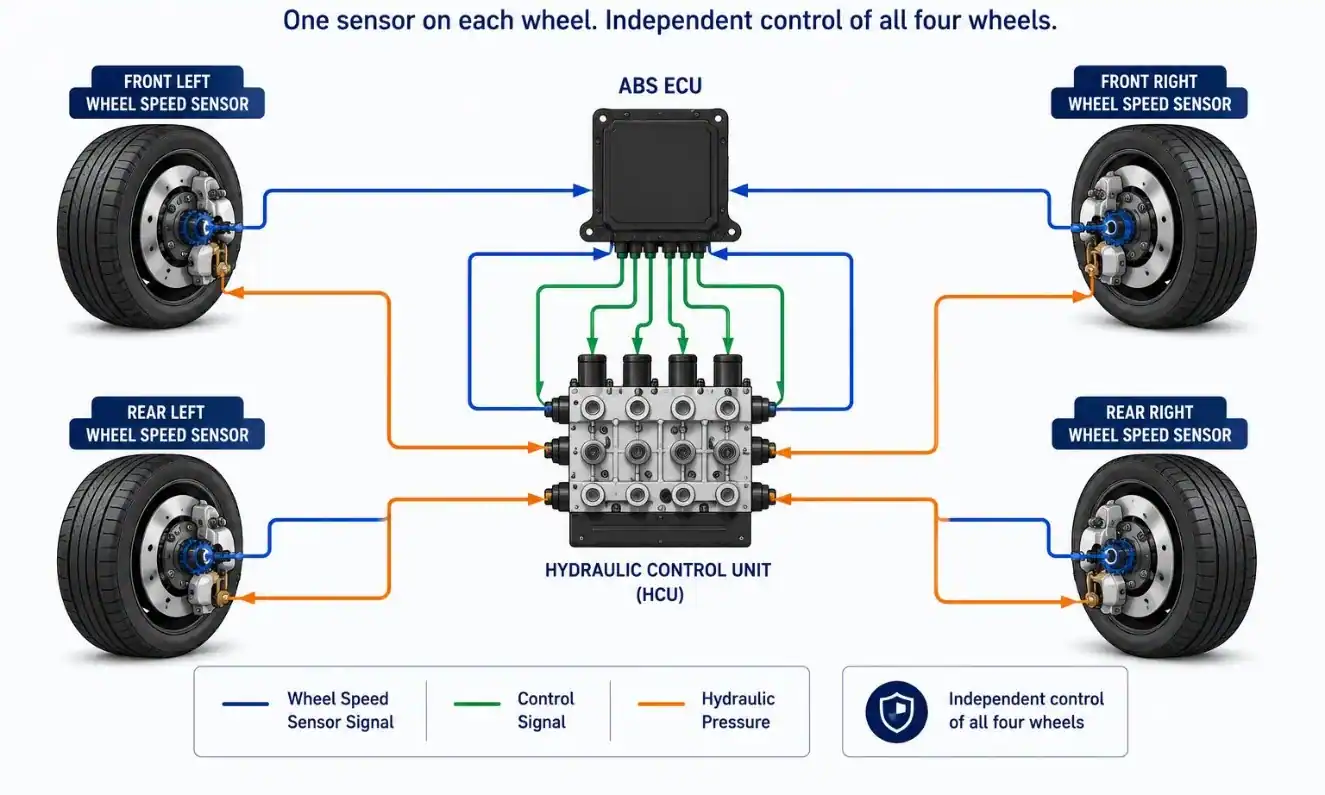
Four-Channel Four-Sensor ABS is the most advanced and widely used ABS configuration in modern vehicles.
How It Works
This system uses:
- Four wheel speed sensors
- Four independent braking control channels
Each wheel is monitored and controlled independently. If one wheel begins to lock, brake pressure is adjusted only for that wheel without affecting the others.
Advantages
- Maximum braking performance
- Superior vehicle stability
- Better steering control
- Enhanced traction management
- Faster response during emergency braking
Applications
- Passenger Cars
- SUVs
- Premium vehicles
- Electric vehicles
- Performance vehicles
This architecture offers the highest level of braking precision and safety.
2. Three-Channel Three-Sensor ABS
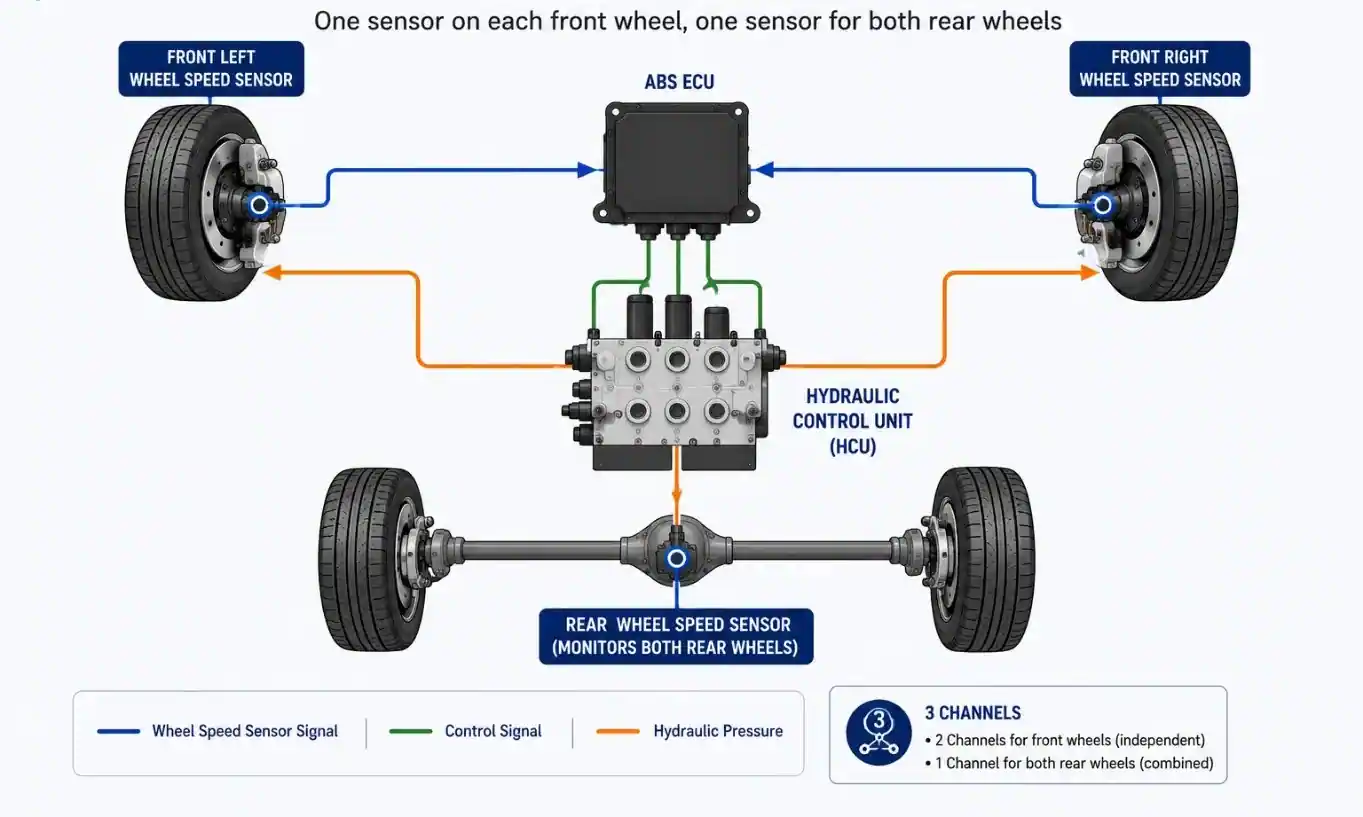
Three-Channel Three-Sensor ABS is commonly found in pickup trucks and older commercial vehicles.
How It Works
The system uses:
- One sensor on each front wheel
- One sensor for both rear wheels
- Independent control of front brakes
- Shared control of rear brakes
Advantages
- Lower cost
- Simpler architecture
- Reliable braking performance
Limitations
- Reduced rear-wheel braking precision
- Less control than four-channel systems
Applications
- Pickup trucks
- Utility vehicles
- Light commercial vehicles
3. Three-Channel Four-Sensor ABS
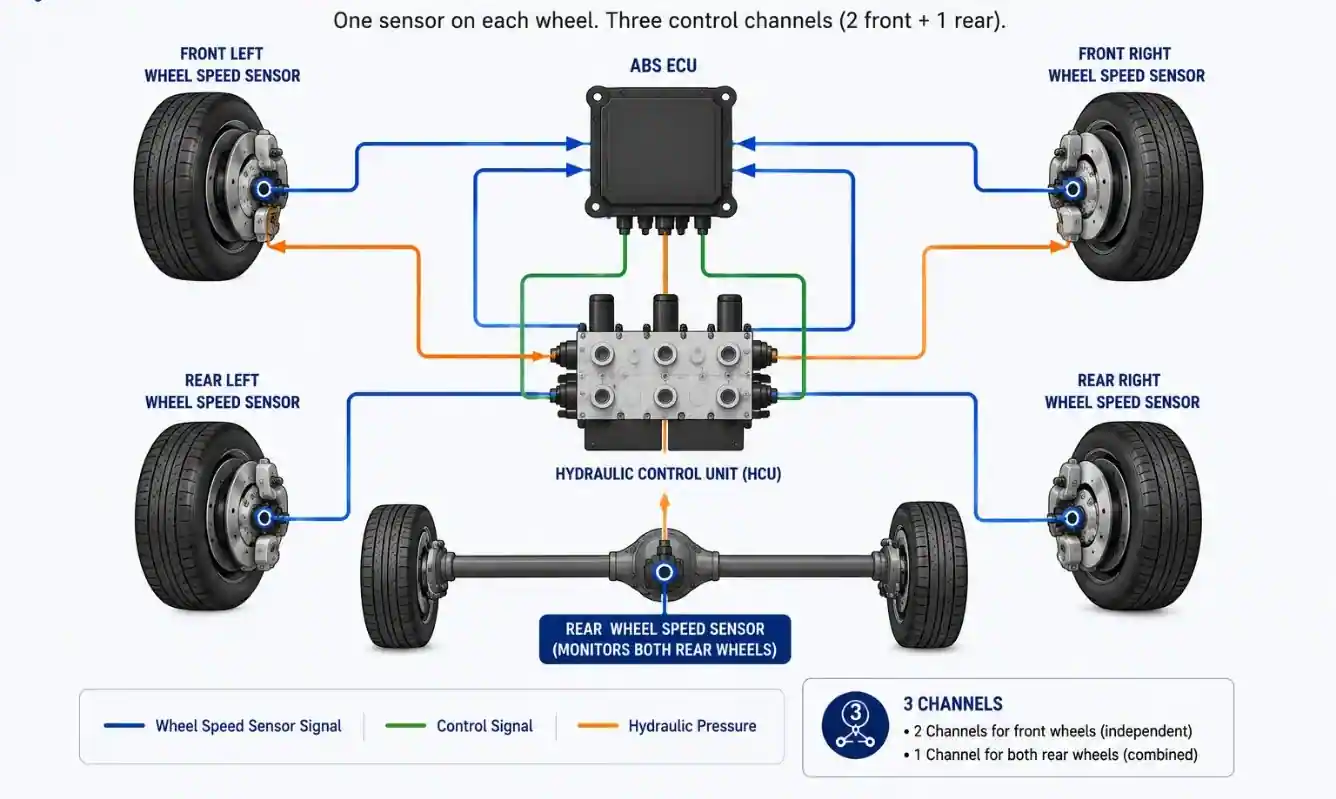
Three-Channel Four-Sensor ABS provides a balance between performance and cost efficiency.
How It Works
The system includes:
- Four wheel speed sensors
- Three braking control channels
Although all wheels are monitored independently, both rear wheels share a common control channel.
Advantages
- Improved wheel monitoring
- Better braking performance than three-sensor systems
- Cost-effective design
Limitations
- Rear wheels cannot be controlled independently
Applications
- Commercial Vehicles
- Fleet vehicles
- Utility platforms
4. One-Channel One-Sensor ABS
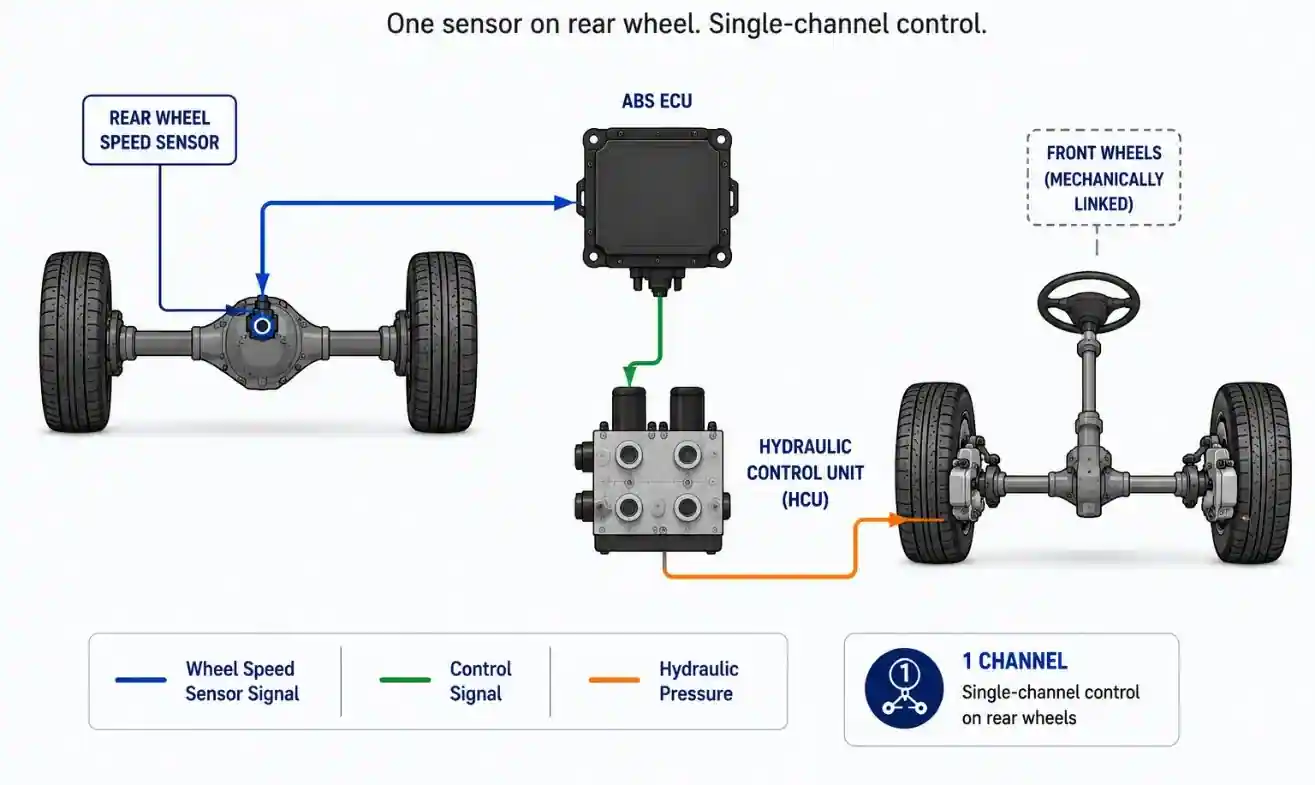
One-Channel One-Sensor ABS is the simplest ABS architecture.
How It Works
The system uses:
- One wheel speed sensor
- One braking control channel
Brake pressure is controlled simultaneously for both rear wheels.
Advantages
- Lowest implementation cost
- Simpler design
- Easier maintenance
Limitations
- Limited braking precision
- Lower stability performance
- Reduced wheel-specific control
Applications
- Older utility vehicles
- Basic commercial vehicles
- Entry-level platforms
ABS Types Comparison Table
| ABS Type | Sensors | Channels | Performance | Cost | Typical Applications |
|---|---|---|---|---|---|
| Four-Channel Four-Sensor | 4 | 4 | Excellent | High | Cars, SUVs, EVs |
| Three-Channel Four-Sensor | 4 | 3 | Very Good | Medium | Commercial Vehicles |
| Three-Channel Three-Sensor | 3 | 3 | Good | Medium | Pickup Trucks |
| One-Channel One-Sensor | 1 | 1 | Basic | Low | Utility Vehicles |
Types of ABS Based on Vehicle Category
Passenger Cars
Most modern passenger vehicles use Four-Channel Four-Sensor ABS because it offers the highest level of braking control and safety.
Motorcycles
Motorcycles generally use:
- Single-Channel ABS
- Dual-Channel ABS
- Cornering ABS
Advanced motorcycles increasingly adopt Cornering ABS for improved stability during lean-angle braking.
Research cited by the European Commission indicates that motorcycles equipped with ABS can reduce fatal and severe injury crashes by up to 38%, making ABS one of the most effective motorcycle safety technologies available today.
Commercial Vehicles
Commercial vehicles typically use Three-Channel or Four-Channel ABS configurations to improve stability, reduce skidding, and enhance braking performance under heavy loads.
How Modern ABS Works with Other Vehicle Safety Systems
Modern ABS no longer functions as a standalone technology. It works alongside several advanced vehicle safety systems.
Electronic Stability Control (ESC)
ESC uses ABS sensor data and braking intervention to help maintain vehicle stability during cornering and sudden maneuvers.
Traction Control System (TCS)
TCS uses wheel speed information from ABS sensors to prevent wheel spin during acceleration.
Electronic Brakeforce Distribution (EBD)
EBD automatically distributes braking force between front and rear wheels for improved braking efficiency.
Advanced Driver Assistance Systems (ADAS)
Modern ADAS features such as Automatic Emergency Braking (AEB) rely heavily on ABS hardware and software to execute controlled braking actions.
Electric Vehicle Integration
Electric vehicles combine regenerative braking with ABS to maintain stability while maximizing energy recovery.
For a deeper understanding of ABS components and their interaction with vehicle electronics, read our guides on:
Conclusion
Anti Lock Braking Systems have become a critical component of modern vehicle safety. While all ABS systems share the same objective of preventing wheel lock-up, different architectures offer varying levels of wheel control, braking precision, and performance.
Among all configurations, Four-Channel Four-Sensor ABS provides the highest level of safety and braking efficiency, making it the preferred choice for most modern vehicles. However, Three-Channel and One-Channel systems continue to play an important role in commercial and specialized applications.
As vehicle safety systems continue to evolve, ABS remains a foundational technology supporting stability control, traction management, ADAS functions, and next-generation automotive platforms.
Looking for Advanced ABS Control Unit Solutions?
Modern braking systems require precise electronic control, real-time responsiveness, and dependable safety performance. Optm develops advanced ABS Control Unit solutions designed to support intelligent braking, vehicle stability, and next-generation automotive safety systems.
Explore Optm's ABS Control Unit solutions and discover how our automotive electronics expertise can help power safer and smarter vehicles.
Frequently Asked Questions (FAQs)
1. What are the different types of Anti Lock Braking Systems (ABS)?
The main types of ABS are Four-Channel Four-Sensor ABS, Three-Channel Three-Sensor ABS, Three-Channel Four-Sensor ABS, and One-Channel One-Sensor ABS. Each type offers a different level of wheel monitoring and braking control depending on the vehicle's requirements.
2. Which type of ABS is considered the most effective?
Four-Channel Four-Sensor ABS is generally considered the most effective because it independently monitors and controls braking force at all four wheels, providing maximum stability, steering control, and braking performance.
3. What is the difference between 3-channel and 4-channel ABS?
A 4-channel ABS system controls each wheel independently, while a 3-channel ABS system typically controls the front wheels separately and the rear wheels together. As a result, 4-channel ABS offers more precise braking control and improved vehicle stability.
4. Which type of ABS is commonly used in modern passenger cars?
Most modern passenger cars use Four-Channel Four-Sensor ABS because it provides the highest level of braking precision, vehicle control, and compatibility with advanced safety systems such as Electronic Stability Control (ESC) and Traction Control Systems (TCS).
5. What type of ABS is used in motorcycles?
Motorcycles commonly use Single-Channel ABS, Dual-Channel ABS, or Cornering ABS. Single-channel ABS typically controls one wheel, while dual-channel ABS controls both wheels independently. Cornering ABS is an advanced system designed to improve braking stability while turning.