
Content Writer & SEO Specialist
Content Writer & SEO Specialist
Aditya Sharma is a content writer at OptM Solutions specializing in automotive electronics, embedded systems, telematics, electric vehicle technologies, connected mobility, and autonomous driving technologies.
LinkedIn ProfileModern Anti-lock Braking Systems are no longer purely mechanical or hydraulic technologies. While wheel speed sensors and hydraulic modulators perform critical physical functions, the real decision-making happens inside the embedded software running within the ABS Control Unit.
Every time a driver applies the brakes, the software continuously analyzes wheel behavior, determines whether a wheel is approaching lock-up, and issues corrective commands within milliseconds. Without embedded software, an ABS module would be unable to interpret sensor inputs, execute braking logic, or coordinate with other vehicle systems.
As automotive platforms continue evolving toward software-defined vehicles, the role of embedded software within ABS architectures has become increasingly important.
What Is Embedded Software in an ABS Control Unit?
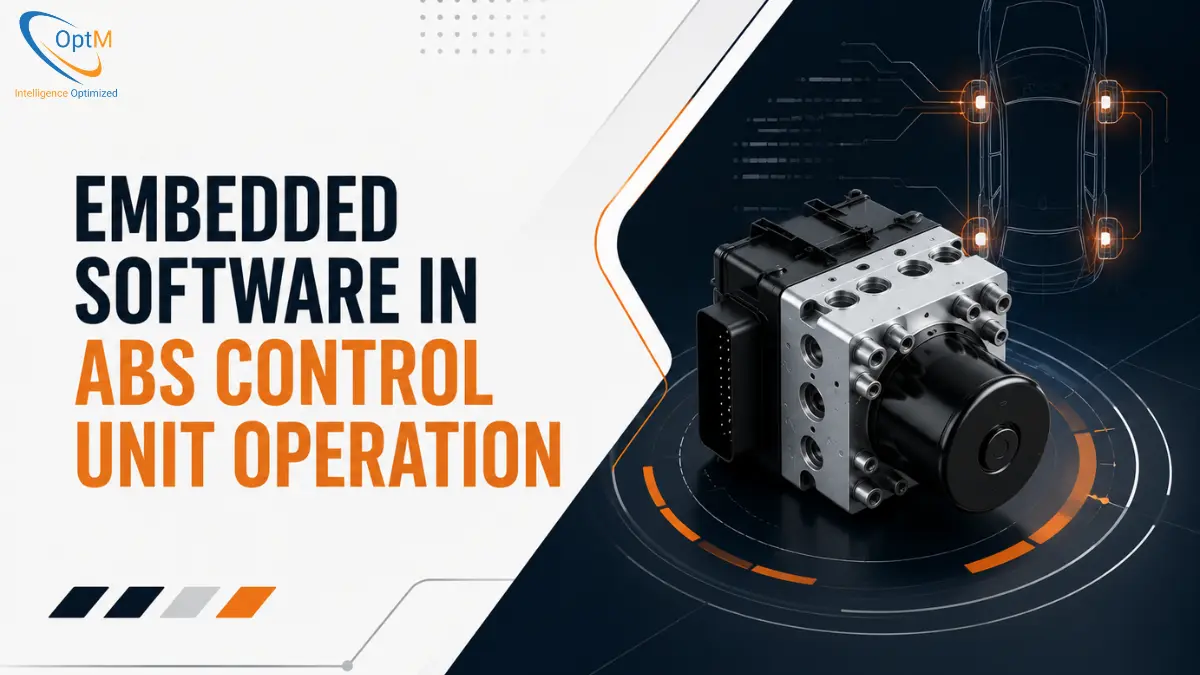
An ABS control unit contains dedicated embedded software that manages braking intelligence. The software operates inside the ABS Electronic Control Unit (ECU), where it continuously monitors wheel speed information, executes control algorithms, and commands braking interventions whenever wheel lock-up conditions are detected.
Unlike physical ABS components such as sensors and hydraulic valves, embedded software acts as the system's decision engine. It interprets real-world vehicle data and determines how the braking system should respond under changing driving conditions.
In safety-critical automotive environments, this software must perform reliably under all operating conditions, including wet roads, loose gravel, sudden emergency stops, and high-speed braking events.
Hardware vs Software in ABS
| Component | Primary Role |
|---|---|
| Wheel Speed Sensors | Capture wheel rotation data |
| Hydraulic Modulator | Adjust brake pressure |
| ABS ECU Hardware | Processing platform |
| Embedded Software | Analysis, decision-making, and control |
How Embedded Software Controls ABS Operation
Embedded software controls ABS operation through a continuous feedback loop. The process begins the moment wheel speed sensors start transmitting data to the ABS control unit.
Sensor Data Acquisition
Wheel speed sensors continuously monitor the rotational speed of each wheel and send this information to the ABS ECU.
The software receives these inputs multiple times per second, creating a real-time picture of vehicle dynamics.
Slip Ratio Calculation
Once wheel speed data is received, the software calculates wheel slip ratios.
A wheel that decelerates significantly faster than the vehicle itself may be approaching lock-up. The software identifies these conditions before complete wheel lock occurs.
Decision-Making Algorithms
Using predefined control algorithms, the software evaluates whether braking pressure should be:
- Increased
- Maintained
- Reduced
This decision must occur within milliseconds to maintain vehicle stability.
Brake Pressure Modulation
After calculating the required action, the software sends commands to the hydraulic modulator.
The modulator then adjusts brake pressure accordingly, preventing wheel lock-up while maximizing braking efficiency.
For a deeper explanation of the braking sequence itself, readers can explore our detailed guide on How Anti Lock Braking System Works.
Core Functions Performed by Embedded Software in ABS
Embedded software is responsible for several critical functions that directly influence braking performance and vehicle safety.
| Function | Purpose |
|---|---|
| Wheel Speed Monitoring | Tracks wheel rotation continuously |
| Slip Detection | Identifies wheel lock-up risk |
| Brake Pressure Control | Adjusts hydraulic pressure dynamically |
| Diagnostic Monitoring | Detects system faults and anomalies |
| ECU Communication | Exchanges information across vehicle networks |
| Safety Monitoring | Maintains reliable operation under all conditions |
These functions collectively enable ABS systems to deliver consistent braking performance across varying road conditions.
Why Real-Time Processing Is Critical in ABS Software
ABS software operates in a highly time-sensitive environment.
Even small delays in processing can affect braking performance, steering control, and overall vehicle stability.
Real-time processing allows the software to:
- Analyze wheel speed changes instantly
- Detect wheel slip before lock-up occurs
- Issue corrective commands without delay
- Maintain directional control during braking
In production-grade automotive environments, ABS software typically performs hundreds of calculations every second to ensure rapid braking response.
This requirement is one reason why automotive ABS platforms rely heavily on real-time embedded architectures and deterministic software behavior.
From an engineering perspective, the challenge is not simply processing data quickly--it is ensuring that every calculation occurs predictably and consistently throughout the vehicle's operating life.
Communication Between ABS Software and Vehicle Systems
Modern ABS modules do not operate in isolation.
Embedded software continuously exchanges information with multiple vehicle subsystems to support coordinated vehicle control.
Wheel Speed Sensors
Sensor data serves as the primary input source for ABS decision-making.
Hydraulic Modulator
The software sends control signals to adjust braking pressure during ABS intervention.
Engine Control Unit (ECU)
The ABS system may exchange data with the main vehicle ECU to support integrated vehicle control strategies.
Vehicle CAN Network
Most automotive ABS systems communicate using the Controller Area Network (CAN) protocol, which enables efficient data exchange between electronic control units.
This communication architecture allows ABS systems to function alongside technologies such as traction control, electronic stability control, and advanced driver assistance systems.
Embedded Software Challenges in ABS Development
Developing embedded software for ABS systems presents several engineering challenges.
Functional Safety Compliance
Because ABS directly affects vehicle safety, software development must align with stringent automotive safety requirements.
One of the most widely recognized standards is ISO 26262 , which defines functional safety requirements for automotive electronic systems.
Real-Time Performance Requirements
Software must execute braking decisions within extremely tight timing windows while maintaining predictable performance.
Sensor Reliability and Noise Handling
Sensor data may be affected by environmental conditions, electrical noise, or component wear.
The software must filter and validate incoming signals before using them for braking decisions.
Validation and Verification
Automotive engineering teams perform extensive testing to ensure ABS software behaves correctly under both normal and extreme braking scenarios.
This process often includes:
- Simulation testing
- Hardware-in-the-loop testing
- Vehicle-level validation
- Fault injection testing
Readers interested in software quality assurance can explore our related articles on ABS Control Unit Testing and Validation and Challenges in ABS Control Unit Development .
Future of Embedded Software in ABS Systems
As vehicles become increasingly software-driven, embedded software is evolving beyond traditional braking control functions.
Several trends are shaping the future of ABS software development:
Software-Defined Vehicles
Vehicle functionality is increasingly determined by software rather than hardware alone.
Integration with ADAS
ABS software is becoming more tightly integrated with Advanced Driver Assistance Systems to support enhanced vehicle safety.
Predictive Vehicle Dynamics
Future systems may use predictive algorithms to anticipate braking requirements before critical situations develop.
OTA Software Updates
Over-the-air update capabilities are allowing vehicle manufacturers to improve software functionality throughout a vehicle's lifecycle.
According to the McKinsey & Company , software content within vehicles continues to grow significantly as the automotive industry transitions toward software-defined architectures.
From an OEM perspective, embedded software is rapidly becoming one of the most important differentiators in vehicle safety and performance systems.
Frequently Asked Questions (FAQs)
How does embedded software improve ABS performance?
Embedded software improves ABS performance by continuously monitoring wheel behavior, detecting slip conditions, and controlling brake pressure in real time to prevent wheel lock-up.
What happens if ABS software fails?
If ABS software encounters a fault, the system typically disables ABS functionality and alerts the driver through a dashboard warning indicator. Conventional braking remains available in most cases.
Does ABS software communicate with other vehicle ECUs?
Yes. ABS software commonly communicates with other vehicle ECUs through CAN-based networks to support integrated vehicle safety functions.
Is ABS software part of automotive functional safety systems?
Yes. ABS software is considered safety-critical software and is typically developed according to functional safety principles such as ISO 26262.
Can ABS software be updated?
Modern vehicle platforms increasingly support software updates, allowing manufacturers to enhance functionality, improve diagnostics, and address software-related issues.
Conclusion
Embedded software is the intelligence behind every modern ABS control unit. While sensors and hydraulic components provide the physical infrastructure, software enables the real-time analysis, decision-making, and control actions that prevent wheel lock-up and improve vehicle stability.
As automotive platforms continue moving toward software-defined architectures, understanding the software layer of ABS systems is becoming just as important as understanding the hardware itself.
For OEMs, Tier 1 suppliers, and mobility technology providers evaluating advanced braking solutions, selecting an ABS platform built on reliable embedded software foundations can have a direct impact on vehicle safety, performance, and long-term scalability.
Looking for automotive-grade ABS solutions engineered with robust embedded architectures, real-time control capabilities, and production-ready software integration? Explore OptM's ABS Module solutions to learn how intelligent braking technologies contribute to safer and more connected vehicle platforms.