Engineering & Innovation Team
Engineering & Innovation Team
OptM Solutions delivers industry-leading engineering, product development, and software integration services for automotive, broadcast, defense, healthcare, and EV platform ecosystems.
LinkedIn ProfileModern vehicle safety is no longer just about surviving a crash; it is about preventing one entirely. The automotive cabin has evolved from a passive seating environment into a highly intelligent, active safety zone.
Global regulatory bodies are forcing this architectural shift. According to the European Commission's General Safety Regulation (GSR), advanced driver distraction warning systems are now mandatory for all new vehicle approvals to combat the estimated 10–30% of road collisions caused by distraction. To meet these mandates, engineers cannot rely on simple cameras. A production-grade driver monitoring setup must execute a complex array of edge-computing functions to interpret human physiology in real time. Here is a deep technical breakdown of exactly how these systems operate.
What is a Driver Monitoring System?
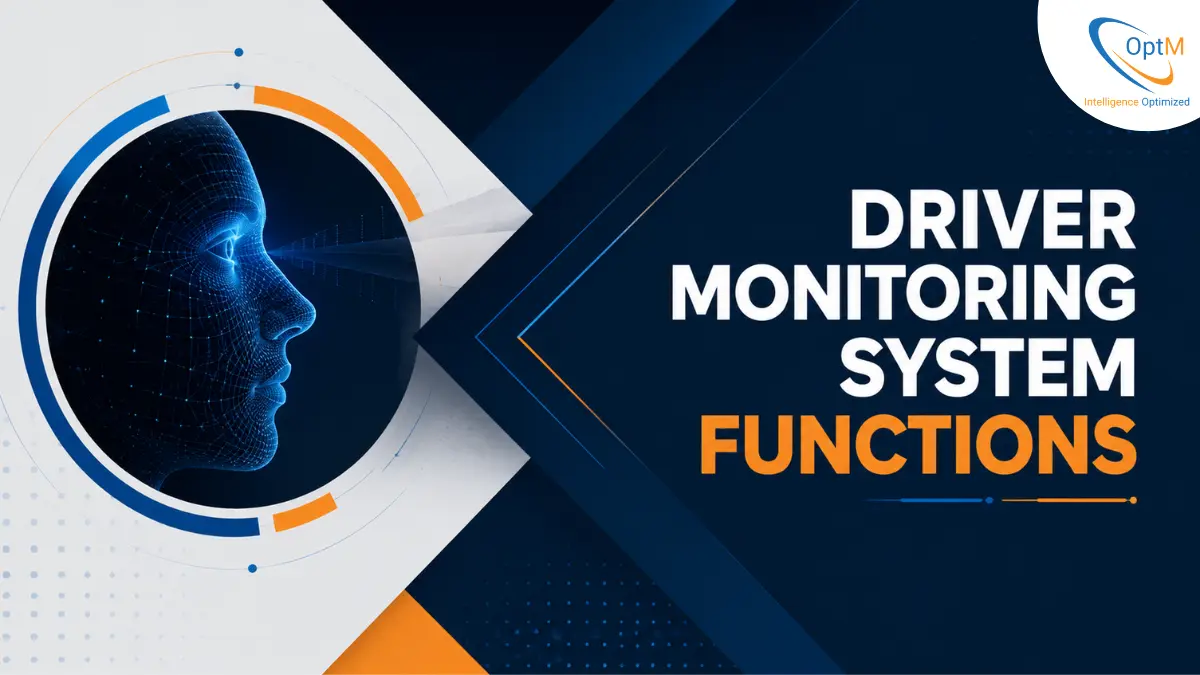
A Driver Monitoring System is an embedded active safety technology that utilizes near-infrared cameras and edge-based computer vision to track human behavioral metrics. Its primary function is to continuously analyze gaze vectors, eyelid margins, and head posture to detect cognitive distraction or fatigue, triggering localized safety interventions before a collision occurs.
Understanding this foundational execution loop is the first step in mastering exactly What is Driver Monitoring System technology doing inside the modern vehicle cabin.
Functions of a Driver Monitoring System
A reliable in-cabin safety architecture relies on deeply mathematical tracking capabilities. The system does not just passively record video; it extracts, analyzes, and acts upon complex geometric data points simultaneously at 60 frames per second.
Here is exactly what the system is executing at the edge to keep drivers safe.
Real-Time Gaze Vector Mapping and Angular Tracking
Most people assume a DMS simply "looks at the eyes." In reality, production-grade systems execute complex geometric triangulation to build a precise 3D line of sight. By tracking the geometric center of the human pupil against the corneal reflection (the glint created by the system's active infrared LEDs), the software calculates exactly where the driver's visual focus lies.
- The Engineering Challenge: The system must instantly differentiate between safe road-scanning behaviors and dangerous visual distractions without triggering annoying false alarms.
- Real-World Execution: The embedded software defines a pre-calibrated spatial matrix. This matrix maps out the safe forward windshield zone, the instrument cluster, and the side mirrors. If a driver glances at the left mirror for 1.2 seconds, the system classifies this as active driving. However, if the gaze vector breaks the acceptable boundary—pointing downward toward a smartphone in the lap for more than 2.0 consecutive seconds—the software instantly flags a critical visual distraction event.
Micro-Sleep Detection via Temporal PERCLOS Analysis
Tracking drowsiness requires far more precision than checking if a driver's eyes are closed. The system calculates a metric called PERCLOS (Percentage of Eye Closure). Operating over a moving temporal window, the edge AI measures the exact distance between the upper and lower eyelid margins in real time.
- The Clinical Indicator: Before a driver falls asleep, their saccadic eye movements (rapid focal shifts) slow down drastically, and their blinks become longer.
- Real-World Execution: The algorithm tracks the proportion of time the eyelids cover the pupil diameter for more than 80% of a specific time block. If the system detects these prolonged micro-closures, it predicts the onset of fatigue long before the vehicle drifts out of its lane. Mastering these exact algorithmic thresholds is critical for engineering teams studying How Driver Monitoring Systems Detect Drowsiness and Distraction in dynamic highway environments.
Spatial Head Pose Estimation for Cognitive Impairment
Sometimes a driver's eyes are wide open, and they are looking straight ahead, but their brain is completely disconnected from the driving task—a dangerous state often referred to as "highway hypnosis." Because the eyes alone cannot confirm this state, the system executes head pose estimation.
- The Mathematical Solution: The system solves the Perspective-n-Point (PnP) problem, building a dynamic 3D geometric mesh of the driver's face using dozens of tracking landmarks (jawline, nose bridge, brow).
- Real-World Execution: By constantly tracking the X, Y, and Z axes—Pitch (nodding), Yaw (turning), and Roll (tilting)—the software identifies rigid staring patterns or unnatural physical slumping. This allows the vehicle to detect severe cognitive distraction or sudden medical distress even if the driver's eyes remain open.
Deterministic HMI Escalation Protocols
Monitoring human physiology has zero value if the vehicle does not execute an immediate, deterministic response. The moment the edge AI confirms a severe distraction or fatigue anomaly, the system transitions from a passive monitor into an active intervention tool.
- The Integration Workflow: The Electronic Control Unit (ECU) generates a highly compressed diagnostic command flag and transmits it across the vehicle's internal CAN or J1939 communication buses.
- Real-World Execution: This network signal commands the digital instrument cluster to deploy a tiered response sequence. It initiates a subtle visual dashboard warning. If the driver's gaze vector does not return to the road within milliseconds, the system escalates automatically to high-frequency auditory chimes and haptic seat vibrations.
Sensor Fusion and Autonomous Safety Handover
In a fully integrated, software-defined vehicle, the interior camera acts as a vital contextual data layer for the vehicle's exterior radars and LiDAR systems. It provides the "human element" to the broader autonomous driving equation.
- The Network Handover: Exterior sensors only know what is happening on the road; they do not know if the driver is prepared to react.
- Real-World Execution: By calibrating the precise sensor fusion parameters of DMS vs ADAS, the internal system prepares exterior modules for an impending failure. If the interior system detects a driver slumped over (Pitch/Roll deviation) while the forward radar detects stopped traffic, the Autonomous Emergency Braking (AEB) module lowers its intervention threshold and forcefully engages the brakes significantly earlier than standard calibration would dictate.
Biometric Operator Authentication and ECU Synchronization
Beyond active collision prevention, the high-fidelity 3D facial landmark mapping provides a highly secure biometric authentication layer for the vehicle, which is incredibly valuable for commercial fleet security.
- The Security Protocol: When the operator enters the cabin, the system cross-references the facial mesh against authorized driver profiles stored in encrypted local memory.
- Real-World Execution: Once authenticated, the vehicle authorizes the engine start. Simultaneously, the DMS broadcasts a synchronization command across the vehicle network, instantly adjusting the seat position, steering column, mirrors, and climate controls to the specific operator. This seamlessly bridges the gap between vehicle security, safety, and personalized comfort.
The Response Mechanism: Executing the Safety Protocol
Monitoring human physiology is useless without an immediate, deterministic response. Once the edge AI confirms a severe distraction or fatigue anomaly, it must execute a safety protocol across the vehicle's internal networks.
Deterministic HMI Escalation
The Electronic Control Unit (ECU) generates a diagnostic command flag and transmits it across the CAN or J1939 communication buses. This triggers a tiered response sequence on the vehicle's digital instrument cluster. It initiates a subtle visual dashboard warning, escalating within milliseconds to high-frequency auditory chimes and haptic seat interventions if the driver fails to correct their gaze.
Autonomous Safety Handover
In a fully integrated ecosystem, the interior camera acts as a contextual data layer for the vehicle's exterior radars. By calibrating the precise sensor fusion between DMS & ADAS, the internal system prepares the exterior modules for an impending failure. If the interior system detects a severely distracted driver while the forward radar detects stopped traffic, the autonomous emergency braking module lowers its intervention threshold and engages significantly earlier.
The Hardware Ecosystem Enabling These Functions
Software algorithms cannot execute without a highly optimized hardware foundation. Standard RGB optical cameras fail completely in dark tunnels or when a driver wears polarized sunglasses.
To ensure continuous operation, engineers must prioritize Near-Infrared (NIR) illumination. This invisible light penetrates dark lenses and maps facial geometry without blinding the driver. Selecting the precise Components of Driver Monitoring System architecture—specifically low-power, automotive-grade SoCs—ensures these heavy neural network computations run efficiently within the ECU's strict thermal limits.
Overcoming Environmental Edge Cases
A safety system that only works in a climate-controlled laboratory is useless to an OEM. Production-grade systems must account for severe environmental variables and unpredictable human behaviors.
The embedded computer vision models must maintain tracking accuracy when the driver is wearing heavy winter clothing, N95 masks, or thick facial hair. Furthermore, the optical sensors must instantly adjust exposure levels when a vehicle exits a pitch-black tunnel directly into blinding midday sunlight. Resolving these dynamic variables requires thousands of hours of rigorous Driver Monitoring System Testing and Validation across diverse road environments.
Frequently Asked Questions
Can DMS functions operate locally without cloud connectivity?
Yes. In production-grade vehicles, all facial landmark extraction and behavioral classifications are executed directly on the local edge ECU. This ensures zero-latency safety interventions and protects driver privacy, even in remote areas with no cellular reception.
How does the system differentiate between checking a mirror and being distracted?
The embedded algorithms are programmed with acceptable gaze deviation thresholds. Glancing at a side mirror for one second is classified as active driving, whereas holding a gaze vector downward toward a mobile device for over two seconds triggers an anomaly.
Does wearing polarized sunglasses disable the eye-tracking functions?
No. Because the system relies on active Near-Infrared (NIR) optical sensors rather than standard visible light, the camera easily penetrates the vast majority of tinted or polarized lenses to track pupil movement and blink frequency accurately.
How fast does the system react to a micro-sleep event?
The entire loop—from optoelectronic image capture to HMI alert generation—happens within milliseconds. The system processes frames at 30 to 60Hz, allowing it to detect eyelid closures and trigger warnings long before the vehicle drifts out of its lane.
Streamline Your Next-Generation Cabin Architecture
Integrating these complex functions into a production-ready safety architecture demands rigorous expertise in edge AI, low-latency processing, and seamless vehicle network integration. Bridging the gap between prototype algorithms and factory-grade deployment is a massive engineering hurdle.
Explore how optimizing your Driver Monitoring System Architecture with OptM can streamline your product lifecycle. Our embedded engineering teams help global OEMs and Tier 1 suppliers build robust, compliant, and thermally efficient safety platforms. Review our production-ready Driver Monitoring System solutions today to accelerate your next deployment.