
Content Writer & SEO Specialist
Content Writer & SEO Specialist
Aditya Sharma is a content writer at OptM Solutions specializing in automotive electronics, embedded systems, telematics, electric vehicle technologies, connected mobility, and autonomous driving technologies.
LinkedIn ProfileThe era of treating in-cabin monitoring as a "nice-to-have" luxury feature is officially over. Driven by the European Union's General Safety Regulation (GSR) and the stringent 2026 Euro NCAP testing protocols, automakers are now legally mandated to integrate Advanced Driver Distraction Warning (ADDW) and Driver Drowsiness and Attention Warning (DDAW) systems into their fleets.
However, writing an algorithm that detects a sleepy driver in a controlled laboratory is vastly different from deploying that same algorithm inside millions of moving vehicles. Grasping the regulatory push and foundational execution of What is Driver Monitoring System technology is straightforward, but scaling it for mass production is a different reality.
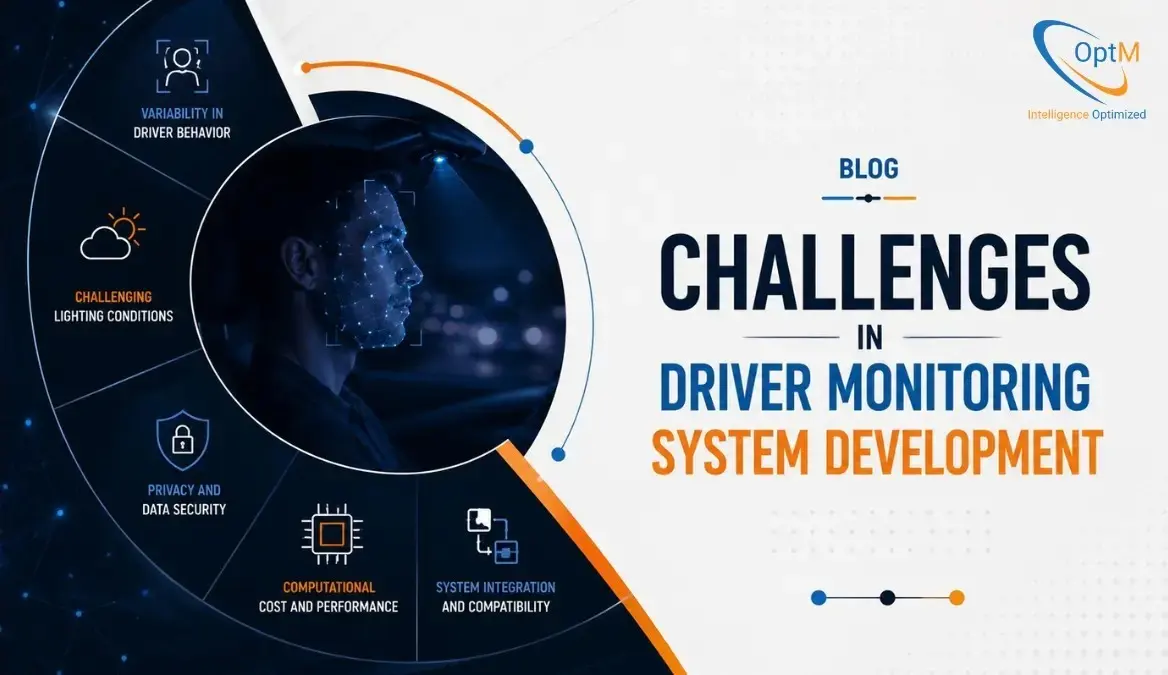
Automotive environments are hostile. Engineers must account for extreme temperature fluctuations, unpredictable ambient lighting, severe hardware limitations, and highly skeptical end-users. For OEMs and Tier 1 suppliers, navigating these Challenges in Driver Monitoring System Development is the defining hurdle of the software-defined vehicle era.
Here is a deep dive into the primary bottlenecks engineering teams face today—and the exact methodologies used to solve them.
Challenge 1: The "False Positive" Paradox and User Trust
The single fastest way to render a safety system useless is to annoy the driver. If a Driver Monitoring System (DMS) issues an aggressive auditory alarm every time the driver naturally glances at their side mirror or adjusts the radio, the driver will find a way to disable the system.
Once the system is disabled, the OEM's safety rating and regulatory compliance are entirely compromised.
The Engineering Reality
Most early-generation systems suffered from extreme sensitivity. They tracked gaze deviation mathematically without understanding driving context.
- The Mitigation Strategy: Modern systems utilize "Contextual Tolerance Zones." Instead of treating the entire cabin uniformly, the edge AI maps the interior spatial geometry.
- How it Works: The system assigns a 1.5-second tolerance for glances toward the side mirrors and rearview mirror (active driving behavior). However, if the gaze vector breaks toward the driver's lap (smartphone usage zone) for the exact same 1.5 seconds, the algorithm flags an immediate critical anomaly. This separation of intent drastically reduces false positives while maintaining strict safety parameters.
Challenge 2: Thermal Throttling in Edge Computing
To achieve zero-latency safety interventions, all computer vision processing must happen directly on the vehicle's edge hardware, bypassing the cloud. The system must process high-definition, 60 frames-per-second (fps) video streams continuously.
The Physics Problem
Executing heavy Convolutional Neural Networks (CNNs) requires billions of operations per second. This generates massive computational heat. Because DMS camera modules are typically crammed into tiny enclosures—such as the steering column casing or the rearview mirror housing—they lack active cooling fans. If the System-on-Chip (SoC) overheats, it drops frames. If it drops frames, the safety loop fails.
How Tier 1 Architects Solve This
Engineering teams cannot simply install larger processors. They must optimize the software at the absolute lowest level to survive the thermal budget.
- INT8 Quantization: Engineers convert massive 32-bit floating-point neural networks into hyper-efficient 8-bit integers. This drastically reduces the memory bandwidth and power consumption required to run the model, keeping the SoC cool.
- Dedicated NPUs: Instead of running the vision loop on the main CPU, modern architectures route the mathematical workloads to dedicated Neural Processing Units (NPUs) or hardware accelerators specifically designed for matrix multiplication.
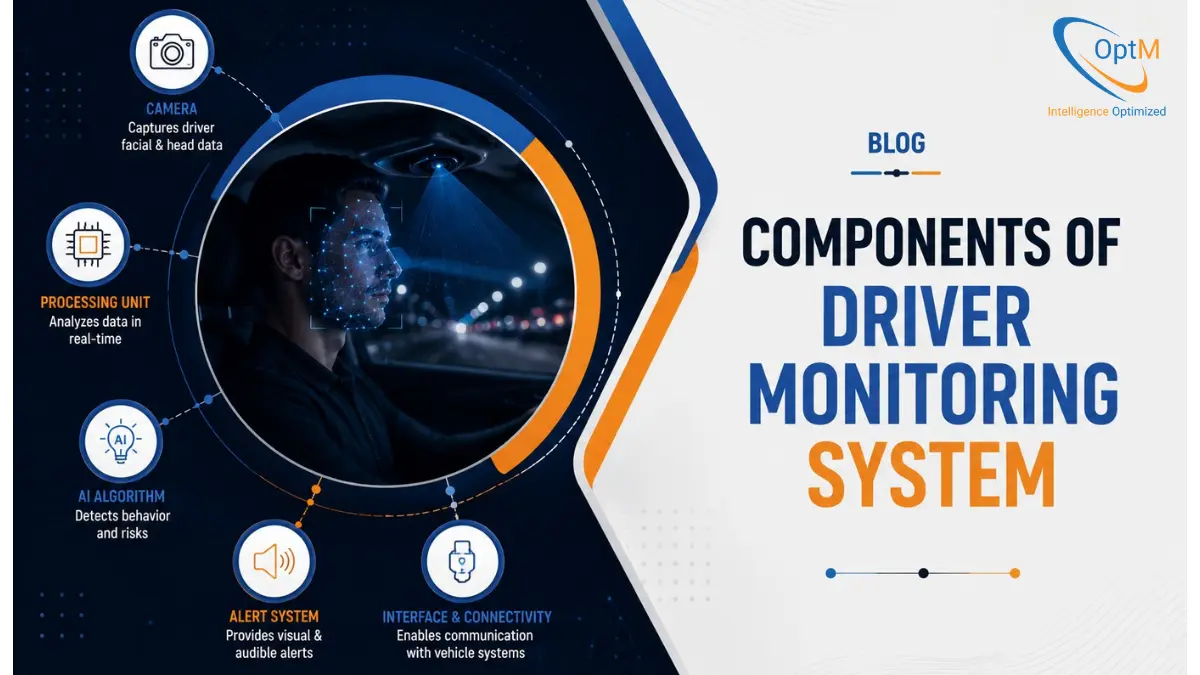
Successfully managing these computational loads is the primary reason why designing an optimized Driver Monitoring System Architecture is non-negotiable for modern Cockpit Domain Controllers.
Challenge 3: Optical Failures in Uncontrolled Environments
A machine learning algorithm is only as good as the pixel data it receives. Unlike exterior ADAS cameras that look at relatively predictable road markings, the interior camera must look into an optically chaotic environment.
The Real-World Variables
Engineers must guarantee system availability (the percentage of time the system is actively tracking) across a highly volatile matrix of human and environmental edge cases.
| Optical Obstacle | Why It Causes System Failure | The Embedded Engineering Solution |
|---|---|---|
| Polarized / Heavy Tint Sunglasses | Standard RGB image sensors cannot penetrate tinted lenses, completely blinding the gaze-tracking algorithms. | The system utilizes pulsed 940nm Near-Infrared (NIR) LEDs. This invisible light effortlessly penetrates dark glass and illuminates the pupil. |
| Rapid Illumination Changes | Exiting a pitch-black tunnel into direct midday sunlight instantly "washes out" or overexposes a standard camera frame. | Hardware Image Signal Processors (ISPs) execute microsecond Auto-Exposure and High Dynamic Range (HDR) corrections to balance the frame instantly. |
| Cosmetic "Source-Hiding" Bezels | Automotive designers want the camera hidden behind tinted plastic, which often blocks the returning IR light signal. | Precision injection molding using specialized IR-transmissive polycarbonates ensures the camera can "see" out while the driver sees nothing. |
| Facial Occlusions (Masks/Beards) | Thick facial hair or medical masks hide the jawline and mouth, breaking standard 3D facial mesh models. | Algorithms transition to part-based tracking, relying entirely on the upper nose bridge, brow, and eye contours to maintain head pose calculations. |
Overcoming these visual obstacles relies entirely on the sophistication of the localized neural networks. A deep understanding of AI and Computer Vision in Driver Monitoring Systems is required to build part-based tracking models that survive these edge cases.
Challenge 4: Navigating the Privacy and GDPR Barrier
As vehicles become rolling sensor platforms, consumer distrust is at an all-time high. A 2023 study by the Mozilla Foundation labeled the automotive sector as the worst product category for data privacy.
Drivers are actively hostile to the idea of an interior camera recording their faces, conversations, and behaviors. If an OEM fails to navigate this privacy barrier, they face massive consumer backlash and strict GDPR (General Data Protection Regulation) fines in Europe.
The Architectural Defense
To achieve compliance, engineers design the system to be fundamentally incapable of spying.
- The Workflow: The local processor ingests a video frame and runs the neural network.
- The Extraction: The algorithm extracts only mathematical coordinate data (e.g., Head Pitch = -12 degrees; Pupil Distance = 4mm).
- The Destruction: The raw video frame is instantly and permanently destroyed in volatile memory.
- The Result: The system never saves, records, or transmits video to the cloud. By stripping the data down to pure mathematics at the edge, the system achieves total GDPR compliance and ensures complete driver anonymity.
Because the system only cares about the mathematical distance between eyelids and spatial coordinate tracking, you can review exactly How Driver Monitoring Systems Detect Drowsiness and Distraction without ever needing to record a recognizable human face.
Challenge 5: Achieving ASIL Compliance and Functional Safety
Consumer electronics are allowed to crash; automotive safety systems are not. Under the ISO 26262 functional safety standard, an active driver monitoring architecture must typically achieve ASIL B (Automotive Safety Integrity Level) certification.
The Redundancy Requirement
If an internal component fails, the system cannot simply freeze or shut down silently. It must possess self-diagnostic awareness.
If a driver places their hand over the camera lens, or if the IR emitter diode burns out, the vision processing layer detects the loss of facial landmark tracking. The software must instantly execute a Built-In Self-Test (BIST). Once the failure is confirmed, the ECU packages a Diagnostic Trouble Code (DTC) and broadcasts it across the CAN-FD network, immediately illuminating a warning light on the instrument cluster to notify the driver that the safety feature is offline.
Frequently Asked Questions
How do engineers validate DMS models for edge cases without risking human lives on the road?
Automotive teams rely heavily on Hardware-in-the-Loop (HIL) simulation and synthetic data generation. Instead of waiting for a real driver to fall asleep in a moving car, engineers inject simulated, physically accurate video feeds (including dynamic shadows and edge-case occlusions) directly into the ECU to validate the neural network's deterministic response times.
Does wearing a low-brimmed hat or cap break the eye-tracking loop?
If the hat physically blocks the optical path to the pupil, direct gaze vectoring is temporarily lost. However, production-grade systems dynamically compensate. The algorithm instantly shifts its computational weight from the eyes to Head Pose Estimation, using the visible jawline, ears, and lower nose bridge to calculate spatial orientation and predict cognitive state.
How do automakers solve network latency between detecting a micro-sleep and triggering a warning?
By eliminating cloud reliance and prioritizing network traffic. The localized edge AI processes the frames, and the resulting safety flag is injected into a deterministic CAN-FD or Automotive Ethernet bus. Because the system runs on a Real-Time Operating System (RTOS), this safety flag bypasses lower-priority data (like infotainment updates), executing the HMI warning in milliseconds.
What happens to the hardware thermal budget when cabin temperatures exceed 50°C (122°F) in summer?
Systems are built using AEC-Q100 certified automotive-grade SoCs designed for extreme thermal resilience. If ambient heat pushes the silicon near its thermal threshold, the system executes dynamic throttling. It temporarily scales down from 60 frames per second to 30 frames per second—reducing the compute load and generating less heat while keeping the core safety loop active.
Conclusion: Bridging the Gap Between Prototype and Production
The underlying math of computer vision has been solved. The true test for the automotive industry today lies in integration. Navigating the Challenges in Driver Monitoring System Development requires a delicate balance of deep hardware knowledge, strict thermal management, and algorithmic refinement.
Original Equipment Manufacturers (OEMs) who master this balance will not only achieve 5-star Euro NCAP ratings but will also deliver a seamless, unobtrusive safety experience that drivers actually trust.
Explore how optimizing your embedded software stack can streamline your production lifecycle and accelerate compliance for next-generation vehicle platforms. Review our production-ready Driver Monitoring System solutions today to elevate your intelligent cabin architecture.