
Content Writer & SEO Specialist
Content Writer & SEO Specialist
Aditya Sharma is a content writer at OptM Solutions specializing in automotive electronics, embedded systems, telematics, electric vehicle technologies, connected mobility, and autonomous driving technologies.
LinkedIn ProfileThe human element is the most unpredictable variable in modern vehicle safety. While external sensors can perfectly map a highway, they cannot predict when a driver is about to fall asleep.
According to the National Highway Traffic Safety Administration (NHTSA), drowsy driving is responsible for roughly 20% of all fatal crashes. To combat this, automotive safety has moved inside the cabin.
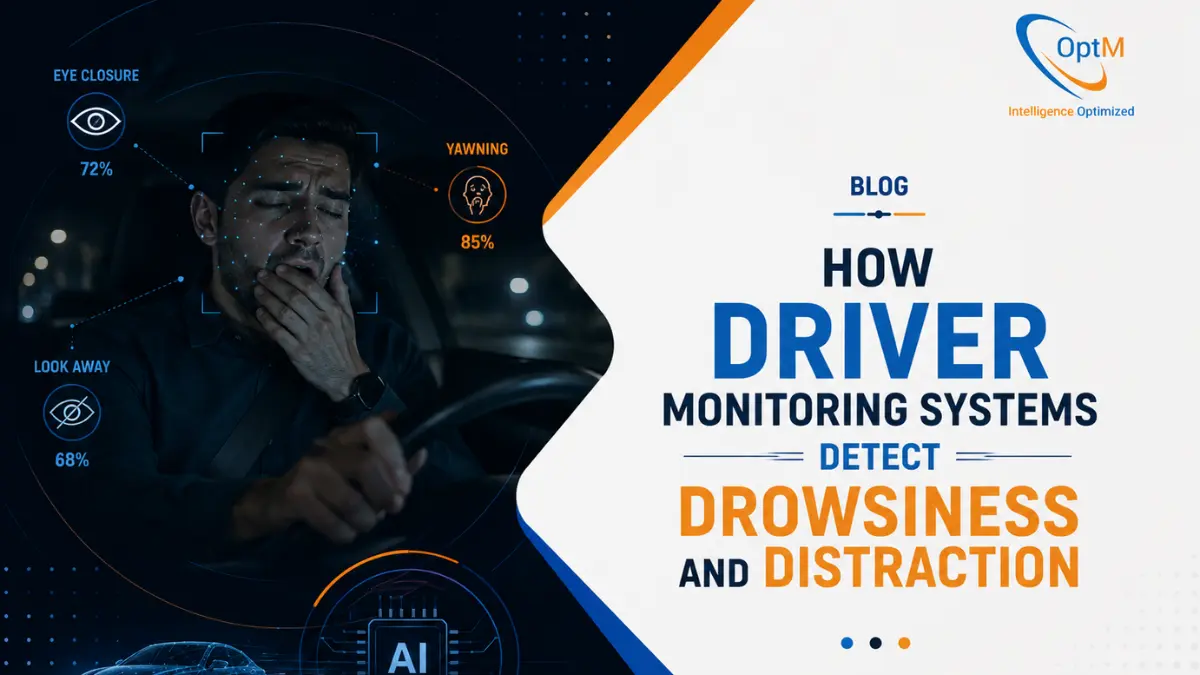
But how does a machine actually know that a human is tired or distracted? It goes far beyond simply checking if someone's eyes are open. Modern systems analyze microscopic physiological changes in real time. Here is an inside look at the exact mechanisms and behavioral thresholds that power today's Driver Monitoring Systems (DMS).
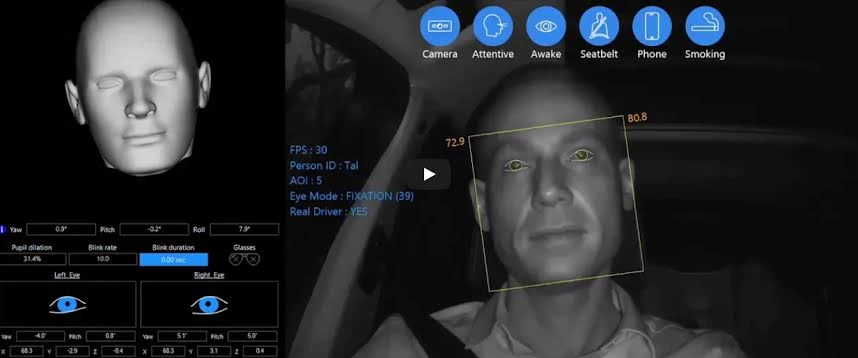
Facial Landmark Tracking via NIR Optical Sensors. Source: AZoSensors
1. The Physiology of Impairment: What the System Looks For
Before exploring the algorithms, we must understand what the system is actually trying to detect. Human impairment manifests in highly specific, measurable biological ways before a critical failure (like falling asleep at the wheel) occurs.
A production-grade DMS tracks three core behavioral pillars:
- Visual Distraction: The eyes are open, but the gaze is directed away from the road (e.g., looking at a smartphone or the infotainment console).
- Physical Drowsiness: The onset of sleep, characterized by prolonged eyelid closures, a drastic reduction in micro-saccades (rapid eye movements), and loss of neck muscle tension.
- Cognitive Distraction: The eyes are open and looking forward, but the brain is disengaged ("highway hypnosis" or sudden medical distress).
To measure these pillars, the system cannot rely on standard cameras.
2. The Hardware Foundation: Seeing in the Dark
A vehicle cabin is an optical nightmare. A system must maintain a perfect visual lock on the driver's face whether they are driving into blinding sunrise glare or navigating a pitch-black rural road at midnight.
To achieve this, the architecture relies on Active Near-Infrared (NIR) Illumination.
The system pulses invisible infrared light (typically at the 940nm wavelength) into the cabin. Because this light exists outside the visible human spectrum, it does not distract the driver.
This NIR illumination creates a high-contrast grayscale image. More importantly, it creates a bright, stationary reflection on the surface of the driver's eyeball (known as the corneal glint). This glint is the fundamental reference point for all gaze tracking calculations.
3. Decoding Drowsiness: The PERCLOS Metric
When a human gets tired, their blinks change. A normal, alert blink lasts between 100 to 400 milliseconds. As fatigue sets in, blinks become longer and slower, eventually turning into "micro-sleeps."
To measure this, the edge AI utilizes a metric called PERCLOS (Percentage of Eye Closure).
How PERCLOS Works
- Landmark Mapping: The software maps specific coordinate points on the upper and lower eyelid margins.
- Distance Calculation: It continuously calculates the distance between these two lids to determine the "Eye Openness Index."
- The Temporal Window: The system doesn't just look at a single blink. It calculates the percentage of time the eyelids cover the pupil by more than 80% over a moving time window (typically 30 to 60 seconds).
- The Intervention Threshold: If the PERCLOS score crosses a specific threshold—for example, if the eyes are 80% closed for 15% of a one-minute window—the system instantly classifies the driver as severely fatigued. It then commands the vehicle's instrument cluster to trigger high-frequency auditory alarms or vibrate the driver's seat.
4. Mapping Visual Distraction: 3D Gaze Tracking
Detecting visual distraction requires knowing exactly where the driver is looking. This is achieved through 3D gaze vector triangulation.
The Gaze Tracking Mechanism
Instead of just tracking the shape of the eye, the software tracks two distinct points simultaneously:
- The Pupil Center: The geometric center of the dark pupil.
- The Corneal Glint: The bright, stationary reflection created by the system's infrared LEDs.
As the eyeball rotates to look around the cabin, the pupil moves, but the infrared glint remains relatively stationary. By calculating the physical distance and angle between the moving pupil and the stationary glint, the software creates a precise 3D directional vector—a literal line of sight.
- The Intervention Threshold: The software overlays this line of sight onto a digital map of the cabin. It knows where the windshield, mirrors, and lap are located. If the gaze vector points downward toward the driver's lap for more than 2.0 consecutive seconds at highway speeds, it triggers an immediate visual distraction warning.
5. Identifying Cognitive Distraction: Head Pose Estimation
What happens if the driver is looking straight ahead, but their mind is completely zoned out? Because the gaze vector is technically "safe," the system relies on Head Pose Estimation to detect cognitive impairment.
The Spatial Tracking Mechanism
The system builds a geometric 3D mesh of the entire face (tracking the jawline, nose bridge, and brow). It uses this mesh to calculate the head's exact orientation across three axes:
- Pitch: Nodding up and down.
- Yaw: Turning left and right.
- Roll: Tilting side to side.
If a driver experiences "highway hypnosis," their head movements become unnaturally rigid, and their eyes stop scanning the environment. Conversely, if a driver suffers a sudden medical emergency, their neck muscles relax, resulting in a severe drop in the Pitch and Roll angles (slumping over). By tracking these spatial anomalies, the system can deploy safety interventions even when the eyes remain wide open.
6. Overcoming Real-World Edge Cases
Laboratory algorithms often fail in the real world. A production-grade system must maintain its tracking lock despite unpredictable human behaviors and accessories.
| Edge Case Variable | How the System Adapts |
|---|---|
| Polarized Sunglasses | Standard cameras cannot see through dark lenses. The 940nm Near-Infrared (NIR) light easily penetrates heavily tinted and polarized glass, allowing the sensor to track the pupil uninterrupted. |
| Medical Masks & Thick Beards | If the lower half of the face is obscured, standard facial recognition fails. Advanced systems dynamically shift their tracking weight to the upper facial landmarks (eyebrows, nose bridge, and eye contours) to maintain head pose calculations. |
| Direct Sunlight Exposure | When exiting a tunnel into blinding sunlight, the camera's hardware Image Signal Processor (ISP) executes microsecond auto-exposure corrections to prevent the image from washing out, keeping the facial mesh locked. |
Frequently Asked Questions
How do the system tell the difference between checking a mirror and being distracted?
The software assigns specific "safe zones" to the side and rearview mirrors. Because checking a mirror is a rapid, active driving behavior, the system allows the gaze vector to hit these zones for short durations (typically 1.0 to 1.5 seconds) without triggering an alarm.
Does the system record or save video of my face?
No. In OEM-grade deployments, the system extracts the mathematical coordinates (like the angle of the head or the distance between eyelids) directly on the local processor. Once those numbers are extracted, the raw video frame is instantly deleted.
What happens if the camera lens gets dirty or blocked?
The system runs continuous diagnostic checks. If a driver places a hand over the camera or if the lens is covered in heavy dust, the software detects the loss of facial landmarks and triggers an "occlusion error," notifying the driver on the dashboard that the safety system is temporarily offline.
Can the system function if the driver has limited eye mobility?
Yes. Modern algorithms are highly adaptable. If a driver has a permanent strabismus (misalignment of the eyes) or limited neck mobility, the system establishes a unique personalized baseline during the first few minutes of driving, calculating relative deviations from that specific individual's norm rather than a generic template.
Moving from Passive Monitoring to Predictive Safety
Detecting drowsiness and distraction is no longer about reacting to a swerving vehicle; it is about predicting human failure before it ever translates to the steering wheel. By combining high-fidelity near-infrared optics with edge-computed PERCLOS analysis and continuous 3D gaze tracking, modern cabin architectures can actively intervene in the critical seconds before a collision occurs.
For global OEMs and Tier 1 suppliers, mastering these complex physiological algorithms—and ensuring they run flawlessly under strict thermal, latency, and environmental constraints—is the defining engineering challenge of the next vehicle generation.
Explore how optimizing your embedded software stack can streamline your production lifecycle and accelerate compliance for next-generation vehicle platforms. Review our production-ready Driver Monitoring System solutions today to elevate your intelligent cabin architecture.