
Overview
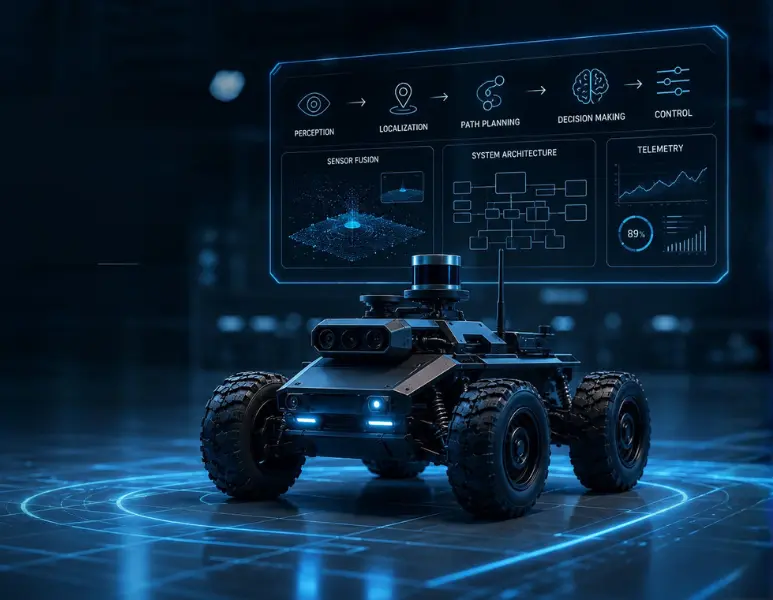
OptM develops autonomous software and perception systems that enable Unmanned Ground Vehicles (UGVs) to safely navigate, perceive their surroundings, and perform autonomous or remotely operated missions across defence, industrial, agricultural, mining, and logistics environments. Leveraging expertise in AI, computer vision, sensor fusion, embedded systems, robotics, and autonomous navigation, we help OEMs and system integrators accelerate the development of next-generation autonomous ground platforms.
What We Offer
Autonomous navigation software for indoor and outdoor unmanned ground vehicles
AI-powered perception using camera, LiDAR, Radar and ultrasonic sensors
Sensor fusion for robust localization, mapping and environmental awareness
SLAM, localization and path planning for GPS-enabled and GPS-denied environments
Obstacle detection, collision avoidance and autonomous mission planning
ROS2-based robotics software development and middleware integration
Embedded software development for vehicle controllers and edge AI platforms
Fleet management, remote diagnostics and OTA software update capabilities
Simulation, validation and field testing using Gazebo, CARLA and real-world environments
Autonomous mission planning, remote monitoring and fleet coordination
Platforms and Tools Expertise
Our autonomy engineering teams leverage key industry platforms and tools for robust, safety-compliant driverless applications.
Edge Computing / Processors:
- NVIDIA Jetson Orin, Xavier & Nano Series
- Intel Core & Intel NUC Edge Platforms
- AMD Ryzen Embedded Platforms
- Qualcomm Robotics RB Series
- Industrial PCs & ARM-based Embedded Platforms
Robotics Software & Sim Tools:
- ROS / ROS2 (Nav2, MoveIt)
- Gazebo, Webots & Isaac Sim
- MATLAB, Simulink & Stateflow
- OpenCV, TensorFlow, PyTorch & ONNX
- Docker, Linux, C++ & Python
- CUDA & TensorRT for Edge AI Acceleration
Autonomous Systems Engineering Details
Explore our path planning, trajectory generation, ROS2 deployment, and simulation validation capabilities.
Frequently Asked Questions
What industries do you support for Autonomous Systems Development?
Do you develop autonomous navigation software for GPS-denied environments?
How do you validate autonomous software before deployment?
Can OptM integrate perception systems with existing autonomous platforms?
Why Us
Modular Autonomy Stack
Our pre-built, modular navigation and control components enable rapid prototyping and reduce time-to-market.
Sim-to-Real Workflows
Comprehensive integration of simulation tools ensures smooth and secure transition from virtual models to physical systems.
ROS/ROS2 Expertise
Deep competency in standard robotics middleware, enabling scalable and industry-compliant communication architectures.
End-to-End Validation
From initial simulation tests to HIL validation and field testing, we ensure robust safety and reliability.
Related Services
Explore our other engineering and technology services.
AI & Machine Learning
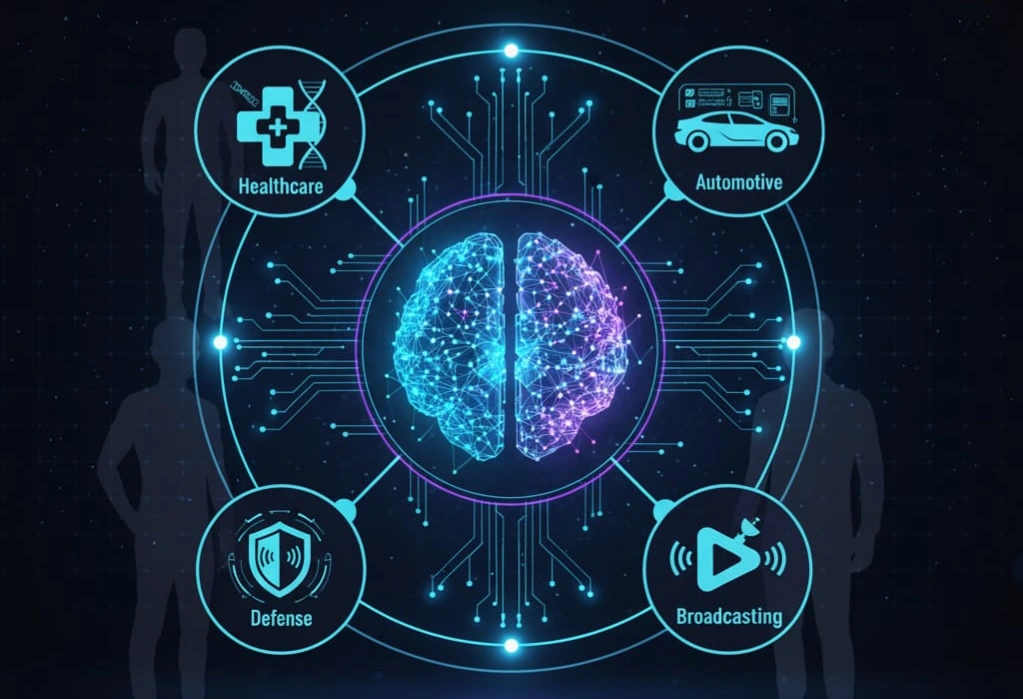
Deploy edge AI, computer vision models, and custom machine learning pipelines.

Data Engineering
Scalable data architecture, big data processing pipelines, and analytics platforms.

Cloud Solutions
Cloud-native architectures, serverless computing, and secure cloud integration services.